Facts
The petitioner, a child in conflict with law (CICL), was 17 years and 2 months old at the time of the alleged murder of the informant’s brother. His name allegedly surfaced in a co-accused’s confessional statement; no incriminating article was recovered from him. The Juvenile Justice Board rejected his bail application, and the appellate court affirmed that decision. The petitioner challenged both orders in revision. The State and informant opposed bail, relying principally on the petitioner’s alleged association with anti-social elements and a separate firearms case.
Source reference: paras. 5–12The Court anonymized the petitioner’s identity pursuant to Section 74 of the Juvenile Justice (Care and Protection of Children) Act, 2015.
Source reference: paras. 3–4Issues
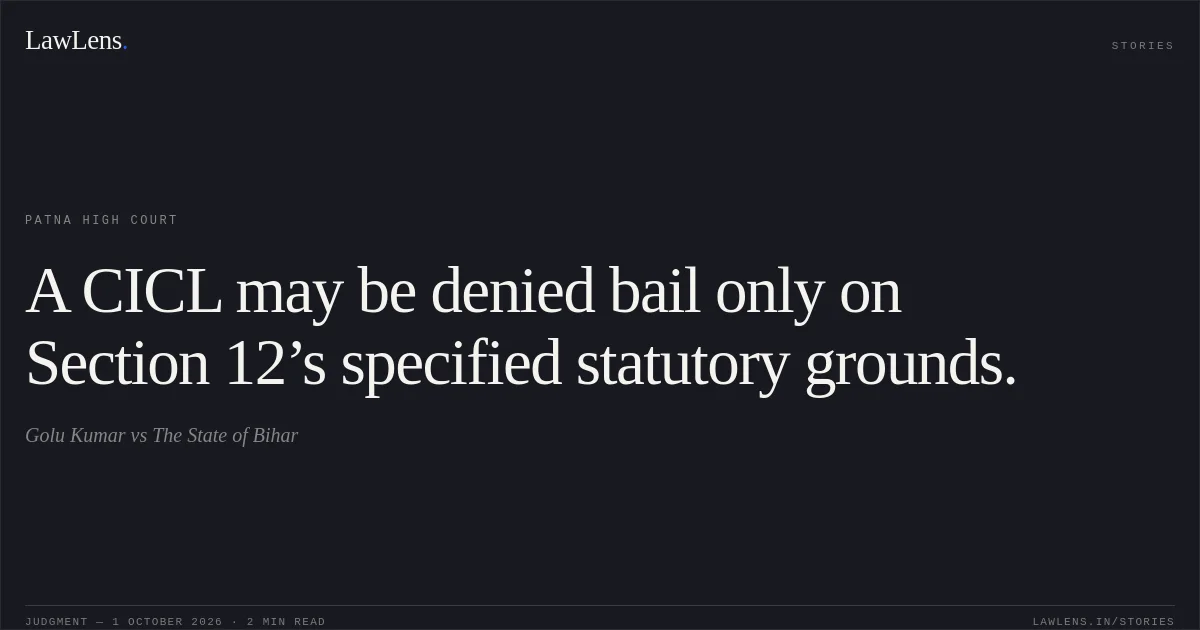
Whether the concurrent orders refusing bail to the petitioner as a CICL were sustainable under Section 12 of the Juvenile Justice Act, 2015.
Source reference: paras. 5, 10, 14Whether the petitioner’s antecedent and the material in the Social Investigation Report (SIR) established a statutory ground for denying bail.
Source reference: paras. 12, 16–17Law Applied
Section 12 of the Juvenile Justice (Care and Protection of Children) Act, 2015 requires a CICL to be released on bail, with or without sureties or under the supervision of a probation officer or fit person, unless reasonable grounds exist to believe that release would bring the child into association with known criminals, expose the child to moral, physical or psychological danger, or defeat the ends of justice.
Source reference: para. 14Section 3 sets out child-centred principles, including the child’s best interests, institutional care as a measure of last resort, and the right to restoration and repatriation, subject to the child’s best interests.
Source reference: paras. 15–16Section 74 prohibits disclosure of a child’s identity in specified circumstances.
Source reference: para. 3Reasoning
The Court noted that the petitioner was not identified by an eyewitness, his implication rested on a co-accused’s confessional statement, and no incriminating article had been recovered from him.
Source reference: para. 17Although he had one antecedent and the SIR referred to his arrest with illegal firearms in another case, the Court held that a single antecedent did not, by itself, establish that he was incorrigible or that release would trigger one of Section 12’s exceptions. It also found that the SIR was not wholly adverse to release. Applying the Act’s child-centred principles, the Court concluded that the subordinate courts had erred in refusing bail; the seriousness of the alleged offence was not, by itself, a ground to deny bail to a CICL.
Source reference: paras. 15–17Holding
The High Court allowed the revision and set aside both the appellate order dated 19 June 2025 and the Juvenile Justice Board’s order dated 28 April 2025.
It directed the petitioner’s release on a bail bond of ₹10,000 with two sureties of the like amount, subject to conditions that one bailor be a parent and the other a relative without criminal antecedents who undertakes to care for the petitioner, and that the petitioner attend each date fixed by the Board.
Source reference: para. 19Acts & Sections Cited
9 provisions across 3 statutes referred to in this judgment. Each provision opens on LawLens.
Juvenile Justice (Care and Protection of Children) Act, 2015.3
Indian Penal Code, 18602
Arms Act, 19594
Original Court PDF
Golu KumarvsThe State of Bihar
Click to open original judgment
Original judgment, available to read, download and summarize on LawLens.in