01Facts
The appellant, a subcontractor of M/s Tecpro Systems Limited (respondent no. 4), sued for outstanding payments and release of its equipment after the principal contract was terminated. The suit sought relief against both respondent no. 1 and respondent no. 4, and was transferred to the Commercial Court as Commercial Case No. 1 of 2019
¶ 10–14During the suit, the NCLT ordered liquidation of respondent no. 4 on 16 January 2020. That order was not brought to the Commercial Court’s attention, and the suit proceeded without notice to the liquidator or leave of the NCLT
¶ 15–19, 24The appellant appealed the Commercial Court’s judgment dated 16 December 2025.
The High Court also condoned the 27-day delay in filing the appeal, as the respondents did not oppose the application
¶ 1–702Issues
i.1. Whether the Commercial Court could proceed with the suit after respondent no. 4 entered liquidation, without leave of the NCLT
¶ 20–24ii.2. Whether the suit or appeal could be maintained against respondent no. 1 alone by deleting respondent no. 4, where the reliefs sought were against both defendants
¶ 25–27iii.3. Whether the impugned judgment should be set aside and the suit remitted for fresh consideration subject to obtaining NCLT leave
¶ 2803Law Applied
Section 279(1) of the Companies Act, 2013 provides that, after a winding-up order or appointment of a provisional liquidator, a pending proceeding by or against the company may not be proceeded with without the Tribunal’s leave; Section 279(2) excludes proceedings pending in appeal before the Supreme Court or a High Court from that restriction
¶ 20The Court also applied Section 33(5) of the Insolvency and Bankruptcy Code, 2016, under which, after a liquidation order, no suit or other legal proceeding may be instituted by or against the corporate debtor, subject to the statutory provision permitting the liquidator to institute proceedings with prior approval of the Adjudicating Authority
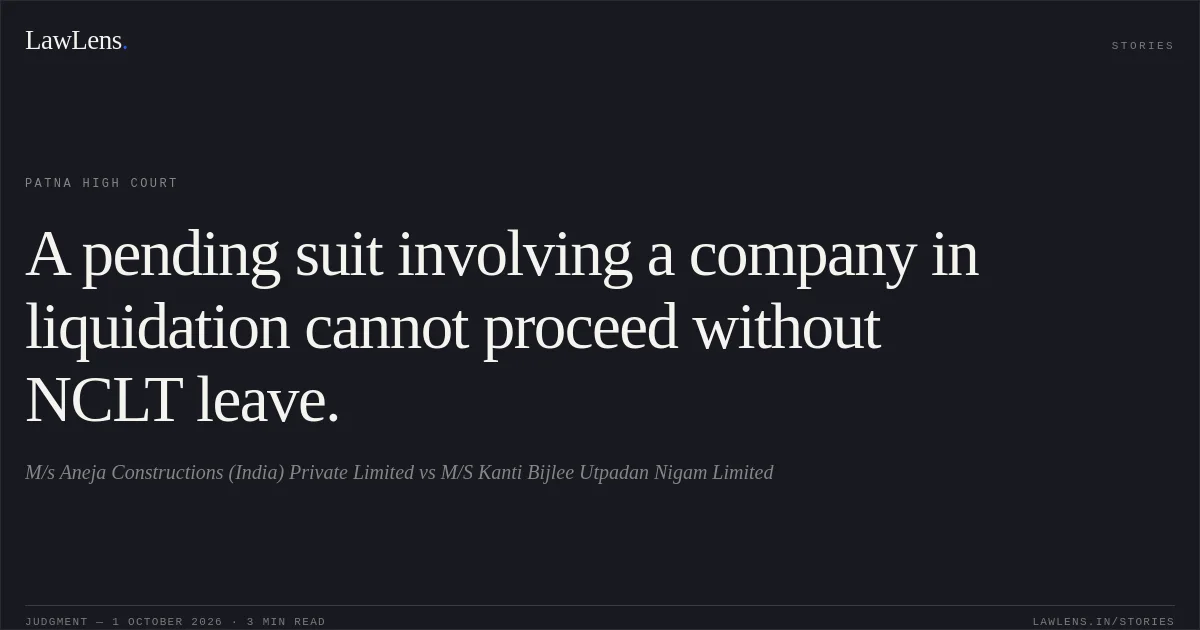
¶ 22Reading these provisions together, the Court held that the pending suit could not proceed without the NCLT’s leave
¶ 23–24On delay, it relied on State of Maharashtra v. Borse Bros. Engineers & Contractors (P) Ltd., (2021) 6 SCC 460, and condoned the short delay
¶ 4–6Provisions in the judgment · 30 · Linked ones open on LawLens
Insolvency and Bankruptcy Code, 2016. 28 provisions
Section 12Section 21Section 30Section 31Section 33Section 34Section 35Section 36Section 37Section 38Section 39Section 40Section 41Section 42Section 43Section 44Section 45Section 46Section 47Section 48Section 49Section 50Section 51Section 52Section 53Section 54Section 56Section 60Companies Act, 2013 Section 278Section 279
04Reasoning
The NCLT’s liquidation order took effect while the commercial suit was pending. Because the suit sought relief against respondent no. 4 and had proceeded without the liquidator’s participation or NCLT leave, it could not validly continue in the Commercial Court
¶ 15–19, 24The appellant could not avoid that restriction by seeking to proceed against respondent no. 1 alone: the pleaded reliefs were directed against both respondents, and the Court held that deleting respondent no. 4 would not leave the appellant able to maintain the suit as framed
¶ 25–27The appropriate course was therefore to set aside the judgment and remit the suit, with further proceedings conditional on the NCLT granting leave
¶ 2805Holding
The High Court condoned the 27-day delay and allowed the appeal to the extent of setting aside the Commercial Court’s judgment and remitting the matter for fresh consideration.
¶ 6–7, 28–30The Commercial Court may proceed with the suit only if the NCLT, New Delhi grants the plaintiff leave to do so; the Court expressed no view on whether leave should be granted
¶ 28–30Original Court PDF
M/s Aneja Constructions (India) Private LimitedvsM/S Kanti Bijlee Utpadan Nigam Limited
Click to open original judgment
Original judgment, available to read, download and summarize on LawLens.in