Facts
The applicant sought to quash Criminal Case No. 650 of 2020, pending before the JMFC, Idar, for alleged offences under Sections 2, 9, 39, 50 and 51 of the Wild Life (Protection) Act, 1972.
Source reference: p. 1–3The prosecution case arose from a Forest Department operation in which an owl was allegedly brought to a field by two persons.
Source reference: p. 1–3The applicant’s alleged connection was based on a photograph of the owl found on his mobile phone, said to have been forwarded through others.
Source reference: p. 1–3After investigation, a chargesheet was filed.
Source reference: p. 1–3The applicant challenged the proceedings on the ground that cognizance under the Act could be taken only on a complaint meeting Section 55, not on a police report.
Source reference: p. 1–3Issues
Whether proceedings under the Wild Life (Protection) Act could be maintained where the case was initiated and cognizance taken on the basis of an FIR/police report rather than a complaint contemplated by Section 55.
Source reference: p. 3–6Whether the applicant’s alleged involvement, based on a photograph of the owl on his mobile phone and a co-accused’s statement, independently warranted quashing.
Source reference: p. 3Law Applied
Section 55 of the Wild Life (Protection) Act, 1972, as described by the Court, bars a court from taking cognizance of an offence under the Act except upon a complaint by the Director of Wild Life Preservation, the Chief Wild Life Warden, or another officer duly authorised by the Central or State Government.
Source reference: p. 3, 5The Court read “complaint” consistently with Section 2(d) of the Code of Criminal Procedure, 1973—or its equivalent, Section 2(1)(h) of the Bharatiya Nagarik Suraksha Sanhita, 2023—as an allegation made to a Magistrate for action, excluding a police report.
Source reference: p. 5The Court distinguished Devendra Kumar v. State (NCT of Delhi), 2025 SCC OnLine SC 1753, holding that its discussion of Sections 195 and 340 CrPC did not apply to the facts before it.
Source reference: p. 6Reasoning
The Court treated the nature of the initiating document as decisive.
Source reference: p. 5–6The proceedings had proceeded by FIR/police report, which the Court held was neither a complaint nor a complaint within the meaning of Section 55.
Source reference: p. 5–6Because the statutory restriction barred cognizance on that basis, the pending criminal case was legally unsustainable.
Source reference: p. 5–6The Court rejected the State’s reliance on Devendra Kumar as addressing a different statutory context.
Source reference: p. 6Although the applicant also challenged the evidence concerning the photograph and co-accused’s statement, the Court’s stated basis for relief was the failure to comply with Section 55.
Source reference: p. 3, 6Holding
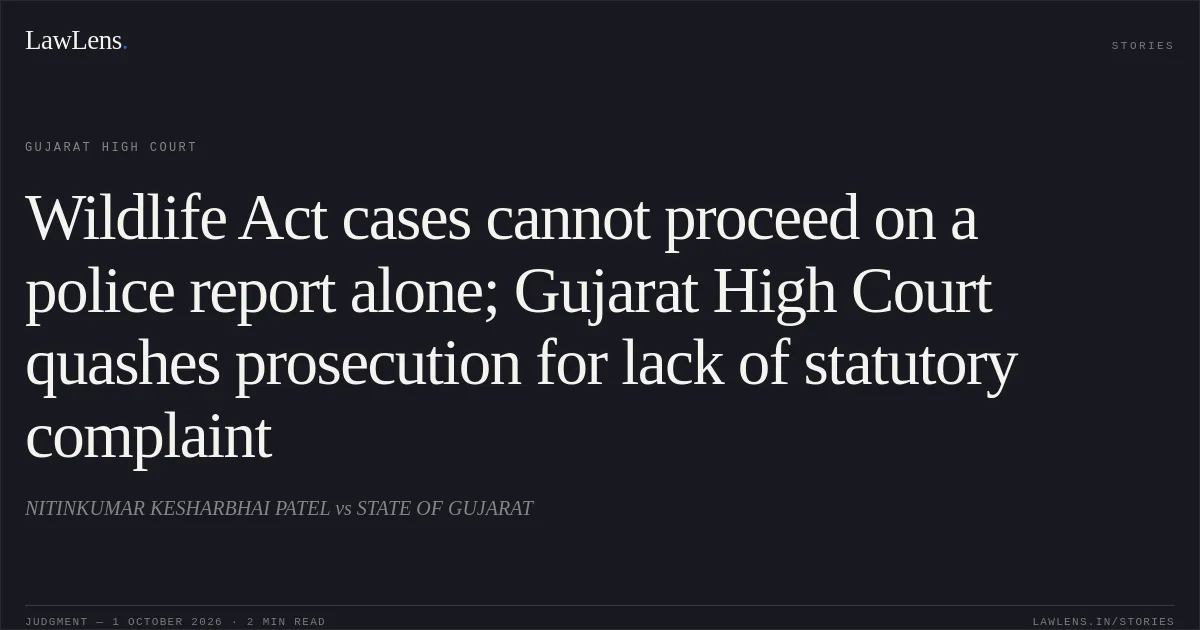
The High Court allowed the application and quashed Criminal Case No. 650 of 2020.
It granted liberty to the competent officer or the State to proceed under the Wild Life (Protection) Act by lodging a complaint in accordance with the Act; the Rule was made absolute to that extent.
Source reference: p. 5–6Acts & Sections Cited
11 provisions across 3 statutes referred to in this judgment. Each provision opens on LawLens.
Code of Criminal Procedure, 19734
Wild Life (Protection) Act, 19726
Bharatiya Nagarik Suraksha Sanhita, 20231
Original Court PDF
NITINKUMAR KESHARBHAI PATELvsSTATE OF GUJARAT
Click to open original judgment
Original judgment, available to read, download and summarize on LawLens.in