Facts
The petitioner, plaintiff in the underlying suit, claimed a one-third interest in property mortgaged by her deceased brother, Sunil Kumar, to respondent No. 5 bank. Sunil Kumar had claimed title under a gift deed from their mother. The petitioner disputed the gift deed’s effect and alleged that her brother could not mortgage her share without her consent.
Source reference: paras. 2–4After Sunil Kumar obtained a loan in 2022 and later died, the bank initiated recovery proceedings under the SARFAESI Act; the outstanding amount exceeded ₹75 lakhs. The petitioner filed suit in 2024. The trial court granted interim injunction but found that she was not in possession. Both sides appealed. By a common order dated 31 August 2026, the appellate court set aside the injunction and dismissed the petitioner’s appeal concerning possession. The petitioner challenged that order under Article 227.
Source reference: paras. 2–4, 12–13Issues
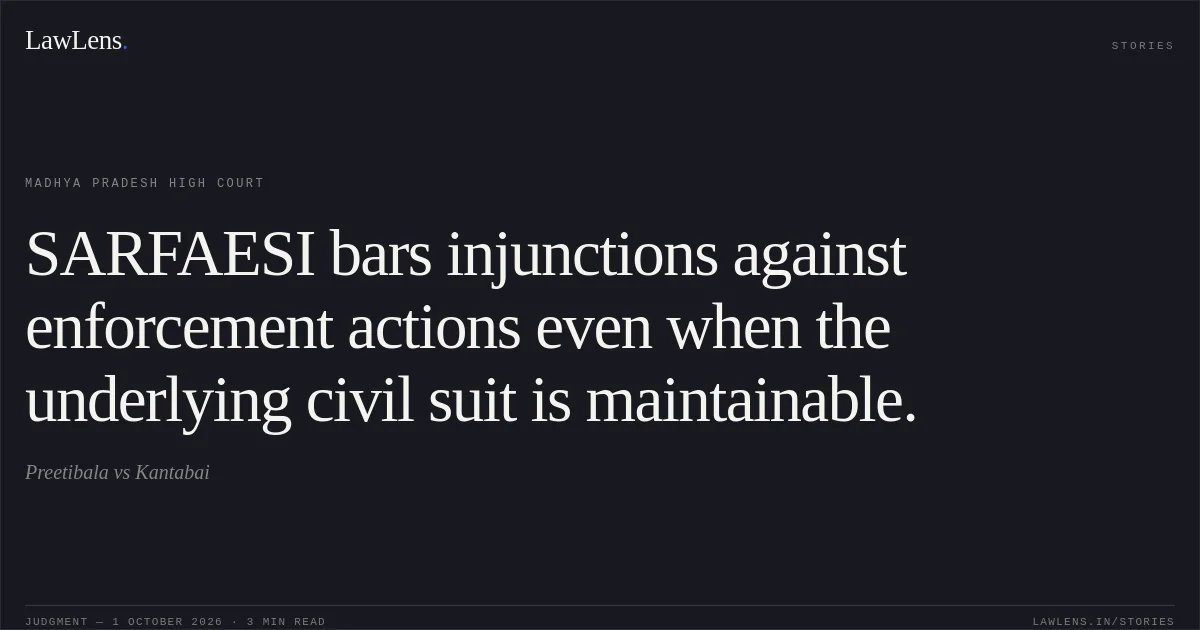
Whether Section 34 of the SARFAESI Act precluded the civil court from granting an injunction against the bank’s SARFAESI recovery action, even where the petitioner’s civil suit asserting an interest in the property was maintainable.
Source reference: paras. 8–10Whether the appellate court’s decision setting aside the interim injunction and dismissing the petitioner’s appeal warranted interference under Article 227 of the Constitution.
Source reference: paras. 18–20Law Applied
Section 34 of the SARFAESI Act bars civil-court jurisdiction over matters entrusted to the DRT or DRAT and separately prohibits any court or authority from granting an injunction concerning action taken or to be taken under the SARFAESI Act or the Recovery of Debts Due to Banks and Financial Institutions Act, 1993; Section 35 gives the SARFAESI Act overriding effect over inconsistent laws.
Source reference: para. 11The court relied on Central Bank of India v. Prabha Jain, (2025) 4 SCC 38, and Babeeta Goyal v. Ratana Bai, 2026 SCC OnLine MP 12522, including the distinction between the maintainability of a civil suit concerning title or interest in property and the bar on injunctions against statutory recovery action. Under Order XXXIX Rules 1 and 2 CPC, interim relief is discretionary and requires consideration of the applicable injunction principles.
Source reference: paras. 9, 15–17Article 227 is supervisory, not appellate; interference is limited to jurisdictional error, patent perversity, or manifest failure of justice, and is not justified merely because another view is possible.
Source reference: paras. 19–20Reasoning
The High Court accepted the appellate court’s view that the petitioner’s claims regarding her alleged share and the gift deed did not permit a civil court to restrain the bank’s SARFAESI proceedings. Even if the suit could proceed to determine her interest in the property, Section 34 barred an injunction against action taken or proposed under the recovery legislation.
Source reference: paras. 9–10The bank held a mortgage, had initiated recovery proceedings, and was seeking to recover a substantial outstanding loan; the appellate court was therefore justified in finding that the requirements for interim injunction were not established in the petitioner’s favour. Any interest ultimately proved could, the court observed, be compensated in money.
Source reference: paras. 12–14The appellate court’s conclusion disclosed no illegality, perversity, or jurisdictional failure warranting supervisory intervention.
Source reference: paras. 18–20Holding
The High Court held that the appellate court had committed no error warranting interference under Article 227.
It dismissed the petition, leaving in place the appellate order that set aside the interim injunction and dismissed the petitioner’s appeal.
Source reference: paras. 18–21Acts & Sections Cited
5 provisions across 2 statutes referred to in this judgment. Each provision opens on LawLens.
Securitisation and Reconstruction of Financial Assets and Enforcement of Security Interest Act, 20023
Code of Civil Procedure, 19082
Original Court PDF
PreetibalavsKantabai
Click to open original judgment
Original judgment, available to read, download and summarize on LawLens.in