01Facts
The election for Chairman of the Municipal Board, Khatushyamji, was scheduled for 21 September 2026, between 10:00 a.m. and 2:00 p.m.
¶ 2Nineteen of the twenty elected councillors voted; Laxmi Kumari, a councillor and candidate for Chairman, did not cast her vote.
¶ 2The State Election Commission directed that the election process continue on 25 September to enable her participation.
¶ 3Vinita Pooniya challenged that direction by writ petition.
¶ 3The Single Judge quashed the Commission’s order and directed the Returning Officer to count the votes cast on 21 September and declare the result, while preserving the remedy of an election petition.
¶ 1Laxmi Kumari and the State Election Commission separately appealed.
¶ 4The election result was subsequently declared on 26 September.
¶ 9 · ¶ 2002Issues
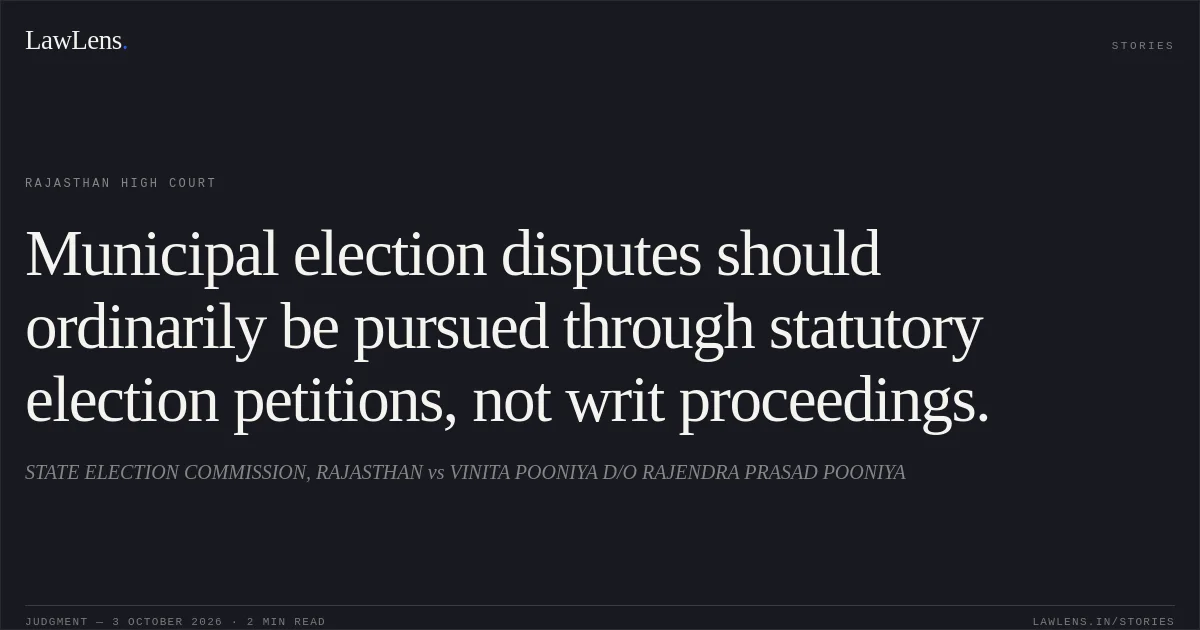
i.1. Whether the High Court should interfere under Article 226 with a municipal election process when Article 243ZG(b) and the governing law provide for an election petition to challenge the election
¶ 10 · ¶ 13–15ii.2. Whether the Single Judge’s order should be set aside because Laxmi Kumari, whose voting participation was affected, was not impleaded in the writ proceedings
¶ 7 · ¶ 12 · ¶ 1703Law Applied
Article 243ZA vests the State Election Commission with superintendence, direction and control over municipal elections; Article 243ZG(b) provides that an election to a Municipality may be called in question only by an election petition presented in the manner prescribed by State law.
¶ 13The election-bar principle, explained under Article 329(b) in N.P. Ponnuswami v. Returning Officer and Mohinder Singh Gill v. Chief Election Commissioner, generally requires an election to proceed to its conclusion, with disputes addressed through the prescribed election remedy.
¶ 13The Court also relied on Anugrah Narain Singh v. State of U.P. and Ashok Kumar v. Election Commission of India for the principle that courts should ordinarily avoid interventions that interrupt or protract an election, while recognising limited scope for interventions that facilitate its completion.
¶ 14–15Sections 31 and 32 of the Rajasthan Municipalities Act, 2009 provide the statutory election-petition mechanism.
¶ 18The arguments based on Rules 52, 53 and 78 of the Rajasthan Municipalities (Election) Rules, 1994 were not finally determined; the relevant questions were left open for the election forum.
¶ 5 · ¶ 19 · ¶ 23Provisions in the judgment · 2 · Linked ones open on LawLens
RAJASTHAN MUNICIPALITIES ACT,2009 Section 31Section 32
04Reasoning
The Court considered that the Single Judge had not finally determined the alleged abduction, Laxmi Kumari’s inability to vote, the legality of the Commission’s 22 September direction, or the validity of the later voting process.
¶ 16 · ¶ 18–20Those matters involved disputed facts and could be examined in an election petition after the result was declared.
¶ 16 · ¶ 18–20Although Laxmi Kumari had not been impleaded in the writ petition, the Court held that this omission did not, in the circumstances, require the order to be set aside: her substantive electoral rights had not been finally adjudicated, and the statutory remedy remained available.
¶ 17The Court therefore found no jurisdictional error warranting appellate interference.
¶ 2105Holding
The Court dismissed both appeals and declined to interfere with the Single Judge’s order.
¶ 21–23It expressed no opinion on the alleged abduction, the legality of the Commission’s order, the exercise of powers under the Election Rules, the validity of the voting on 25 September, or the ultimate validity of the election; those issues were left open to be raised before the competent forum in accordance with law.
¶ 23Original Court PDF
LAXMI KUMARI WIFE OF SHRI HARLAL JINJWADIAvsVINITA POONIYA DAUGHTER OF RAJENDRA PRASAD POONIYA
Click to open original judgment
Original judgment, available to read, download and summarize on LawLens.in