Facts
The applicant sought anticipatory bail in Case Crime No. 805 of 2021, registered at Police Station Sikandra, Agra, for offences under Sections 506, 504, 406, 420, 120B, 147, 467, 468 and 471 IPC.
Source reference: para. 2The prosecution concerned a land transaction and allegations that the applicant had not paid the full sale consideration.
Source reference: paras. 3–5The applicant asserted that he had paid the consideration, challenged the informant’s standing, relied on earlier civil litigation, and alleged that the FIR was delayed and motivated.
Source reference: paras. 3–5The State and informant opposed bail, citing the applicant’s earlier unsuccessful anticipatory-bail application and writ petition, an unexplained delay in bringing the present application, non-cooperation, abscondence and criminal antecedents.
Source reference: paras. 6–7Issues
Whether the applicant was entitled to anticipatory bail in light of the allegations, the material on record and the factors relevant to pre-arrest bail.
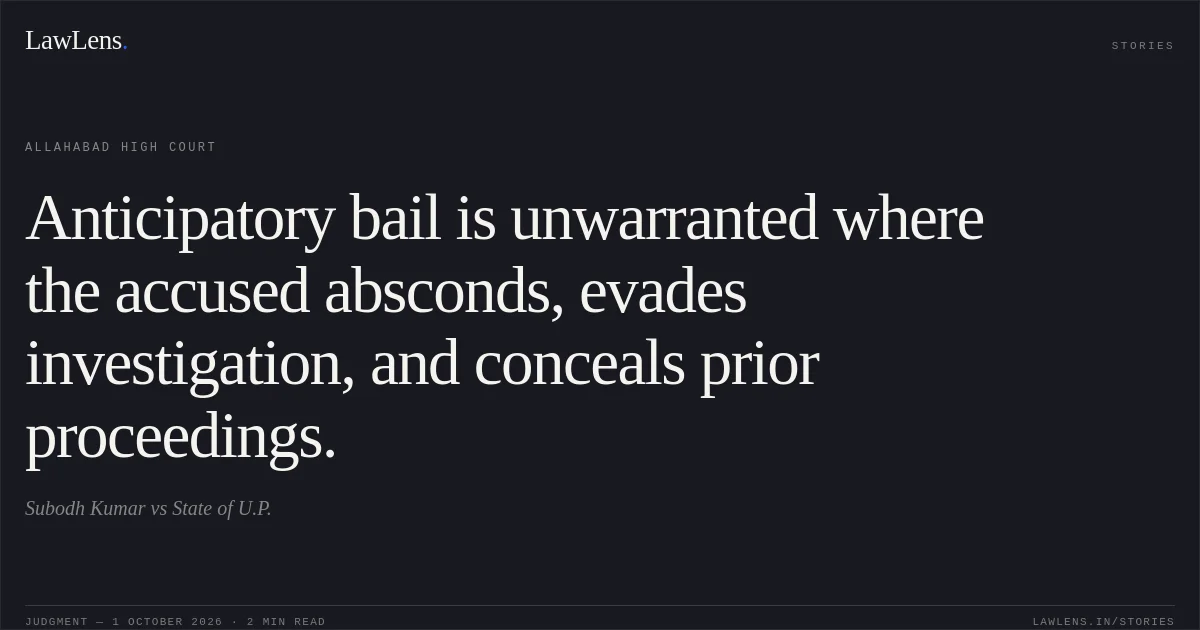
Source reference: paras. 9, 13–15Whether the applicant’s failure to disclose prior proceedings and explain the delay, together with the alleged abscondence, non-cooperation and unexplained criminal history, weighed against granting anticipatory bail.
Source reference: paras. 6–9Law Applied
The Court considered the power to grant anticipatory bail under Section 482 BNSS, describing it as extraordinary and to be exercised cautiously, not as a matter of routine; it relied on Srikant Upadhyay v. State of Bihar, which states that a person continuously defying process and absconding is generally not entitled to such relief, subject to exceptional cases.
Source reference: para. 10Relying on P. Chidambaram v. Directorate of Enforcement and Kishor Vishwasrao Patil v. Deepak Yashwant Patil, the Court noted that pre-arrest bail may affect investigation and requires consideration of the accusation’s nature and gravity, the applicant’s role, the risk of flight or interference, and investigative needs.
Source reference: paras. 11–12It also referred to Sushila Agrawal v. State (NCT of Delhi) on the relevant discretionary factors, and Gurbaksh Singh Sibbia v. State of Punjab on the extraordinary character of the power.
Source reference: paras. 12, 14Reasoning
The Court found that the applicant had not disclosed the rejection of his earlier anticipatory-bail application or the dismissal of his writ petition, and had not explained the delay in filing the present application.
Source reference: para. 9It also considered that his criminal history was not fully explained, that he appeared to have absconded and failed to cooperate, and that the bank transfers relied on by him were said to have occurred in 2013 although the sale deed was executed in 2011.
Source reference: para. 9Finding prima facie cognizable offences and no material establishing that the case was false, the Court concluded that the applicant had not shown grounds warranting the exceptional relief of anticipatory bail.
Source reference: paras. 9, 13–15Holding
The Court held that the applicant was not entitled to anticipatory bail.
The High Court dismissed the application.
Source reference: para. 16Acts & Sections Cited
10 provisions across 3 statutes referred to in this judgment. Each provision opens on LawLens.
Bharatiya Nagarik Suraksha Sanhita, 20231
Code of Criminal Procedure, 19731
Indian Penal Code, 18608
Original Court PDF
Subodh KumarvsState of U.P.
Click to open original judgment
Original judgment, available to read, download and summarize on LawLens.in