Facts
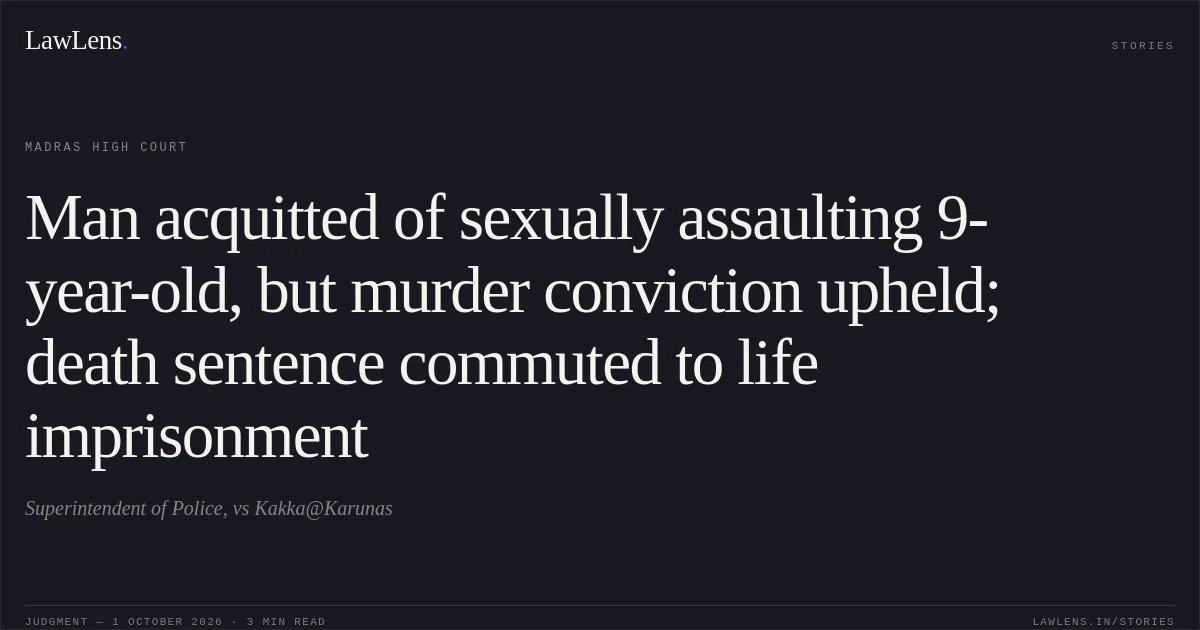
The nine-year-old daughter of PW1 and PW2 went missing on 2 March 2024. Her body was found in a canal on 5 March, and post-mortem evidence established homicidal death involving asphyxia and genital injuries; semen was detected in a vaginal swab.
Source reference: para. 2(i)–(v), 13(a)–(c)The prosecution case against the accused, based on circumstantial evidence, included last-seen evidence, his presence at the co-accused’s house, his conduct after the occurrence, discovery evidence, and DNA evidence.
Source reference: para. 12, 16The trial court convicted him of offences including murder under Section 302 IPC and penetrative sexual assault under Section 6 of the POCSO Act, and imposed death sentences for murder and the POCSO offence.
Source reference: para. 2(xiv)–(xv)The High Court considered the referred death sentence and the accused’s appeal; it also received further evidence from a constable and recalled witnesses for examination.
Source reference: para. 3–5, 9–10Issues
Whether the circumstantial evidence proved the accused’s guilt of penetrative sexual assault under Section 6 of the POCSO Act beyond reasonable doubt
Source reference: para. 28–30Whether the circumstances proved the accused’s guilt of murder and screening of the offence under Sections 302 and 201 IPC
Source reference: para. 31–33Whether the death sentence was justified, or should be modified in light of the circumstances and mitigating material
Source reference: para. 34–35Law Applied
Under Section 27 of the Indian Evidence Act, only the portion of a confession that distinctly relates to a fact discovered is admissible; a fact already known to police is not thereby discovered.
Source reference: para. 27(ii)(b)In a case resting on circumstantial evidence, the circumstances must be fully established and form a chain pointing unerringly to the accused’s guilt; last-seen evidence, without sufficient supporting evidence, does not itself establish every charged offence.
Source reference: para. 27(i), 35(ii)An expert opinion must be assessed against its stated methodology and evidential foundation; here, the DNA analyst’s asserted “close match” was undermined by the failure to meet the laboratory threshold and the absence of a corresponding allele chart in the original report.
Source reference: para. 22–26The death penalty is reserved for the “rarest of rare” cases, and residual doubt and other individual mitigating circumstances may weigh against it [para. 35(i)–(vii), discussing Ashok Debbarma v. State of Tripura, (2014) 4 SCC 747].
Source reference: para. 35(i)–(vii)Reasoning
The Court accepted the evidence that the accused was last seen with the victim, was seen leaving the co-accused’s house, knew the place of occurrence, and displayed suspicious post-occurrence conduct.
Source reference: para. 27–31It treated these circumstances as supporting guilt for murder and screening of the offence, but found them insufficient to establish that the accused himself committed penetrative sexual assault.
Source reference: para. 27–31The DNA evidence did not reliably connect him to that assault: the analyst’s “close match” opinion concerned trace DNA, failed the threshold, and was not supported by a chart in the original report; the Court also found no other acceptable evidence proving the accused’s sexual assault of the victim.
Source reference: para. 27–31For sentencing, the Court considered the case’s circumstantial nature, uncertainty about the accused’s precise role in the killing, the probation report, his age, and his satisfactory prison conduct; it concluded that life imprisonment was proportionate.
Source reference: para. 35(ii), 35(v)–(vii)Holding
The Court acquitted the accused of the charge under Section 6 of the POCSO Act, but upheld his convictions under Sections 367 read with 366, 342, 302, and 201 IPC.
It modified the death sentence for murder to imprisonment for life and confirmed the sentences for the other offences.
Source reference: para. 35(vii), 36The death reference was answered accordingly, and the criminal appeal was partly allowed.
Source reference: para. 36Acts & Sections Cited
14 provisions across 4 statutes referred to in this judgment. Each provision opens on LawLens.
Code of Criminal Procedure, 19733
Indian Penal Code, 18608
Scheduled Castes and the Scheduled Tribes (Prevention of Atrocities) Act, 19891
Original Court PDF
Superintendent of Police,vsKakka@Karunas
Click to open original judgment
Original judgment, available to read, download and summarize on LawLens.in