Facts
The petitioner, a child in conflict with law (“CICL”), was implicated in Ara Town P.S. Case No. 247 of 2025, registered under Sections 103(1) and 61(2) of the Bharatiya Nyaya Sanhita and Section 27 of the Arms Act, concerning the shooting death of the informant’s son.
Source reference: paras. 3–4; pp. 2–3He was taken into custody on 22 April 2025. The Juvenile Justice Board determined that he was aged 14 years, 4 months and 19 days on the date of the alleged offence and declared him a CICL on 4 August 2025.
Source reference: para. 4; p. 2His bail application was rejected by the Juvenile Justice Board on 26 September 2025, and his appeal was dismissed by the First Additional Sessions Judge, Bhojpur at Ara, on 19 January 2026.
Source reference: paras. 5–7; pp. 2–3In revision, the petitioner contended that bail under Section 12 of the Juvenile Justice (Care and Protection of Children) Act, 2015 (“JJ Act”) could not be denied on conjectures, and that his two antecedents did not establish any statutory ground for refusal of bail.
Source reference: para. 8; pp. 3–4The State and the informant opposed bail, relying principally on his criminal antecedents and the possibility of his returning to bad company.
Source reference: para. 9; pp. 4–5Issues
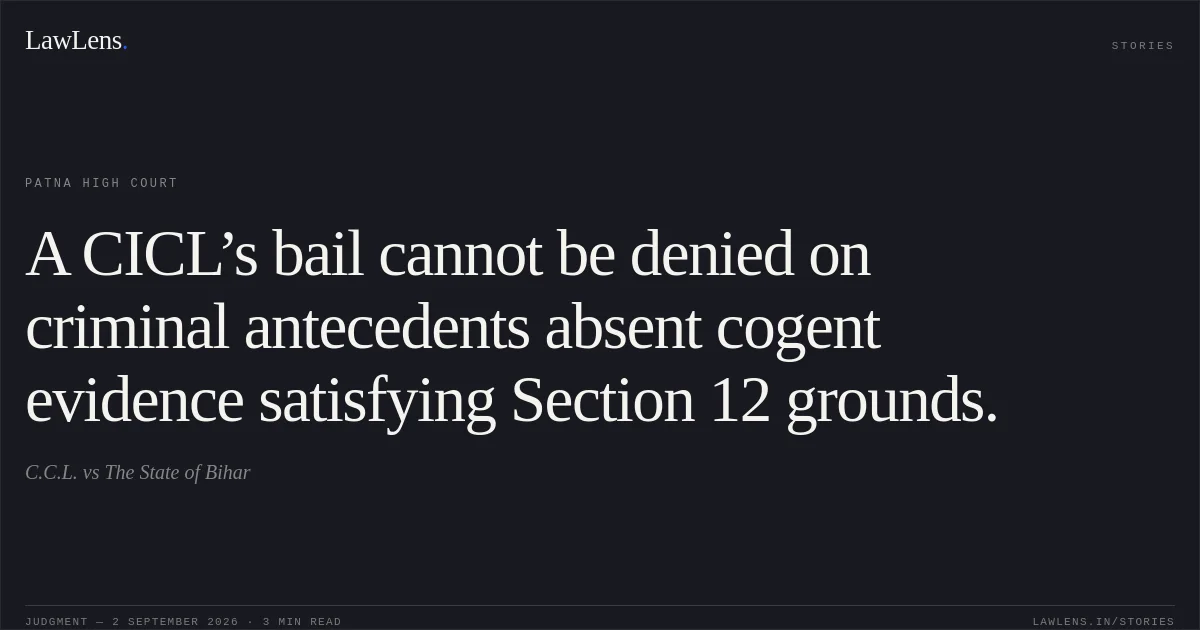
1. Whether bail could be denied to the petitioner under Section 12 of the JJ Act merely on the basis of his criminal antecedents and apprehension that he might fall into bad company.
Source reference: paras. 11, 14; pp. 5, 7–82. Whether the courts below had sufficient material to conclude that the petitioner’s release would bring him into contact with known criminals, expose him to moral, physical or psychological danger, or defeat the ends of justice.
Source reference: paras. 11, 14; pp. 5, 7–83. Whether the concurrent orders rejecting bail required interference in revision in light of the child-friendly, reformative and rehabilitative objectives of the JJ Act.
Source reference: paras. 12–15; pp. 5–8Law Applied
The Court primarily applied Section 12 of the JJ Act, under which a CICL is ordinarily entitled to bail and bail may be refused only where release is likely to bring the child into association with a known criminal, expose the child to moral, physical or psychological danger, or otherwise defeat the ends of justice.
Source reference: para. 11; p. 5The Court also applied the general principles under Section 3 of the JJ Act, particularly the best-interest principle under Section 3(iv), the principle that institutional care must be a measure of last resort under Section 3(xii), and the principle of repatriation and restoration under Section 3(xiii).
Source reference: para. 12; pp. 5–6These provisions require courts to favour the child’s welfare, reformation, rehabilitation and restoration to a family environment unless contrary to the child’s best interests.
Source reference: paras. 12–13; pp. 5–6The gravity of the alleged offence, by itself, is not a statutory ground for denying bail to a CICL.
Source reference: para. 14; pp. 7–8Reasoning
The Court found that the courts below had relied on the petitioner’s two criminal antecedents to infer that he would again associate with bad or criminal elements, but that inference was unsupported by cogent material.
Source reference: para. 14; pp. 7–8The Social Investigation Report indicated that the petitioner was motherless, came from a low-income family, and may have lacked proper guidance; it did not establish that his release would expose him to moral, physical or psychological danger or bring him into contact with known criminals.
Source reference: para. 14; p. 7The Court held that antecedents alone did not establish that the petitioner was incorrigible or incapable of reform.
Source reference: paras. 12–14; pp. 5–8Applying the best-interest, last-resort institutionalisation and rehabilitative principles under Section 3, the Court concluded that continued institutional custody was not justified and that the statutory exceptions under Section 12 had not been proved.
Source reference: paras. 12–14; pp. 5–8Holding
The revision petition was allowed.
The order dated 19 January 2026 dismissing the petitioner’s criminal appeal and the Juvenile Justice Board’s order dated 26 September 2025 rejecting bail were set aside.
Source reference: para. 15; p. 8The petitioner/CICL was directed to be released on bail on furnishing a bond of ₹10,000 with two sureties of the like amount to the satisfaction of the Juvenile Justice Board, subject to the conditions that one bailor be his parent, the other be a relative without criminal antecedents who undertakes his care and upkeep, and that the petitioner remain present before the Board on every date fixed in the case.
Source reference: para. 16; pp. 8–9Acts & Sections Cited
5 provisions across 3 statutes referred to in this judgment. Each provision opens on LawLens.
Bharatiya Nyaya Sanhita, 20232
Arms Act, 19591
Juvenile Justice (Care and Protection of Children) Act, 2015.2
Original Court PDF
C.C.L.vsThe State of Bihar
Click to open original judgment
Original judgment, available to read, download and summarize on LawLens.in