Facts
The second respondent alleged that, after her daughter’s death, she paid ₹33,50,000 towards a house purchased by the first petitioner, her son-in-law, and later gave him 30 sovereigns of gold and ₹5,00,000 in connection with his second marriage.
Source reference: p. 2–3She complained that the petitioners failed to maintain her and sought return of the money and jewellery.
Source reference: p. 2–3The police registered Crime No. 334 of 2025 for offences under Sections 406 and 420 IPC.
Source reference: p. 2–3The complainant had also filed a civil suit concerning the same subject matter, which was pending.
Source reference: p. 2–3The petitioners sought quashing of the FIR under Section 482 CrPC / Section 528 BNSS.
Source reference: p. 2–3Issues
1. Whether the allegations in the complaint, taken at face value, made out the ingredients of criminal breach of trust under Sections 405 and 406 IPC
Source reference: p. 4–5, 72. Whether the allegations made out cheating and dishonest inducement to deliver property under Sections 415 and 420 IPC
Source reference: p. 5–73. Whether continuation of the FIR was an abuse of process where the dispute was predominantly civil and a civil suit concerning the same subject matter was pending
Source reference: p. 3, 7–8Law Applied
Section 405 IPC requires entrustment of property or dominion over it, dishonest misappropriation or use, and conduct contrary to a legal direction or obligation; Section 406 provides the punishment for criminal breach of trust.
Source reference: p. 4–5Section 420 IPC requires cheating under Section 415 and dishonest inducement resulting in delivery of property or the making, alteration, or destruction of valuable security.
Source reference: p. 5–6Under Indian Oil Corporation v. NEPC India Ltd., (2006) 6 SCC 736, civil liability should not be converted into criminal liability, and criminal prosecution should not be used to pressure settlement of civil claims.
Source reference: p. 6G. Sagar Suri v. State of U.P., (2000) 2 SCC 636, states that criminal proceedings are not a shortcut to civil remedies and that Section 482 jurisdiction may be exercised to prevent abuse of process or secure the ends of justice.
Source reference: p. 7Reasoning
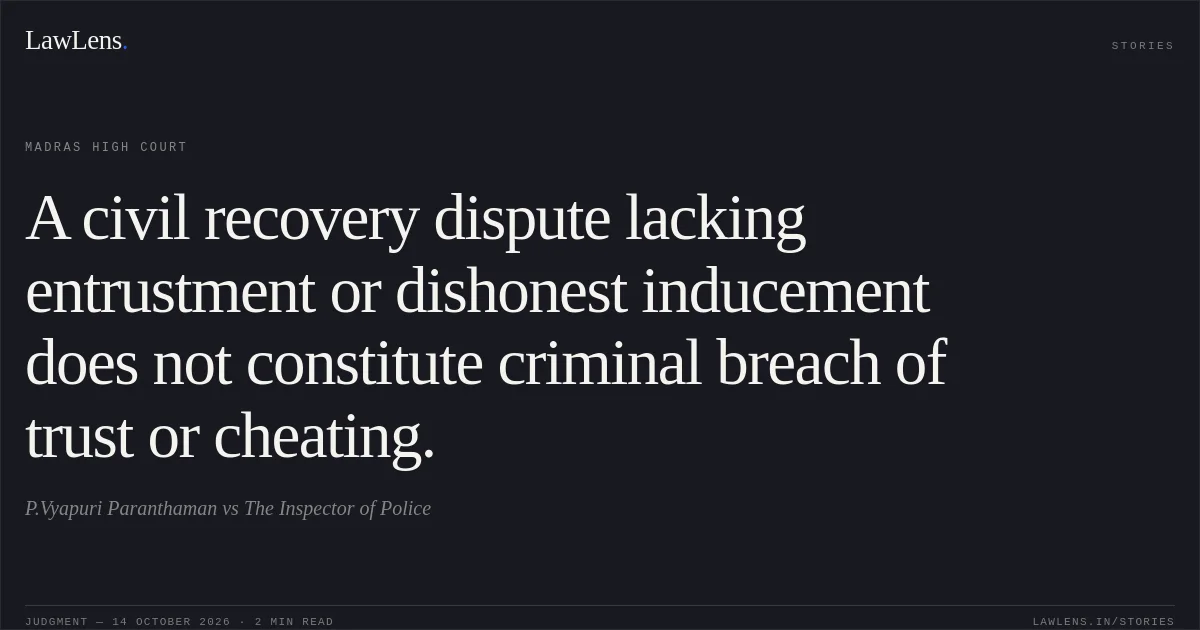
The Court found that the complaint principally sought recovery of money and jewellery allegedly given by the complainant to the first petitioner.
Source reference: p. 4–7It concluded that the allegations did not disclose the requisite entrustment and dishonest misappropriation for criminal breach of trust, or the cheating and dishonest inducement necessary for Section 420 IPC.
Source reference: p. 4–7The pending civil suit concerning the same subject matter reinforced the Court’s view that the dispute was essentially civil; continuation of the criminal investigation in the absence of the alleged offences’ essential ingredients would amount to abuse of process.
Source reference: p. 7–8Holding
The Court held that the complaint did not make out offences under Sections 406 or 420 IPC and that the dispute was predominantly civil in nature.
It quashed the FIR in Crime No. 334 of 2025 insofar as it concerned the petitioners, allowed the criminal original petition, and closed the connected miscellaneous petition.
Source reference: p. 7–8Acts & Sections Cited
6 provisions across 3 statutes referred to in this judgment. Each provision opens on LawLens.
Code of Criminal Procedure, 19731
Bharatiya Nagarik Suraksha Sanhita, 20231
Indian Penal Code, 18604
Original Court PDF
P.Vyapuri ParanthamanvsThe Inspector of Police
Click to open original judgment
Original judgment, available to read, download and summarize on LawLens.in