Facts
The informant married Kamlesh Pandey on 8 July 2010.
Source reference: p. 2She alleged that her father provided ₹13,00,000 and a car for the wedding, and that, shortly after she entered the matrimonial home, her husband and in-laws demanded a further ₹5,00,000–₹7,00,000 and valuable land
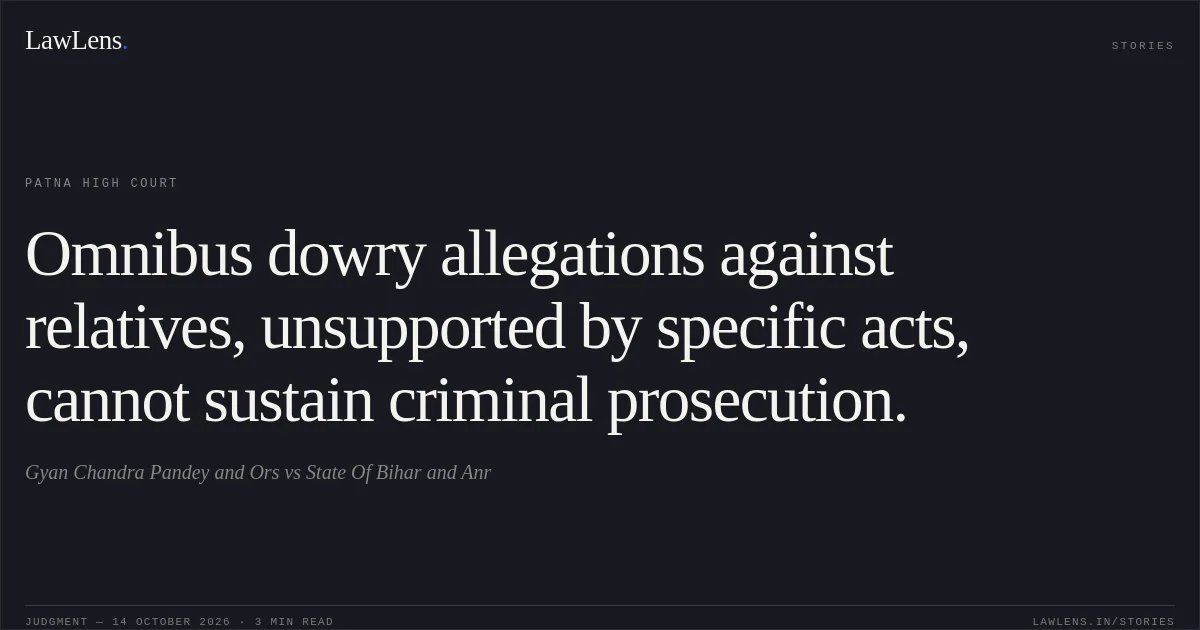
Source reference: p. 2The petitioners—her father-in-law, mother-in-law, brother-in-law, sister-in-law and another brother-in-law—sought to quash the cognizance order dated 26 April 2016 under Section 498A of the IPC and Sections 3 and 4 of the Dowry Prohibition Act
Source reference: pp. 1–2They relied on the timing of the FIR, lodged on 16 July 2015 while the husband’s divorce suit was nearing conclusion, and on the absence of dowry allegations in the informant’s pleadings and testimony in that suit
Source reference: pp. 2–4The divorce decree was subsequently affirmed on appeal
Source reference: p. 3Issues
1. Whether the cognizance order and criminal proceedings against the petitioners should be quashed as an abuse of the process of court, in light of the allegations and the circumstances in which the FIR was filed
Source reference: pp. 2–4, 132. Whether the allegations and material on record disclosed a sufficient basis to continue prosecution of the petitioners under Section 498A IPC and Sections 3 and 4 of the Dowry Prohibition Act
Source reference: pp. 2, 13Law Applied
Section 498A IPC penalises cruelty by a husband or his relatives, including harassment intended to coerce the woman or a person related to her to meet an unlawful demand for property or valuable security; Sections 3 and 4 of the Dowry Prohibition Act address giving, taking or abetting dowry and demanding dowry, respectively
Source reference: pp. 4–7In exercising its inherent jurisdiction to prevent abuse of the process of court, the High Court may quash proceedings where the allegations, taken at face value, do not disclose an offence or where continuation of the prosecution would constitute an abuse of process.
Source reference: pp. 4, 7–9, 12–13The court relied on State of Haryana v. Bhajan Lal, 1992 Supp (1) SCC 335, and the principles against proceeding on vague or omnibus matrimonial allegations discussed in Preeti Gupta v. State of Jharkhand, Geeta Mehrotra v. State of U.P., Kahkashan Kausar v. State of Bihar, Achin Gupta v. State of Haryana and Dara Lakshmi Narayana v. State of Telangana
Source reference: pp. 4, 7–9, 12–13It also referred to Sanjay D. Jain v. State of Maharashtra, which states that vague and general allegations that do not prima facie establish cruelty under Section 498A IPC cannot sustain prosecution
Source reference: pp. 9–12Reasoning
The court considered the prosecution allegations alongside the matrimonial proceedings and the timing of the FIR.
Source reference: no citationThe informant had contested the divorce suit for approximately two years, yet the FIR was lodged on the date fixed in that suit when it was nearing conclusion; the court treated this circumstance as supporting the petitioners’ contention that the prosecution was retaliatory and vexatious
Source reference: pp. 2–4, 13Applying the cited principles on matrimonial prosecutions, the court concluded that continuing the proceedings against these petitioners would amount to an abuse of the process of court
Source reference: p. 13Holding
The High Court held that continuation of the criminal proceedings against the petitioners would be an abuse of the process of court.
It quashed the cognizance order dated 26 April 2016 in Chandan P.S. Case No. 76 of 2015 (G.R. No. 1560 of 2015), only insofar as it concerned the petitioners, and allowed the application
Source reference: p. 13Acts & Sections Cited
8 provisions across 4 statutes referred to in this judgment. Each provision opens on LawLens.
Indian Penal Code, 18603
Hindu Marriage Act, 19551
Code of Criminal Procedure, 19732
Original Court PDF
Gyan Chandra Pandey and OrsvsState Of Bihar and Anr
Click to open original judgment
Original judgment, available to read, download and summarize on LawLens.in