Facts
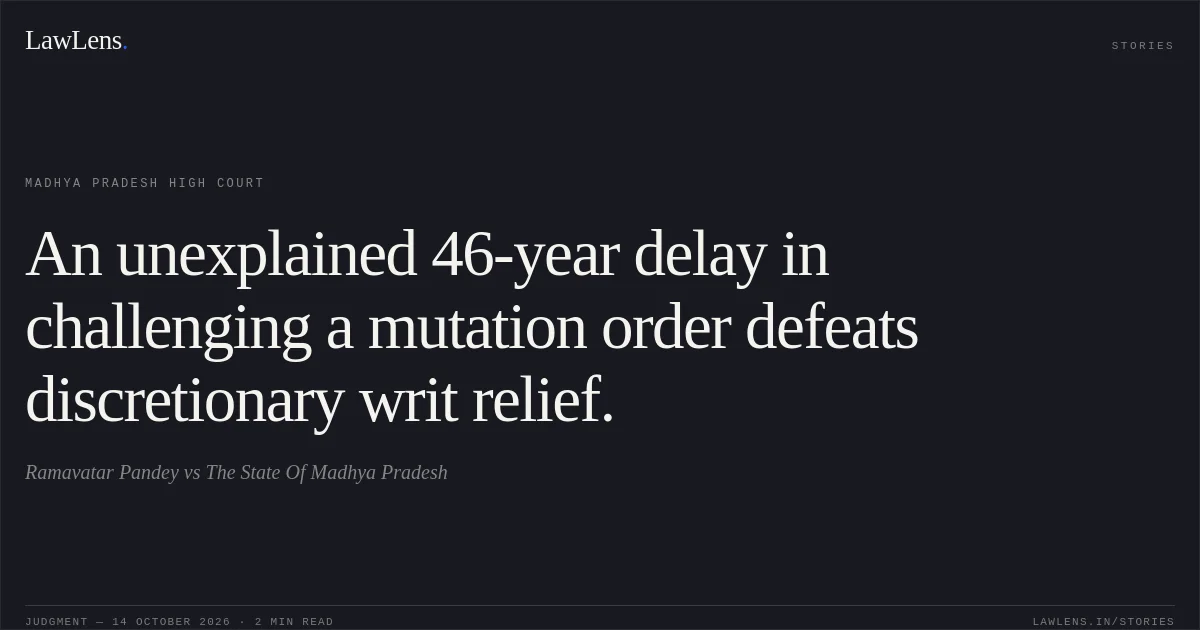
The petitioners challenged a mutation order dated 10 January 1978, alleging that it concerned ancestral property and had been obtained without joining them.
Source reference: para. 2After obtaining a certified copy on 5 August 2024, they filed an appeal on 21 October 2024 before the Sub-Divisional Officer, together with an application under Section 5 of the Limitation Act seeking condonation of delay. The SDO dismissed the appeal as time-barred on 13 May 2025. The Additional Collector dismissed their revision on 20 July 2026, affirming the SDO’s order. The petitioners sought to quash the revisional order and have the matter remanded for consideration of the appeal on its merits.
Source reference: para. 2Issues
Whether the petitioners gave a sufficient explanation for the approximately 46-year delay in challenging the 1978 mutation order.
Source reference: para. 3Whether the High Court should grant relief under Article 226 against the authorities’ refusal to condone the delay.
Source reference: paras. 4, 11Law Applied
The High Court’s jurisdiction under Article 226 is discretionary, and delay and laches are relevant factors in deciding whether to grant relief. A court may refuse relief where a claimant’s inaction, considered alongside the length of delay and the circumstances arising during that period, makes it inequitable to grant a remedy.
Source reference: para. 5The Court relied on Karnataka Power Corpn. Ltd. v. K. Thangappan, (2006) 4 SCC 322, on the discretionary and equitable assessment of delay and laches.
Source reference: para. 5A.P. SRTC v. N. Satyanarayana, (2008) 1 SCC 210, on dismissal for an unexplained delayed approach.
Source reference: para. 6S.S. Balu v. State of Kerala, (2009) 2 SCC 479, on delay defeating equitable relief.
Source reference: para. 7State of Orissa v. Mamata Mohanty, (2011) 3 SCC 436, on the need for a proper explanation for delay.
Source reference: para. 8Ghulam Rasool Lone v. State of J&K, (2009) 15 SCC 321, on delay and laches as grounds to decline discretionary relief.
Source reference: para. 9Ashok Kumar v. District Magistrate, Basti, (2012) 3 SCC 311, on denying discretionary relief to a party that has slept over its rights.
Source reference: para. 10Reasoning
The petitioners’ explanation was that they learned of the alleged illegality when they applied for the certified mutation order in August 2024. The Court found that the Section 5 application did not explain what steps, if any, they had taken since 1978 or why they had not challenged the order earlier.
Source reference: para. 3In the absence of a plausible explanation for the 46-year delay, the Court held that the authorities had rightly treated the claim as substantially delayed and declined to exercise its discretionary writ jurisdiction.
Source reference: para. 11Holding
The Court held that the delay in challenging the mutation order was unexplained and that no relief was warranted.
It dismissed the petition on the ground of delay and laches, without an order as to costs.
Source reference: para. 12Acts & Sections Cited
1 provisions across 1 statute referred to in this judgment. Each provision opens on LawLens.
Limitation Act, 19631
Original Court PDF
Ramavatar PandeyvsThe State Of Madhya Pradesh
Click to open original judgment
Original judgment, available to read, download and summarize on LawLens.in