Facts
The respondent-wife sought divorce under Section 13 of the Hindu Marriage Act, 1955, alleging that the appellant-husband had abused her, suspected her of infidelity because she worked with male colleagues, assaulted her, exploited her financially and neglected her during illness
Source reference: paras. 3–10The husband denied the allegations but admitted the marriage and their prior relationship.
Source reference: para. 12The wife and her mother testified at trial; the husband adduced no evidence. The trial court granted a decree of divorce under Section 13(1)(ia). The husband appealed under Section 28 of the Act.
Source reference: paras. 2, 15Issues
Whether the wife proved that the husband had treated her with cruelty so as to warrant divorce under Section 13(1)(ia) of the Hindu Marriage Act, 1955
Source reference: paras. 31–33Whether the trial court’s decree of divorce disclosed any error warranting appellate interference
Source reference: paras. 17, 39Law Applied
Section 13(1)(ia) of the Hindu Marriage Act, 1955 permits divorce where a spouse has treated the petitioner with cruelty; cruelty may be physical or mental.
Source reference: paras. 32–33In matrimonial proceedings, the petitioner must establish the allegations on the balance of probabilities, not beyond reasonable doubt.
Source reference: para. 36The respondent cited Dr. N.G. Dastane v. Mrs. S. Dastane, (1975) 2 SCC 326, and other authorities; the judgment’s stated reasoning applies the statutory test and the preponderance-of-probability standard.
Source reference: paras. 28, 36Reasoning
The High Court found that the wife’s testimony about the husband’s suspicion of her character and his relationship with another woman remained unshaken in cross-examination.
Source reference: paras. 34–36It considered that allegations of cruelty within the matrimonial home did not necessarily require corroboration by an independent witness and found no basis to discard her testimony merely because documentary evidence was lacking.
Source reference: paras. 36–37The court also considered the cumulative circumstances, including character assassination, alleged economic exploitation, neglect during illness and the husband’s relationship with another woman, and concluded that the evidence established mental cruelty on the required standard.
Source reference: para. 37The parties’ prolonged separation and absence of prospects for reconciliation were also noted.
Source reference: para. 38Holding
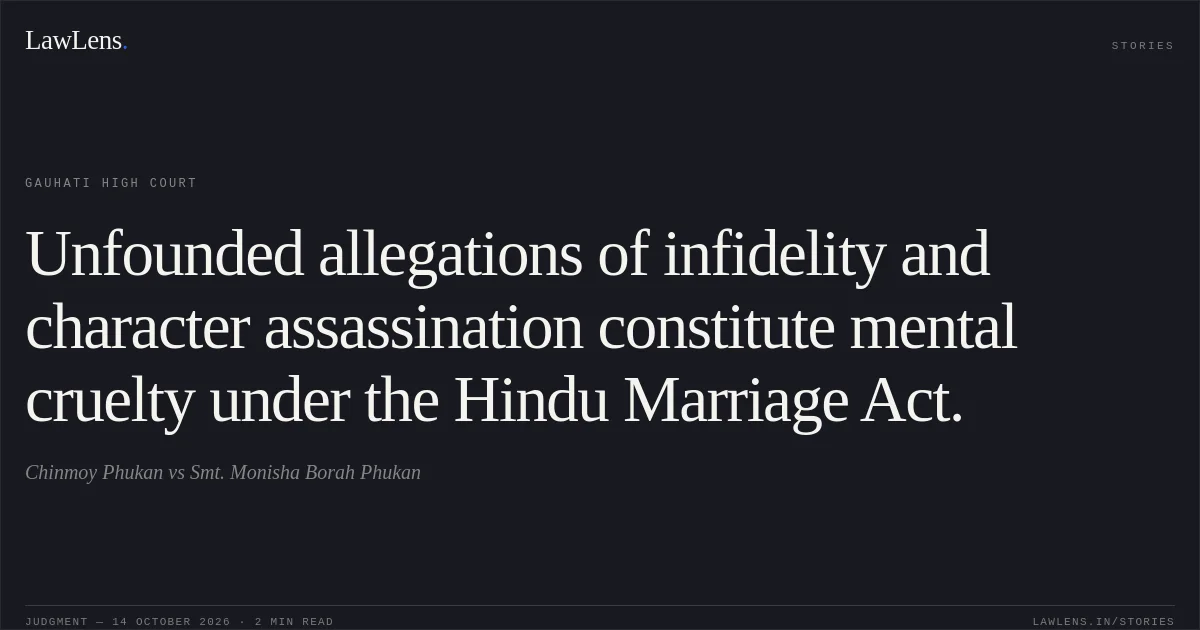
The High Court held that the wife had proved cruelty and found no infirmity in the trial court’s decree.
It dismissed the appeal, vacated the stay of the divorce decree, and directed the parties to bear their own costs.
Source reference: paras. 39–42Acts & Sections Cited
3 provisions across 1 statute referred to in this judgment. Each provision opens on LawLens.
Hindu Marriage Act, 19553
Original Court PDF
Chinmoy PhukanvsSmt. Monisha Borah Phukan
Click to open original judgment
Original judgment, available to read, download and summarize on LawLens.in
![Non-inclusion in railway pass or medical records cannot alone defeat compassionate appointment consideration.. YADVENDRA vs NORTH EASTERN RAILWAY. CAT - ['Allahabad']. LawLens](/stories/thumbnails/non-inclusion-in-railway-pass-or-medical-records-cannot-alone-defeat-compassionate-appoint-e186bad941e646b9b28be0fa75663d2f.webp)
![Ten years’ qualifying service is not required for family pension after one year of continuous railway service.. ANJANA DEVI vs NORTH EASTERN RAILWAY. CAT - ['Allahabad']. LawLens](/stories/thumbnails/ten-years-qualifying-service-is-not-required-for-family-pension-after-one-year-of-continuo-21aef602d06c48fbabbee8c57d854298.webp)