Facts
The plaintiffs claimed ownership of the suit property, alleged that defendant No.1 was their lessee and had sublet the premises to defendant No.2, and sought ejectment.
Source reference: pp. 3–7Defendant No.2 contested the suit, asserting that he had no landlord–tenant relationship with the plaintiffs.
Source reference: pp. 3–7The Trial Court decreed the suit and directed defendants No.1 and 2 to deliver vacant possession.
Source reference: pp. 3–7Defendant No.2 appealed.
Source reference: pp. 3–7The Trial Court found no landlord–tenant relationship between the plaintiffs and defendant No.2, but held him to be an unauthorised occupant.
Source reference: pp. 5–6, 11–12Issues
1. Whether defendant No.2 was an unauthorised occupant liable to be evicted from the suit property.
Source reference: p. 9; para. 122. Whether the absence of a landlord–tenant relationship between the plaintiffs and defendant No.2 made the suit, valued under Section 41(2) of the Karnataka Court Fees and Suits Valuation Act, 1958, not maintainable.
Source reference: pp. 9–10; para. 123. Whether the plaintiffs had validly terminated defendant No.2’s tenancy.
Source reference: p. 10; para. 124. Whether the Trial Court’s judgment and decree required appellate interference.
Source reference: p. 10; para. 12Law Applied
The Court considered Section 3(c) of the Karnataka Rent Act, 1999, in distinguishing a Rent Court from the City Civil Court, and Section 43 of that Act in the context of the appellant’s jurisdictional argument.
Source reference: pp. 11–12, 15It also considered Sections 41(2) and 28 of the Karnataka Court Fees and Suits Valuation Act: the Court treated Section 41(2) as the provision under which the suit had been valued, but held that the valuation provision invoked did not itself alter the suit’s nature; it stated that a claim for possession ought to have been valued under Section 28.
Source reference: pp. 13–14, 17The Court referred to the authorities cited by the appellant but held them inapplicable on the facts.
Source reference: pp. 8–9, 14–15Reasoning
The Court accepted that the plaintiffs owned the property, defendant No.1 was their lessee, and defendant No.2 occupied the premises under defendant No.1, rather than as a tenant of the plaintiffs.
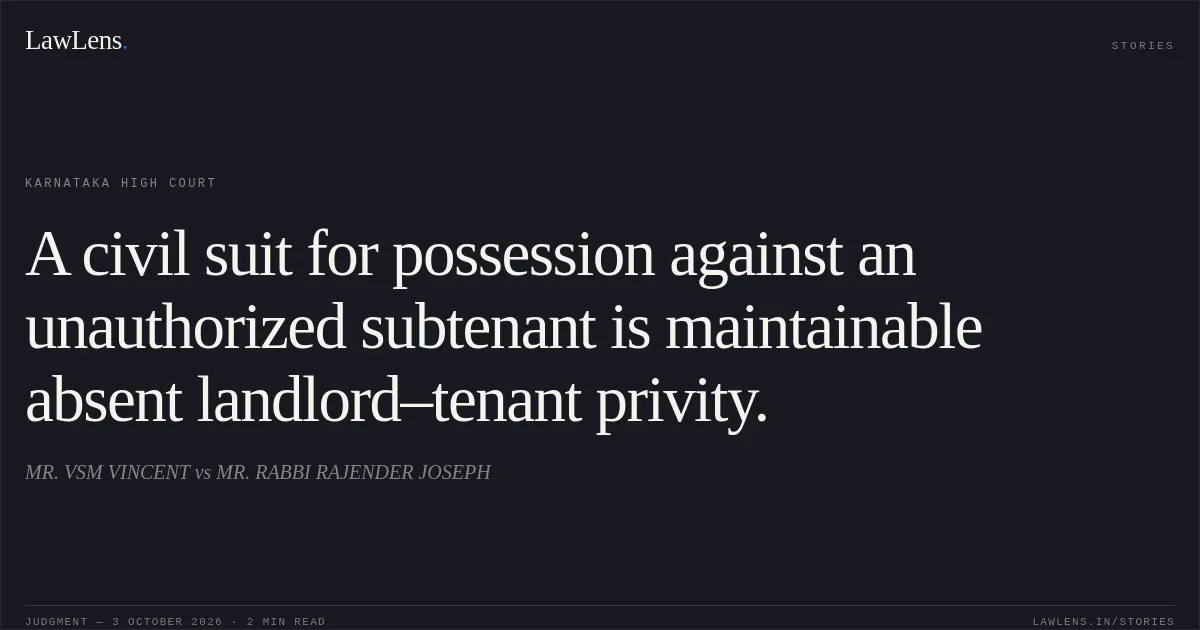
Source reference: pp. 10–12, 15–16It therefore rejected the contention that the suit had to be brought before the Rent Court: the plaintiffs sought possession from an alleged sub-tenant with whom they had no landlord–tenant relationship, and the suit was filed in the City Civil Court.
Source reference: pp. 11–12The Court further held that valuing the suit under Section 41(2) did not convert it into a landlord–tenant ejectment action or defeat maintainability; the incorrect valuation provision could be corrected by assessing the possession claim under Section 28 and paying the requisite court fee.
Source reference: pp. 13–14, 16–17On the record, defendant No.2 was an unauthorised occupant, and the notice and termination relied on by the plaintiffs were found sufficient.
Source reference: pp. 15–16Holding
The Court answered the first issue in the affirmative and the remaining issues in the negative, finding no ground to interfere with the Trial Court’s decree.
It dismissed the appeal and confirmed the judgment and decree dated 17 February 2026.
Source reference: pp. 16–17It directed the plaintiffs to compute the suit under Section 28 of the Karnataka Court Fees and Suits Valuation Act and pay the requisite court fee before the High Court, after which the Registry was to draw the decree accordingly; no costs were ordered.
Source reference: pp. 16–17Acts & Sections Cited
5 provisions across 3 statutes referred to in this judgment. Each provision opens on LawLens.
Code of Civil Procedure, 19081
KARNATAKA COURT-FEE AND SUITS VALUATION ACT, 1958.2
KARNATAKA RENT ACT, 19992
Original Court PDF
MR. VSM VINCENTvsMR. RABBI RAJENDER JOSEPH
Click to open original judgment
Original judgment, available to read, download and summarize on LawLens.in