Facts
The petitioner and another plaintiff had obtained a decree for partition and separate possession against the defendants in O.S. No. 55 of 2015.
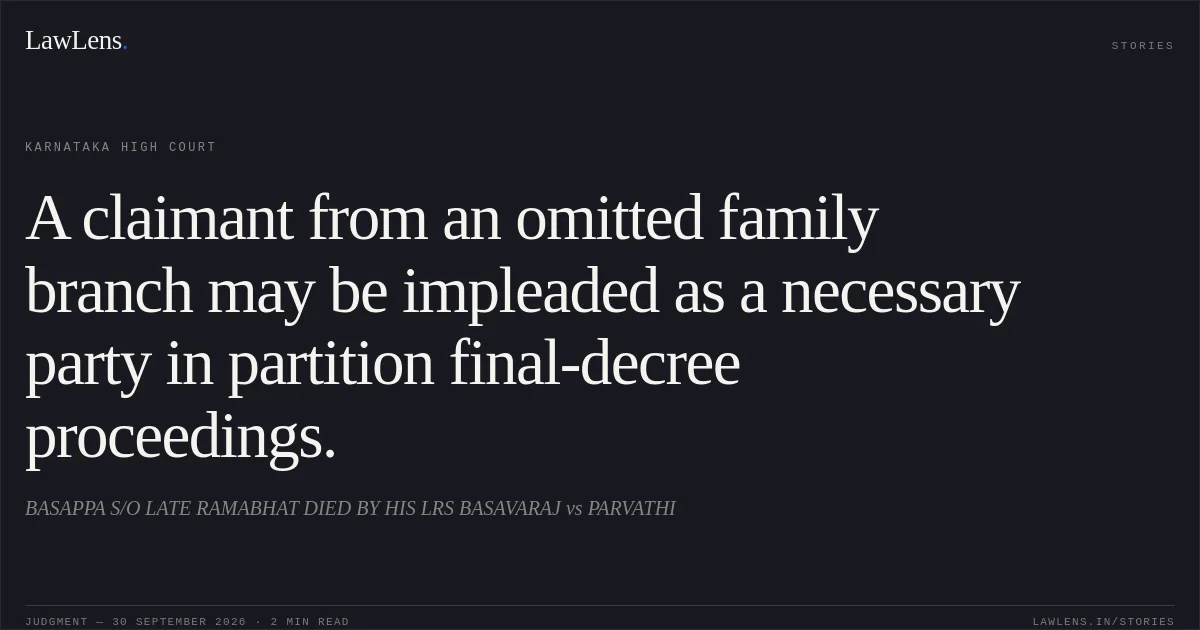
Source reference: para. 3–7, 11–12In the subsequent final decree proceedings, FDP No. 3 of 2016, respondent No. 1 applied under Order I Rule 10(2) CPC to be impleaded. She claimed descent from Krishnappa, whose branch was not shown in the family tree relied on in the partition suit.
Source reference: para. 3–7, 11–12The petitioner opposed impleadment, but the Trial Court allowed the application, finding her a necessary party. The petitioner challenged that order under Articles 226 and 227 of the Constitution
Source reference: para. 3–7, 11–12Issues
Whether respondent No. 1 was a necessary or proper party to the final decree proceedings and could be impleaded under Order I Rule 10(2) CPC
Source reference: para. 9, 11–12Whether the Trial Court’s order allowing impleadment warranted interference in writ jurisdiction
Source reference: para. 9, 13–14Law Applied
The application for impleadment was made under Order I Rule 10(2) CPC, which permits the court to add a person whose presence is necessary for effective and complete adjudication.
Source reference: para. 12The Trial Court also referred to the principle that parties whose rights and liabilities must be determined in a partition proceeding should be before the court.
Source reference: para. 12Its final decree proceedings arose under Order XX Rule 18(1), read with Sections 54 and 151 CPC, as noted in the Trial Court’s reasoning
Source reference: para. 12Reasoning
The Trial Court found that the family tree in the partition suit identified the branches of Rama Bhat and Soma Bhat but showed no heirs in Krishnappa’s branch.
Source reference: para. 12Respondent No. 1 claimed that Krishnappa’s daughter, Yankamma, was her mother, and that Yankamma had three daughters, including the applicant.
Source reference: para. 12The petitioner denied her status but did not explain the omission of Krishnappa’s heirs from the family tree.
Source reference: para. 12Given that a partition proceeding required the relevant parties’ rights and liabilities to be determined, the High Court held that the Trial Court was justified in finding respondent No. 1 a necessary party
Source reference: para. 12It found no basis to interfere with the impleadment order
Source reference: para. 13Holding
The High Court dismissed the writ petition and upheld the order allowing respondent No. 1 to be impleaded in the final decree proceedings.
It also reserved liberty to the petitioner to file a rejoinder to the objection filed by the proposed respondents
Source reference: para. 14Acts & Sections Cited
2 provisions across 1 statute referred to in this judgment. Each provision opens on LawLens.
Code of Civil Procedure, 19082
Original Court PDF
BASAPPA S/O LATE RAMABHAT DIED BY HIS LRS BASAVARAJvsPARVATHI
Click to open original judgment
Original judgment, available to read, download and summarize on LawLens.in