Facts
On 3 April 2010, the appellant was travelling with her family from Mungawali to Jhansi. While attempting to board Train No. 221 at Bina Railway Station, the train started and she fell, suffering injuries that resulted in amputation of her left leg above the knee and the forefoot of her right leg.
Source reference: para. 1–2She claimed compensation under the Railways Act, 1989, relying on journey tickets for the relevant date and route. The Railway Claims Tribunal accepted the occurrence and injuries but dismissed her claim because it found that she had not established bona fide passenger status. She appealed under Section 23 of the Railway Claims Tribunal Act, 1987.
Source reference: para. 1–2The record contained tickets dated 3 April 2010 for the Mungawali–Jhansi journey, and the DRM report recorded that the appellant was travelling with her family and fell while attempting to board the train.
Source reference: para. 3–8Issues
Whether the appellant established that she was a bona fide passenger, notwithstanding that the tickets were not recovered at the scene and tickets for all accompanying family members were not produced.
Source reference: para. 3–6Whether the appellant was entitled to compensation for the injuries sustained in the fall, and, if so, the applicable amount.
Source reference: para. 8Law Applied
Section 23 of the Railway Claims Tribunal Act, 1987 provides for an appeal from an order of the Railway Claims Tribunal.
Source reference: para. 1Sections 123(c)(2) and 124-A of the Railways Act, 1989 govern claims arising from an “untoward incident” and the resulting liability for compensation.
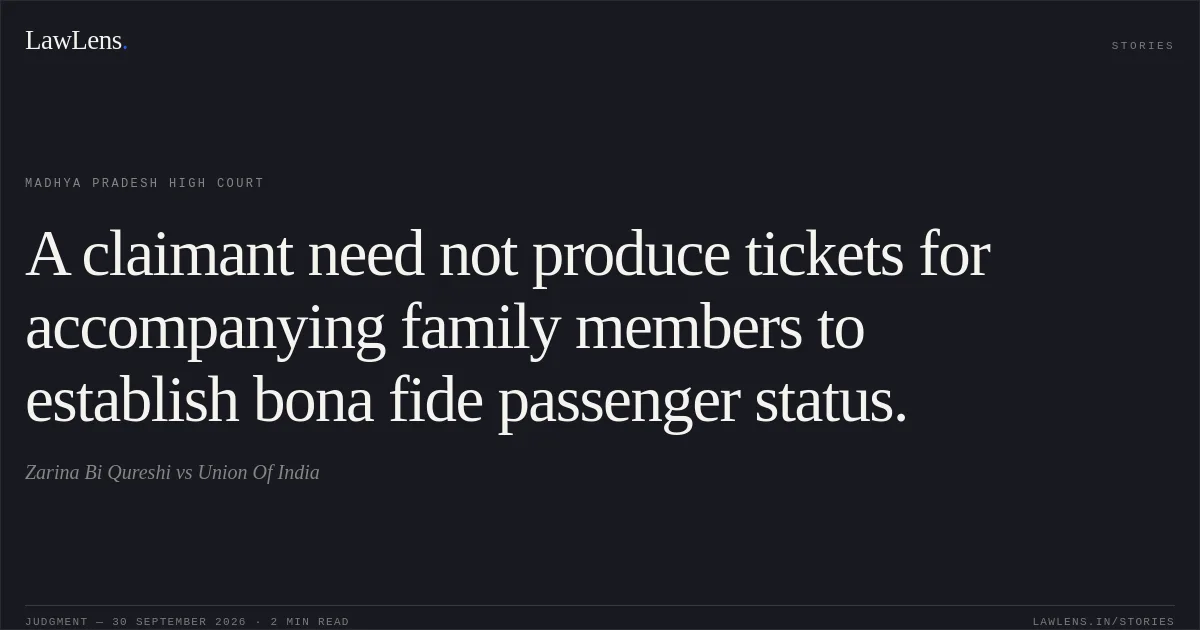
Source reference: para. 2Applying Sudhir Batham (Kasyap) and others v. Union of India, M.A. No. 1202/2017 (decided 30 January 2023), the Court stated that a passenger travelling with family need not produce tickets for every family member, particularly where there is no allegation that a ticket checker found the passenger travelling without a valid ticket.
Source reference: para. 6The Apex Court principles quoted in the judgment treat Section 124-A proceedings as welfare proceedings governed by the preponderance of probabilities, and hold that verified issuance of a ticket matching the date and route is prima facie evidence of bona fide travel; the absence of a seizure memo or preserved physical evidence does not, by itself, defeat a claim.
Source reference: para. 7The Court awarded compensation of Rs. 8,00,000 under the Ministry of Railways notification dated 22 December 2016.
Source reference: para. 8Reasoning
The Court found no evidence that a ticket checker had challenged her ticket or treated her as travelling without one.
Source reference: para. 3–8In those circumstances, the absence of recovered tickets, the production of only two tickets for the family, and the non-examination of the appellant’s husband did not justify rejecting her bona fide passenger status.
Source reference: para. 3–8Given that the fall and the resulting amputations were established, the Tribunal’s approach was unduly technical.
Source reference: para. 3–8Holding
The Court allowed the appeal, set aside the Tribunal’s order, and held the appellant entitled to Rs. 8,00,000 in compensation.
The amount was directed to be paid within three months; failing payment within that period, it would carry interest at 9% per annum.
Source reference: para. 8–9Acts & Sections Cited
2 provisions across 2 statutes referred to in this judgment. Each provision opens on LawLens.
Railway Claims Tribunal Act, 19871
Railways Act, 19891
Original Court PDF
Zarina Bi QureshivsUnion Of India
Click to open original judgment
Original judgment, available to read, download and summarize on LawLens.in