Facts
Komalchand Sahu was found dead on a railway track on 3 July 2017; the post-mortem described the death as unnatural, and the investigation concluded that he had died by suicide.
Source reference: para. 1–4The prosecution alleged that the respondent, the deceased’s brother-in-law, persistently pressured him to shift residence and, with his sister, harassed him over matrimonial disputes.
Source reference: para. 1–4A suicide note attributed the deceased’s death to Ravi.
Source reference: para. 1–4After the case was committed to the Court of Sessions, the respondent sought discharge under Section 227 CrPC. The Sessions Judge allowed the application and discharged him of the Section 306 IPC offence; the State challenged that order in revision.
Source reference: para. 1–4The judgment refers inconsistently to the Sessions Court order as dated 9 February 2021 and 9 September 2021.
Source reference: para. 1, 4, 28–29Issues
Whether the prosecution material, taken at face value, disclosed the ingredients of abetment of suicide under Sections 306 and 107 IPC sufficient to proceed against the respondent.
Source reference: para. 18–27Whether the Sessions Judge erred in discharging the respondent under Section 227 CrPC, warranting interference in revision.
Source reference: para. 25–29Law Applied
Section 306 IPC punishes abetment of suicide and must be read with Section 107 IPC, under which abetment requires instigation, conspiracy accompanied by an act or illegal omission, or intentional aid.
Source reference: no citationThe court applied the principles that instigation means goading, urging, provoking, inciting, or encouraging, and may be inferred from conduct that leaves the deceased with no other option; the prosecution must nevertheless show the requisite mens rea and an act of instigation or aid with a proximate connection to the suicide (Ude Singh v. State of Haryana, (2019) 17 SCC 301).
Source reference: para. 10–11Mere harassment, without a positive and proximate act, is insufficient (Pawan Kumar v. State of H.P., (2017) 7 SCC 780).
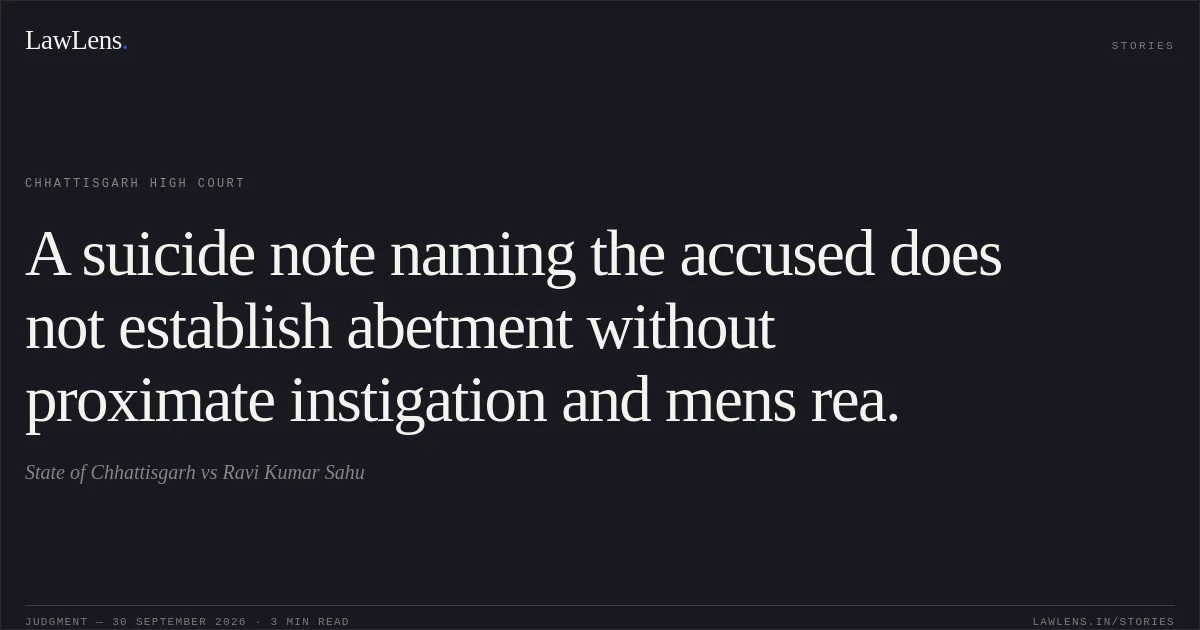
Source reference: para. 13Continuous harassment or a suicide note naming an accused does not, by itself, establish abetment absent material showing the required intentional and proximate conduct (Abhinav Mohan Delkar v. State of Maharashtra, (2026) 6 SCC 233; Vinod Shivakumar v. State of Maharashtra, 2026 SCC OnLine SC 1583).
Source reference: para. 14–17At the discharge stage, if the material taken at face value does not disclose the essential ingredients of the offence, the accused should not be required to face trial.
Source reference: para. 25Reasoning
The statements of the deceased’s relatives and the village Sarpanch described pressure to live separately and move to Tedesara, as well as an allegation that household articles had been thrown out. But the statements did not identify when the latter incident occurred, and the material did not establish a specific act by the respondent immediately before the suicide or a proximate causal connection.
Source reference: para. 18–20Even assuming the alleged threat of a dowry case, the record did not show a proximate act or an intention to drive the deceased to suicide.
Source reference: para. 21The suicide note naming Ravi was relevant but could not substitute for proof of conduct satisfying Section 107 IPC; considered with the surrounding circumstances, it did not establish the necessary mens rea or intentional instigation or aid.
Source reference: para. 22–24The allegations therefore disclosed family and matrimonial discord, but not the statutory ingredients of abetment.
Source reference: para. 26–27Holding
The High Court held that the prosecution material did not disclose sufficient grounds to proceed against the respondent for abetment of suicide under Section 306 IPC.
It found no error in the discharge order, dismissed the State’s revision, and affirmed the discharge.
Source reference: para. 27–30Acts & Sections Cited
6 provisions across 2 statutes referred to in this judgment. Each provision opens on LawLens.
Code of Criminal Procedure, 19734
Indian Penal Code, 18602
Original Court PDF
State of ChhattisgarhvsRavi Kumar Sahu
Click to open original judgment
Original judgment, available to read, download and summarize on LawLens.in