Facts
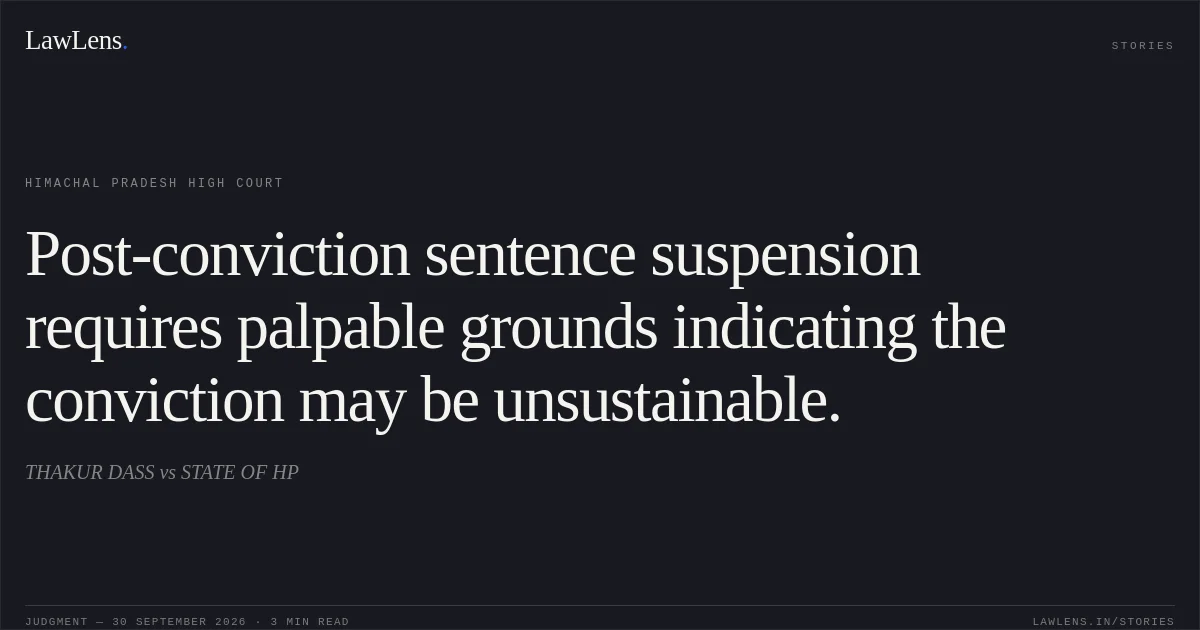
The appellant was convicted by the Special Judge, Kullu, of offences under Sections 6 and 8 of the Protection of Children from Sexual Offences Act, 2012 (POCSO Act), and Section 506 IPC, and sentenced to concurrent terms including 20 years’ rigorous imprisonment under Section 6 of the POCSO Act.
Source reference: para. 1–2The prosecution alleged that he repeatedly sexually abused his seven-year-old niece during 2019–2020.
Source reference: para. 3After the FIR was registered, the parties entered into a compromise on 3 October 2020, and the child initially denied sexual harassment in a statement before a Magistrate. The matter was later pursued, and the child and her parents supported the prosecution at trial; the child’s statement under Section 164 CrPC was recorded on 28 October 2022.
Source reference: para. 18–19After conviction, the appellant sought suspension of sentence pending appeal, relying principally on the compromise and alleged evidentiary infirmities.
Source reference: para. 4–5Issues
1. Whether the appellant’s sentence should be suspended under Section 430 BNSS pending appeal, having regard to the applicable post-conviction principles.
Source reference: para. 7–152. Whether the compromise and the asserted infirmities in the evidence disclosed an apparent or palpable basis to conclude that the conviction might not be sustainable and that the appellant had a fair chance of acquittal.
Source reference: para. 13–15, 18–20Law Applied
Section 430 of the BNSS governs suspension of sentence pending appeal; at the post-conviction stage, the court must assess the request in light of the conviction and the circumstances of the case.
Source reference: para. 7–8Ash Mohammad v. Shiv Raj Singh alias Lalla Babu, (2012) 9 SCC 446, requires consideration of the totality of circumstances and societal concerns, alongside the individual’s liberty.
Source reference: para. 9Bhagwan Rama Shinde Gosai v. State of Gujarat, (1999) 4 SCC 421, recognises that suspension may be considered liberally for a fixed-term sentence, subject to exceptional circumstances and any statutory restriction, and emphasises making the appeal meaningful where it cannot be heard promptly.
Source reference: para. 10The Court also referred to Atul Tripathi v. State of Uttar Pradesh, (2014) 9 SCC 177, and Kishori Lal v. Rupa, (2004) 7 SCC 638, concerning the distinct considerations applicable to post-conviction bail and suspension applications.
Source reference: para. 11–12In applying these principles, the Court stated that it should look for an apparent or gross infirmity indicating that the conviction may be unsustainable, without reappreciating the evidence or searching for isolated gaps at the suspension stage.
Source reference: para. 13–15Reasoning
The Court considered whether the compromise and alleged evidentiary weaknesses presented a palpable ground to doubt the conviction, rather than undertaking a fresh assessment of the trial evidence.
Source reference: para. 13–15It found that the compromise was made after the FIR and that the child’s initial denial did not, on the material before the Court, displace her trial testimony and later Section 164 CrPC statement, which supported the prosecution account; her parents also supported the prosecution.
Source reference: para. 18–19The Court further noted that the asserted land dispute was not reflected in the compromise and that the trial court had addressed the appellant’s contentions.
Source reference: para. 18, 20It therefore found no apparent basis at this stage to conclude that the conviction was likely to be set aside.
Source reference: para. 21Holding
The Court answered the suspension question in the negative, holding that the case did not disclose an ex facie likelihood of acquittal at the final hearing.
It dismissed the application for suspension of sentence as devoid of merit and clarified that its observations were confined to disposal of the application and would not affect the appeal’s merits.
Source reference: para. 21–22Acts & Sections Cited
10 provisions across 4 statutes referred to in this judgment. Each provision opens on LawLens.
Bharatiya Nagarik Suraksha Sanhita, 20231
Protection of Children from Sexual Offences Act, 20124
Indian Penal Code, 18602
Code of Criminal Procedure, 19733
Original Court PDF
THAKUR DASSvsSTATE OF HP
Click to open original judgment
Original judgment, available to read, download and summarize on LawLens.in