Facts
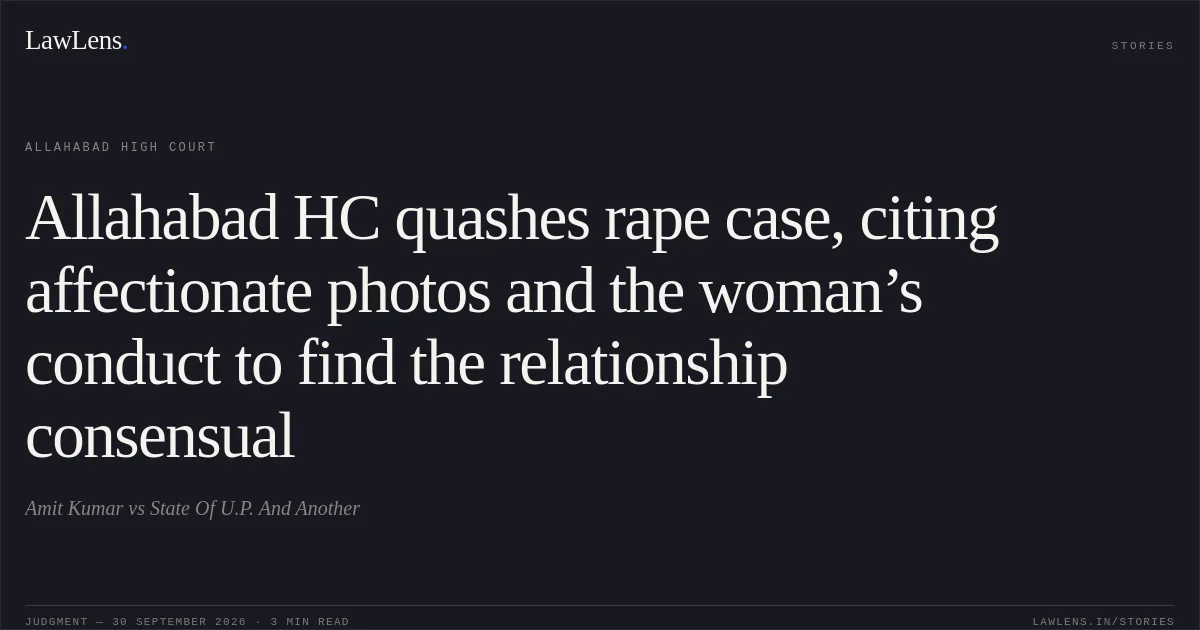
The complainant alleged that the applicant, a police inspector, concealed his existing marriage, induced her to travel to Varanasi on a promise of marriage, drugged and sexually assaulted her, secretly recorded obscene images, and later used them to coerce further sexual relations.
Source reference: para. 3–4, 9–14, 39, 43She also alleged forced termination of her pregnancy, threats and blackmail.
Source reference: para. 3–4, 9–14, 39, 43The applicant denied the allegations and contended that the relationship was consensual, relying on photographs and WhatsApp chats which, he argued, showed that the complainant knew of his marriage and was willing to wait for his divorce.
Source reference: para. 3–4, 9–14, 39, 43After investigation, a charge-sheet was filed under Sections 376, 323, 504 and 506 IPC and Section 67A of the Information Technology Act; cognizance was taken and the applicant was summoned.
Source reference: para. 2, 5He sought quashing of the charge-sheet and criminal proceedings.
Source reference: para. 2Issues
Whether the allegations and material on record disclosed rape on the basis of a false promise of marriage, or instead indicated a consensual relationship
Source reference: para. 19–20Whether the charge-sheet and resulting criminal proceedings should be quashed as an abuse of the process of court
Source reference: para. 45–47Law Applied
The Court applied Sections 375 and 90 IPC, reasoning that consent may be vitiated by a misconception of fact where a promise to marry was false from the outset, made in bad faith to induce sexual relations, and had a direct bearing on the complainant’s decision to consent.
Source reference: para. 21–25, 30It relied on Pramod Suryabhan Pawar v. State of Maharashtra, AIR 2019 SC 4010, and Deepak Gulati v. State of Haryana, AIR 2013 SC 2071, for the distinction between a dishonest, false promise and a subsequent failure to fulfil a genuine promise; the dishonest intention must exist at inception.
Source reference: para. 24, 28–31It also relied on Abbas Ahmed Choudhury v. State of Assam, (2010) 12 SCC 115, for the principle that a sexual-assault case must be proved beyond reasonable doubt and that a complainant’s statement is not automatically to be treated as conclusively true.
Source reference: para. 27and cited Mahesh Damu Khare, Nitin B. Nikhare and Pradeep Kumar Kesharwani on consent and false promises to marry.
Source reference: para. 33–38The Court invoked its inherent jurisdiction to prevent abuse of the process of court.
Source reference: para. 46Reasoning
The Court considered the complainant’s statements alongside the WhatsApp chats and photographs on record.
Source reference: para. 39–43, 45It found that she knew the applicant was married and had stated in chats that she would wait until his divorce before marrying him; it also noted the continued contact between them, their visits and photographs, and the absence of obscene images or videos collected during the investigation.
Source reference: para. 39–43, 45On that basis, the Court concluded that the material did not establish that the applicant had made a promise to marry dishonestly from the outset or that the complainant’s consent to the relationship was obtained because of such a promise.
Source reference: para. 40–45It treated the relationship as consensual and found no basis to continue the prosecution.
Source reference: para. 40–45Holding
The Court held that the material did not make out the alleged offences and that continuation of the proceedings would amount to an abuse of the process of court.
It quashed the charge-sheet dated 18 July 2020 and the entire proceedings in Criminal Case No. 11358 of 2020, arising from Case Crime No. 02 of 2020, and allowed the application.
Source reference: para. 47–48Acts & Sections Cited
13 provisions across 3 statutes referred to in this judgment. Each provision opens on LawLens.
Code of Criminal Procedure, 19734
Bharatiya Nagarik Suraksha Sanhita, 20231
Indian Penal Code, 18608
Original Court PDF
Amit KumarvsState Of U.P. And Another
Click to open original judgment
Original judgment, available to read, download and summarize on LawLens.in