Facts
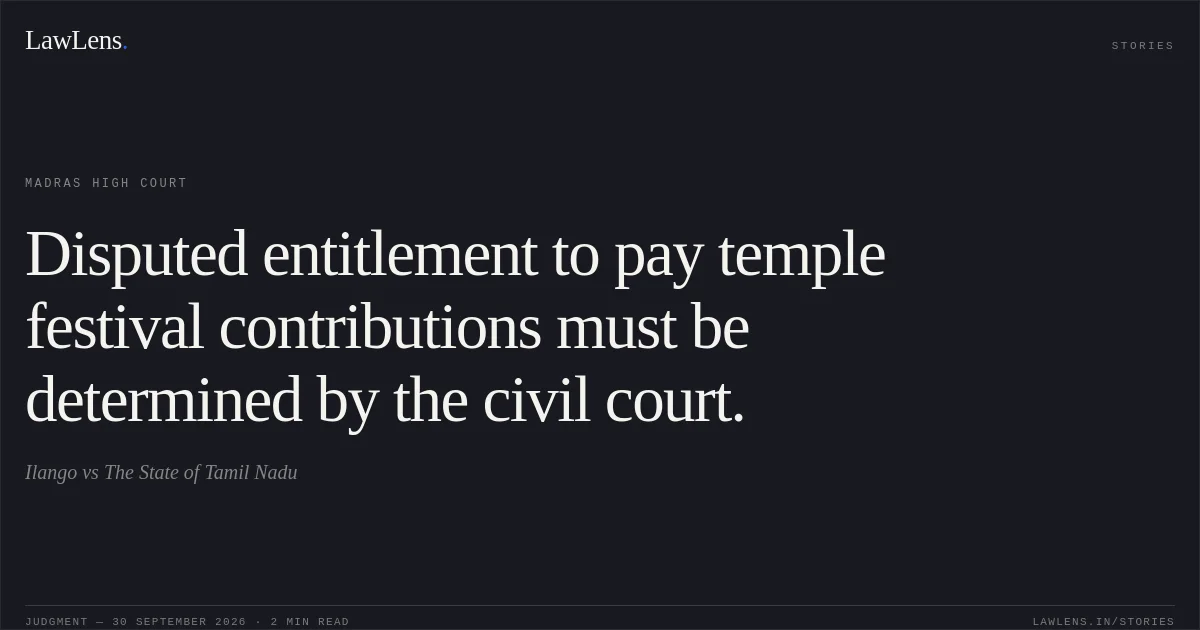
The petitioner, a member of the Muniyan Vakaiyara, sought permission and police protection to conduct the Puratasi Palkudam festival at Arulmigu Sree Nanthi Perumal Swamy Temple from 17 to 27 September 2026.
Source reference: para. 2–10He claimed the temple belonged to his lineage and alleged that the private respondents had obstructed the festival; they asserted that the temple was shared by several lineages, including their Nalla Pichan Vakaiyara, and that they were entitled to participate and pay Thalaikattu vari.
Source reference: para. 2–10In an earlier writ petition concerning the 2025 festival, the Court had directed the parties claiming rights to approach the civil court to establish them.
Source reference: para. 15–16The present petition was filed on 21 September 2026; respondents 4 and 8 were shown by birth certificates to be minors.
Source reference: para. 18Issues
Whether the private respondents, who were described as having a Maman–Machan relationship with the petitioner’s Vakaiyara rather than being Pangalees, could claim the right to pay Thalaikattu vari for the temple festival.
Source reference: para. 12–14, 17Whether the petitioner was entitled to permission and police protection to conduct the festival, and what directions were appropriate given that the scheduled dates had passed.
Source reference: para. 21–22Whether the petition could be entertained against respondents 4 and 8, who were minors and had been impleaded without guardians.
Source reference: para. 18Law Applied
The petition was brought under Article 226 of the Constitution, and the petitioner invoked Articles 25 to 28 in support of his asserted religious rights.
Source reference: para. 1, 5The Court treated the parties’ competing claims concerning customary entitlement to pay Thalaikattu vari and temple administration as disputed questions of fact and rights to be established before the civil court, consistent with the direction in the earlier writ proceedings.
Source reference: para. 16–17, 19It also held that the petition could not be entertained against the minor respondents in the absence of their guardians.
Source reference: para. 18Reasoning
The Court noted that the private respondents’ participation in worship and festivals was not disputed, but their claimed entitlement to pay Thalaikattu vari remained contested.
Source reference: para. 13, 19It declined to decide that customary entitlement in writ proceedings and left the respondents to pursue a civil remedy.
Source reference: para. 17, 19The scheduled festival dates had passed, so the Court directed the petitioner to submit a fresh request if the festival had not taken place and was rescheduled; it also required that the private respondents be allowed to worship and participate without hindrance.
Source reference: para. 21–22As respondents 4 and 8 were minors and no guardians had been impleaded, the petition was dismissed as against them.
Source reference: para. 18Holding
The writ petition was disposed of with directions.
If the festival had not been held, the petitioner could submit a fresh representation stating the rescheduled date, and the police were directed to grant permission and police protection free of cost.
Source reference: para. 22(i)–(ii)Respondents 3 to 8 were permitted to worship and participate without hindrance; their claim to pay Thalaikattu vari was left to the civil court, though any amount offered in the meantime could be accepted as a donation against a receipt.
Source reference: para. 22(iii)–(v)The police were directed to take appropriate legal action against anyone causing a disturbance, and the petition was dismissed as against minor respondents 4 and 8.
Source reference: para. 22(vi)–(vii)Original Court PDF
IlangovsThe State of Tamil Nadu
Click to open original judgment
Original judgment, available to read, download and summarize on LawLens.in