Facts
The appellant, mother of the deceased Razaulla alias Altmas Mohd. Haider Shaikh, filed a claim under Section 23 of the Railway Claims Tribunal Act, 1987, alleging that the deceased was travelling from Ajmer to Bandra Terminus in Train No. 19708 on 30 August 2021 with a valid second-class ticket.
Source reference: pp. 1–2Owing to overcrowding during the COVID-19 period, he was standing near the entrance of the general compartment when, due to a sudden jerk and the push of passengers, he fell from the running train near Karjoda station and died from the injuries sustained in the fall.
Source reference: pp. 1–2The Railway Administration denied that he was a bona fide passenger, relying on a discrepancy in the train number, statements allegedly indicating that he fell due to dizziness, and the assertion that he was travelling without a ticket.
Source reference: pp. 2–4The Railway Claims Tribunal dismissed the claim, holding that the deceased was travelling without a valid ticket and that the claimant had taken inconsistent positions.
Source reference: p. 3The appellant consequently preferred the present appeal.
Source reference: p. 5The High Court noted that the claimant had filed an affidavit asserting bona fide travel, while the Railway Administration led no oral evidence to prove its defence; the post-mortem report recorded death due to head injuries caused by a fall from a running train.
Source reference: pp. 22–24Issues
Whether the deceased was a bona fide passenger travelling with a valid railway ticket, notwithstanding the non-recovery of the ticket and the discrepancy regarding the train number?
Source reference: pp. 5–6, 22–24Whether the deceased’s death resulted from an accidental fall from a passenger train, constituting an “untoward incident” under Sections 123(c)(2) and 124-A of the Railways Act, 1989?
Source reference: pp. 5, 14, 23–24Whether the Railway Administration established that the death was excluded from compensation as a suicide, attempted suicide, self-inflicted injury, or the deceased’s own criminal act under the proviso to Section 124-A?
Source reference: pp. 15–19, 23–24Whether the claimant was entitled to statutory compensation and interest?
Source reference: pp. 5, 24–25Law Applied
The Court applied Sections 123(c)(2) and 124-A of the Railways Act, 1989, under which the accidental falling of a passenger from a train is an “untoward incident” attracting the Railway Administration’s strict/no-fault liability, subject to the statutory exceptions.
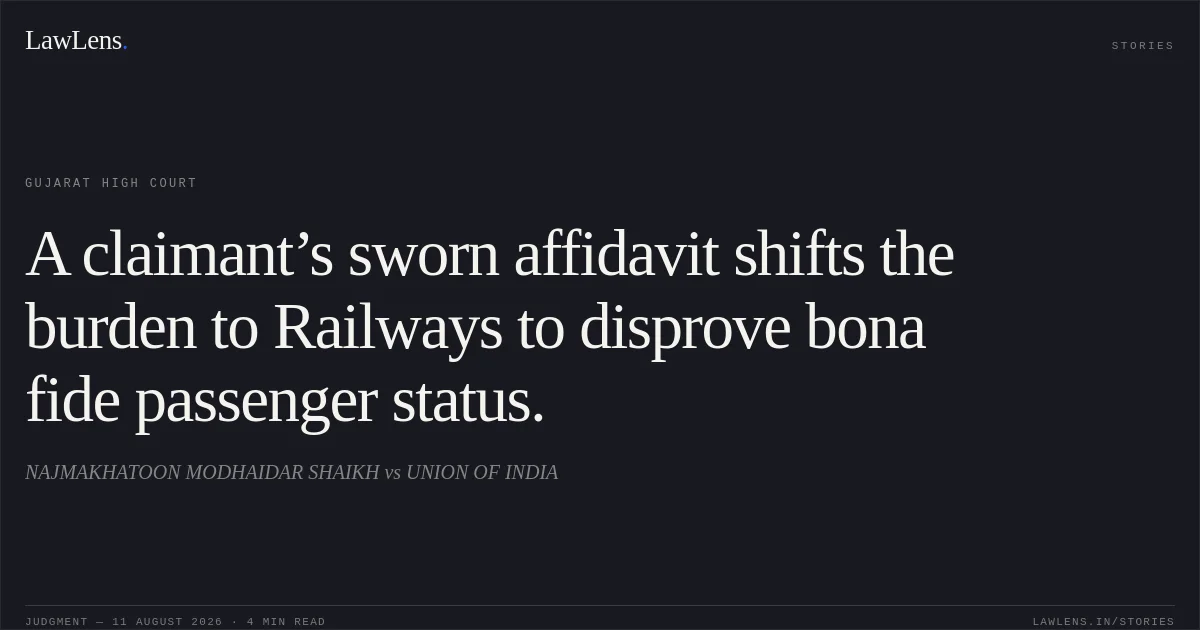
Source reference: pp. 6, 18–22Relying principally on Union of India v. Rina Devi, the Court held that the claimant bears an initial, light burden of showing bona fide travel, which may be discharged by a sworn affidavit; the burden then shifts to the Railways, and mere non-recovery or absence of a ticket does not by itself defeat the claim.
Source reference: pp. 6, 18–22Dolly Rani Saha v. Union of India and Rajni v. Union of India were relied upon for the proposition that claims under Section 124-A are determined on a preponderance of probabilities and should not be rejected on hyper-technical grounds.
Source reference: pp. 6–10Under Union of India v. Prabhakaran Vijaya Kumar, the Railway Act is beneficial legislation requiring a liberal interpretation.
Source reference: p. 10Jameela v. Union of India and Rina Devi establish that mere negligence, including standing near an open train door, does not amount to “self-inflicted injury” or a criminal act absent an intention to cause injury; intentional self-injury is required to attract the statutory exclusion.
Source reference: pp. 13, 17–19The Court also relied on Shrikumar Gupta v. Union of India to hold that a railway authority must prove an allegation that the deceased deliberately jumped or alighted from a running train.
Source reference: pp. 15–16Reasoning
The claimant’s sworn affidavit asserting that the deceased had travelled with a valid ticket discharged the initial burden under the principles in Rina Devi and Dolly Rani Saha.
Source reference: pp. 22–24The Railway Administration did not lead oral evidence or examine the co-passenger, investigating officer, or any witness to prove that the deceased was ticketless, had fallen due to dizziness, or had deliberately caused his injuries.
Source reference: pp. 22–24The discrepancy between Train Nos. 19708 and 09709 was insufficient, by itself, to disprove that the deceased had been travelling by train and had fallen during the journey.
Source reference: p. 23The post-mortem report recorded multiple fresh head injuries and attributed the death to head injury caused by a fall from a running train, supporting the claimant’s version and ruling out the Tribunal’s theory of a self-inflicted injury.
Source reference: p. 23The unproved police statement of the co-passenger could not be preferred over the evidence recorded before the Tribunal, particularly when the maker of the statement and the investigating officer were not examined.
Source reference: p. 24Even assuming that the deceased stood near the entrance of the crowded compartment, such conduct could at most constitute negligence; it did not establish suicide, attempted suicide, intentional self-injury, intoxication, insanity, or a criminal act within the proviso to Section 124-A.
Source reference: pp. 13, 17–19Applying the beneficial and no-fault character of the statutory scheme, the Court held that the Tribunal had adopted an impermissibly technical and negative approach.
Source reference: p. 24Holding
The High Court allowed the appeal and quashed and set aside the Railway Claims Tribunal’s judgment dated 13 June 2024.
It held that the deceased was a bona fide passenger and that his death resulted from an untoward incident falling within Sections 123(c)(2) and 124-A of the Railways Act, 1989.
Source reference: para. 19; p. 25The Railway Administration was directed to pay ₹8,00,000 with interest at 9% per annum from the date of the incident until realization, and to deposit the decretal amount before the Railway Claims Tribunal, Ahmedabad within eight weeks.
Source reference: para. 19; p. 25The Tribunal was directed to disburse the amount to the claimants after due verification.
Source reference: para. 19; p. 25Acts & Sections Cited
5 provisions across 3 statutes referred to in this judgment. Each provision opens on LawLens.
Railway Claims Tribunal Act, 19871
Railways Act, 19893
Motor Vehicles Act, 19881
Original Court PDF
NAJMAKHATOON MODHAIDAR SHAIKHvsUNION OF INDIA
Click to open original judgment
Original judgment, available to read, download and summarize on LawLens.in