Facts
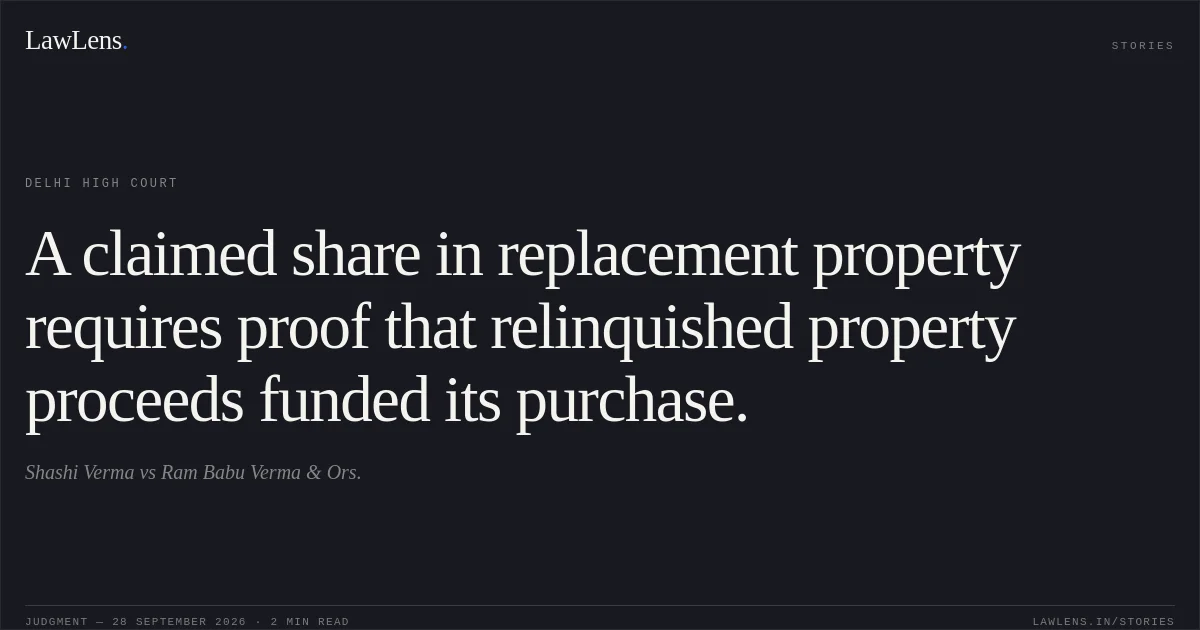
The appellant/plaintiff claimed that, after she and certain family members relinquished their shares in the Brahampuri property, ₹23,00,000 received in connection with those shares was retained for the joint purchase of the suit property.
Source reference: pp. 3–5, paras. 7–16She sought a declaration, partition, possession and injunction, or alternatively recovery of ₹7,66,666.
Source reference: pp. 3–5, paras. 7–16The defendants maintained that the amount had been divided equally and that the plaintiff had received approximately ₹7,66,700; they denied any agreement to purchase the suit property jointly.
Source reference: pp. 5–7, paras. 17–22The Trial Court dismissed the suit, finding that the plaintiff had not proved either non-receipt of her share or use of the proceeds to acquire the suit property.
Source reference: p. 9, paras. 32–35She appealed under Section 96 CPC.
Source reference: p. 2, para. 3Issues
1. Whether the Trial Court erred in placing the burden on the plaintiff to establish that she had not received her alleged share of the ₹23,00,000, despite the defendants’ assertion that they had paid her ₹7,66,700.
Source reference: pp. 10–11, paras. 37–402. Whether the plaintiff proved that proceeds connected with the Brahampuri property were retained or used to purchase the suit property, thereby entitling her to the reliefs claimed.
Source reference: pp. 10–12, paras. 41, 47–51Law Applied
The appeal was brought under Section 96 of the Code of Civil Procedure, 1908, which provides for an appeal from an original decree.
Source reference: p. 2, para. 3The Court applied the burden of proof reflected in the framed issues, which placed the onus on the plaintiff to prove that the suit property was purchased from the jointly received sale proceeds and, consequently, her entitlement to partition, possession, declaration and injunction.
Source reference: p. 8, para. 28The Court also treated the signed, unchallenged Relinquishment Deed as relevant evidence and held that the plaintiff had to establish her claim that she neither received her share nor had the relevant proceeds applied to the suit property.
Source reference: pp. 11–12, paras. 43–50No other statute or precedent was identified as a basis for the decision.
Source reference: no citationReasoning
The Court found that the plaintiff’s signature on the Relinquishment Deed was admitted and that she had not challenged the deed.
Source reference: pp. 11–12, paras. 44–46It also noted that the defendants’ evidence was that she had received her share, while the plaintiff did not call persons present when the deed was executed or the cash was counted to corroborate her denial.
Source reference: pp. 11–12, paras. 44–46Further, she produced no cogent evidence that the ₹23,00,000, or any part of it, was retained by the defendants or used to purchase the suit property.
Source reference: p. 12, paras. 47–50The Court therefore found no basis to disturb the Trial Court’s conclusion that the plaintiff had failed to prove the essential factual foundation for her claims.
Source reference: no citationHolding
The Court held that the plaintiff had not established either that she remained unpaid for her relinquished share or that the suit property was purchased using funds in which she had an interest.
It dismissed the appeal and upheld dismissal of the suit for declaration, partition, possession, injunction and alternative recovery.
Source reference: pp. 12–13, paras. 49–52Separately, in the court-fee application, the appellant was granted eight weeks to pay the deficit court fee, failing which it could be recovered as arrears of land revenue.
Source reference: p. 2, paras. 1–2Acts & Sections Cited
1 provisions across 1 statute referred to in this judgment. Each provision opens on LawLens.
Code of Civil Procedure, 19081
Original Court PDF
Shashi VermavsRam Babu Verma & Ors.
Click to open original judgment
Original judgment, available to read, download and summarize on LawLens.in