Facts
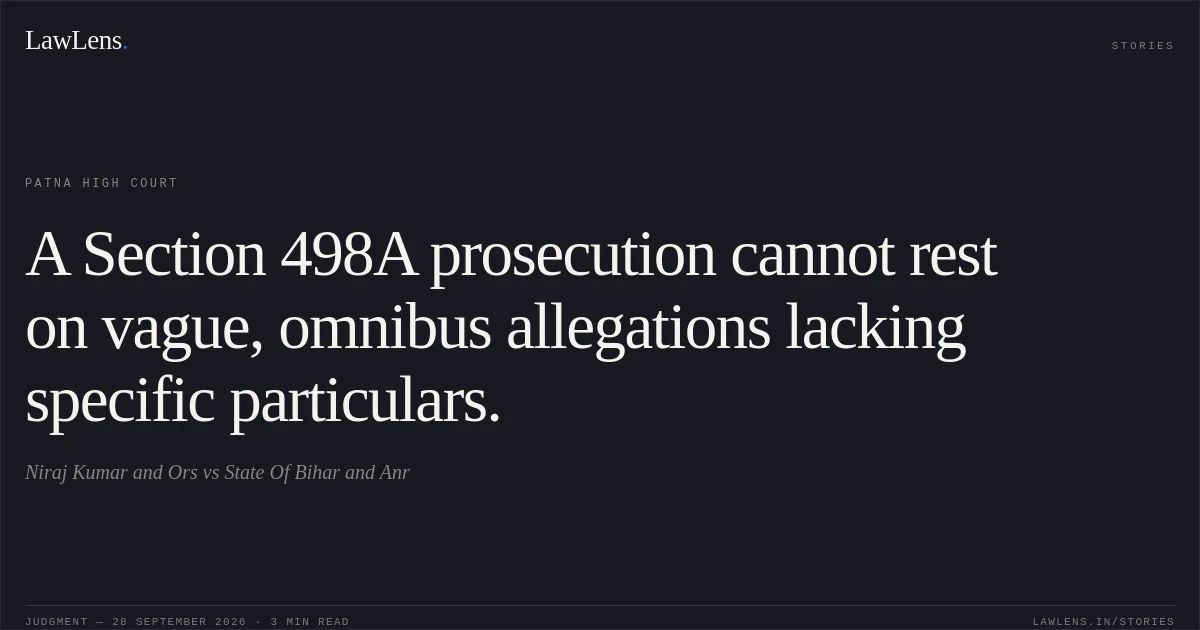
The complainant alleged that, after her 2007 marriage to petitioner No. 1, she and her family faced dowry demands and that she was subjected to physical and mental cruelty, including pressure concerning her pregnancy, studies, jewellery and payment of a vehicle loan.
Source reference: pp. 2–8She also alleged that on 2 April 2016 the petitioners demanded Rs. 5,00,000 for house construction.
Source reference: pp. 2–8Following an inquiry, the Magistrate issued process against the petitioners for offences under Sections 498-A, 323, 504 and 34 IPC.
Source reference: pp. 2–8The petitioners sought quashing under Section 482 CrPC, contending that the allegations were vague and retaliatory, and that the husband had filed for divorce shortly before the complaint.
Source reference: pp. 2–8The complainant and State opposed quashing, arguing that the allegations disclosed a prima facie case and that their truth should be tested at trial.
Source reference: pp. 9–13Issues
1. Whether the complaint and inquiry materials, taken at face value, disclosed the ingredients of the alleged offences so as to justify continuation of the criminal proceedings
Source reference: pp. 23–25, 46–522. Whether the proceedings should be quashed under Section 482 CrPC as an abuse of process, given the alleged omnibus nature of the accusations and the circumstances in which the complaint was filed
Source reference: pp. 33–40, 48–54Law Applied
Section 498-A IPC criminalises cruelty by a husband or his relative; “cruelty” includes wilful conduct likely to drive a woman to suicide or cause grave injury or danger to her health, and harassment intended to coerce her or her relatives to meet an unlawful demand for property or valuable security.
Source reference: p. 14The Court relied on the principle that the High Court’s inherent jurisdiction under Section 482 CrPC may be exercised, cautiously and on the facts of each case, to prevent abuse of process or secure the ends of justice.
Source reference: pp. 29–31Applying State of Haryana v. Bhajan Lal, it noted that quashing may be warranted where allegations, even accepted in full, do not prima facie constitute an offence, or where proceedings are manifestly mala fide and brought to wreak vengeance.
Source reference: pp. 31–32It also relied on Supreme Court decisions cautioning against prosecution based on general or omnibus matrimonial allegations, particularly against relatives, without specific allegations of their involvement.
Source reference: pp. 23–28Reasoning
The Court considered the complaint alongside the complainant’s solemn affirmation and the materials on record.
Source reference: pp. 17–19It found that the allegations against the husband concerning assault, abuse and cruelty were general and lacked specific particulars of time, place or incident; the alleged forced abortion was likewise unsupported by particulars or supporting material.
Source reference: pp. 17–19The Court further noted that the complainant’s affirmation placed the parties’ last cohabitation in September 2013, with no stated interaction thereafter, while the complaint alleged a later demand and was filed shortly after the husband instituted divorce proceedings.
Source reference: pp. 19–23As to the parents-in-law, the Court found no specific overt act connecting them to the alleged cruelty and considered their inclusion to rest on omnibus allegations.
Source reference: pp. 21–23On these facts, it concluded that the complaint did not disclose a prima facie case and that the proceedings appeared retaliatory and an abuse of process.
Source reference: pp. 23–32Holding
The Court held that the alleged offences were not made out on the materials before it and that continuation of the prosecution was neither expedient nor in the interests of justice.
It quashed and set aside the Magistrate’s order dated 23 July 2016 issuing process, and quashed all criminal proceedings arising from Complaint Case No. 380(C) of 2016 against the petitioners.
Source reference: pp. 31–33The application was allowed.
Source reference: pp. 31–33Acts & Sections Cited
5 provisions across 3 statutes referred to in this judgment. Each provision opens on LawLens.
Indian Penal Code, 18603
Code of Criminal Procedure, 19731
Hindu Marriage Act, 19551
Original Court PDF
Niraj Kumar and OrsvsState Of Bihar and Anr
Click to open original judgment
Original judgment, available to read, download and summarize on LawLens.in