Facts
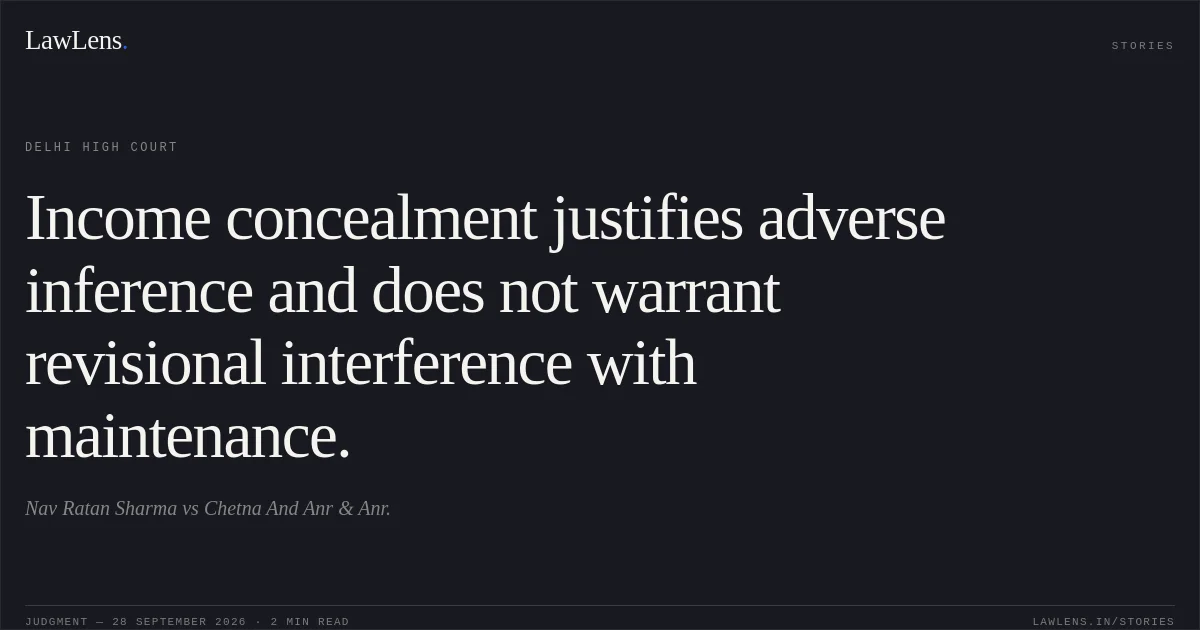
The Family Court, in proceedings under Section 125 of the Code of Criminal Procedure, 1973, assessed the petitioner-husband’s monthly income at ₹30,000 and ordered him to pay maintenance of ₹7,500 each per month to his wife and minor child
Source reference: pp.2–3, paras. 5–7The husband challenged the income assessment, seeking that his income be treated as ₹25,000 per month
Source reference: p.1, para. 2The Family Court had noted that he gave inconsistent accounts of his employment, concealed an SBI bank account, and did not produce evidence substantiating his claimed current salary
Source reference: pp.2–3, para. 7In revision, his counsel accepted that he had not filed an updated affidavit of income and liabilities
Source reference: p.4, para. 8Issues
1. Whether the Family Court’s assessment of the petitioner’s monthly income at ₹30,000, rather than his admitted income of ₹25,000, disclosed an error warranting interference in revision
Source reference: pp.4–7, paras. 8–142. Whether the difference in maintenance resulting from those competing income assessments constituted a material irregularity warranting revisional interference
Source reference: p.7, para. 14Law Applied
Section 397 CrPC confers limited revisional jurisdiction to correct, among other things, patent legal or jurisdictional errors, findings based on no evidence, or arbitrary or perverse exercises of discretion; it does not ordinarily permit reappreciation of evidence or reassessment of factual findings (*Amit Kapoor v. Ramesh Chander*, as quoted at pp.4–5, para. 9; *State of Gujarat v. Dilipsinh Kishorsinh Rao*, p.5, para. 9).
Source reference: pp.4–5, para. 9Revisional jurisdiction is discretionary and not claimable as of right (*Girish Kumar Suneja v. CBI*).
Source reference: p.6, para. 10In maintenance proceedings, the principles concerning disclosure of income and assets in *Rajnesh v. Neha* support drawing an adverse inference where a party fails to make complete financial disclosure.
Source reference: p.7, para. 13Reasoning
The High Court found that the husband had taken inconsistent positions about his employment, first claiming that he had been terminated and remained unemployed, but later admitting that he had worked for Onkar International and then joined Rama Vision
Source reference: pp.6–7, paras. 11–12His concealed SBI account, failure to file an updated affidavit, and failure to produce current salary slips justified the Family Court’s adverse inference and its assessment of income at ₹30,000
Source reference: p.7, para. 13It also observed that, even on the husband’s claimed income of ₹25,000, the difference in the total monthly maintenance would be only ₹2,500, which, in the circumstances, did not amount to a material irregularity
Source reference: p.7, para. 14Holding
The High Court held that no ground for interference in revisional jurisdiction had been established
The High Court dismissed the revision petition and pending applications. The Family Court’s order requiring payment of ₹7,500 per month to each respondent remained undisturbed.
Source reference: p.7, paras. 9, 13–15; pp.2–3, para. 7Acts & Sections Cited
3 provisions across 1 statute referred to in this judgment. Each provision opens on LawLens.
Code of Criminal Procedure, 19733
Original Court PDF
Nav Ratan SharmavsChetna And Anr & Anr.
Click to open original judgment
Original judgment, available to read, download and summarize on LawLens.in