Facts
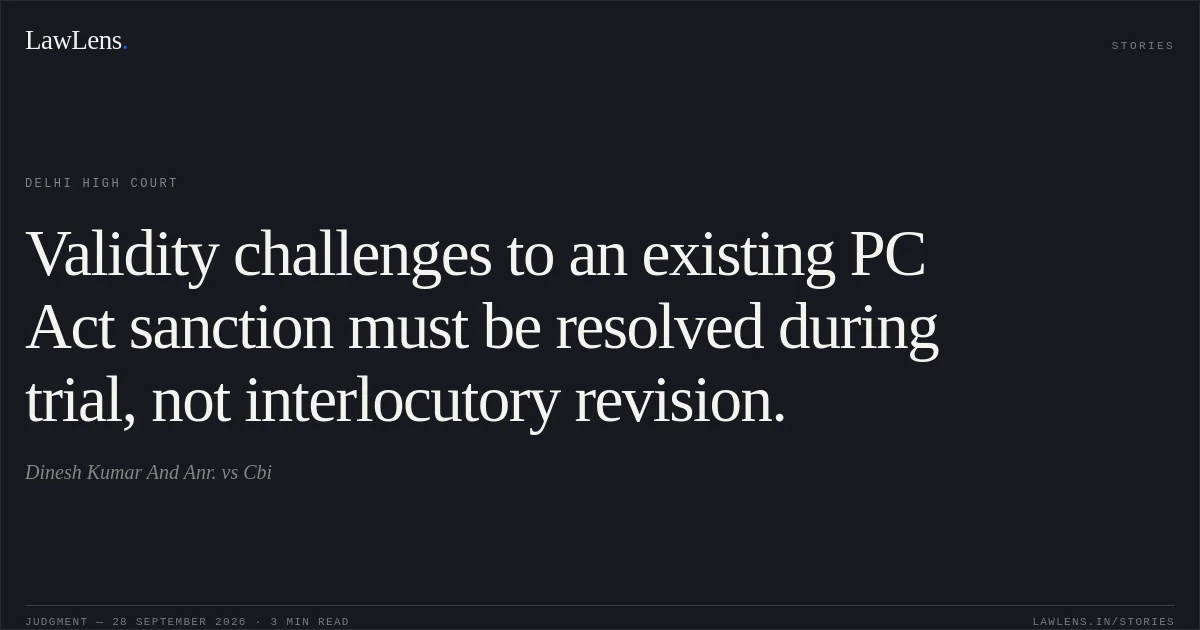
The petitioners challenged the Special Judge’s common order dated 19 May 2026 dismissing their applications to discharge them or drop the proceedings on the ground that the prosecution sanctions under Section 19 of the Prevention of Corruption Act, 1988 (PC Act) were invalid.
Source reference: para. 2, 7The prosecution alleged that petitioner Dinesh Kumar, an Inspector and then SHO, and petitioner no. 2, a Head Constable, were involved in demanding a bribe; petitioner no. 2 was apprehended in a CBI trap.
Source reference: para. 3–6, 17A charge-sheet was filed under Section 61(2) of the Bharatiya Nyaya Sanhita, 2023, and Section 7 of the PC Act, and sanction orders had been issued.
Source reference: para. 3–6, 17The petitioners contended that the sanctioning authority was not competent to remove them, relying, among other things, on Article 311 of the Constitution.
Source reference: para. 8Issues
1. Whether the challenge to the competence of the authority granting sanction could be determined at the discharge stage, before evidence was led at trial.
Source reference: para. 14, 17–192. Whether the revision petition could be entertained against the order refusing to discharge the petitioners or drop proceedings on the sanction objection, in view of Section 19(3)(c) of the PC Act.
Source reference: para. 20–21Law Applied
Section 19(1) of the PC Act requires previous sanction from the specified authority before cognizance of the relevant offences against a public servant; Section 19(3)–(4) provides that an error, omission or irregularity in sanction—including the sanctioning authority’s competence—does not warrant interference unless it has occasioned a failure of justice, a question ordinarily assessed on the evidence.
Source reference: para. 10–12In State of Bihar v. Rajmangal Ram, (2014) 11 SCC 388, the Supreme Court held that defective sanction does not justify interrupting a prosecution absent failure of justice.
Source reference: para. 13Dinesh Kumar v. Chairman, Airport Authority of India, AIR 2012 SC 858, distinguishes absence of sanction, which may be raised at the threshold, from invalidity of an existing sanction, which may be challenged during trial.
Source reference: para. 14CBI v. Ashok Kumar Aswal, (2015) 16 SCC 163, likewise treats prejudice from a sanction defect as a factual question generally left for trial.
Source reference: para. 16Section 19(3)(c) bars revision in relation to an interlocutory order in the proceedings.
Source reference: para. 10, 20–21Reasoning
Sanction orders existed, so the petitioners’ objection concerned their validity, not the complete absence of sanction.
Source reference: para. 17–18Whether a Deputy Commissioner or Joint Commissioner was competent to remove the petitioners required consideration of the Delhi Police Act, applicable rules and notifications, and relevant delegations; the Court held that this could not be resolved on the record at the discharge stage and required evidence.
Source reference: para. 17–18Whether any defect caused a failure of justice under Section 19(3)–(4) also required assessment during trial.
Source reference: para. 19The refusal to discharge did not finally determine the sanction objection and was interlocutory; revision was therefore barred by Section 19(3)(c).
Source reference: para. 20–21Article 311 did not change that result, as the validity of the relevant statutory provisions and the competent removal authority remained matters to be determined in the proceedings.
Source reference: para. 22Holding
The High Court dismissed the revision petition and declined to interfere with the order dated 19 May 2026.
It clarified that the petitioners remained at liberty to raise all objections to the validity of sanction, including the competence of the sanctioning authority, before the Special Judge during trial; those objections were to be decided on their merits and uninfluenced by the observations in either order.
Source reference: para. 25Acts & Sections Cited
11 provisions across 5 statutes referred to in this judgment. Each provision opens on LawLens.
Prevention of Corruption Act, 19885
Code of Criminal Procedure, 19733
Bharatiya Nyaya Sanhita, 20231
Bharatiya Nagarik Suraksha Sanhita, 20231
Bharatiya Sakshya Adhiniyam, 20231
Original Court PDF
Dinesh Kumar And Anr.vsCbi
Click to open original judgment
Original judgment, available to read, download and summarize on LawLens.in