Facts
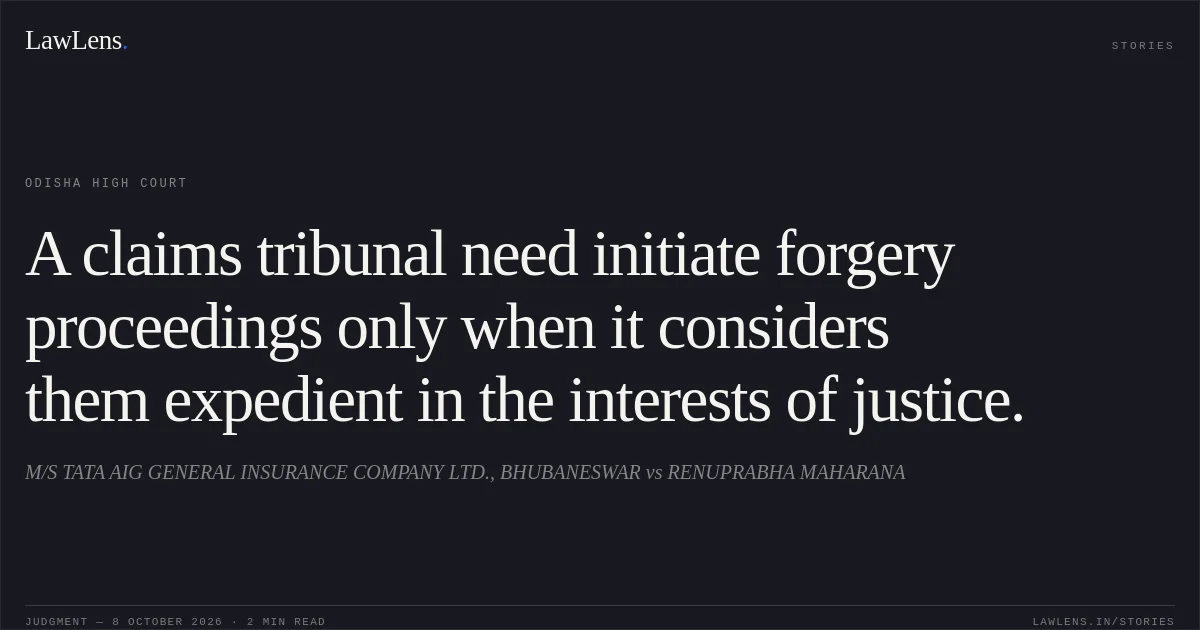
The insurer challenged an order dated 25 August 2026 of the 2nd Motor Accident Claims Tribunal (SD), Berhampur, in MAC No. 102 of 2025.
Source reference: p. 1–3, 7–8Before the Tribunal, the insurer sought to summon the Income Tax Officer to establish alleged fraud concerning a document marked Ext.17 and requested an inquiry under Section 169(2) of the Motor Vehicles Act, 1988, read with Section 379 of the Bharatiya Nagarik Suraksha Sanhita, 2023 (BNSS).
Source reference: p. 1–3, 7–8The claimants sought recall of Ext.17 and an award based on other income-tax and bank documents.
Source reference: p. 1–3, 7–8The insurer also asserted that it had not received sufficient opportunity to lead evidence.
Source reference: p. 1–3, 7–8Issues
1. Whether the Tribunal could initiate an inquiry under Section 169(2) of the Motor Vehicles Act read with Section 379 of the BNSS concerning the alleged use of a false document.
Source reference: p. 3–52. Whether summoning the Income Tax Officer to verify Ext.17 was necessary in the circumstances.
Source reference: p. 73. Whether the insurer should be granted further time to complete its evidence.
Source reference: p. 7–8Law Applied
Section 169(2) of the Motor Vehicles Act confers specified civil-court powers on a Claims Tribunal, including powers relating to evidence, witness attendance and production of documents, and deems the Tribunal a civil court for the purposes stated in that provision.
Source reference: p. 3–4Section 379 of the BNSS provides a mechanism for a court to make a written complaint concerning specified offences connected with proceedings or documents produced in evidence, where the court considers an inquiry expedient in the interests of justice.
Source reference: p. 4The decision to invoke that mechanism is discretionary, not automatic; under Iqbal Singh Marwah v. Meenakshi Marwah, the court assesses expediency by considering the effect of the alleged offence on the administration of justice, rather than simply the injury to the affected person.
Source reference: p. 5–6The Tribunal may also use its inherent power under Section 151 of the Code of Civil Procedure to recall or expunge an exhibit where no express CPC provision addresses that step.
Source reference: p. 3Reasoning
The Court observed that the claimants had not pressed Ext.17 and that, on the parties’ submissions, it was not a genuine document.
Source reference: p. 3, 7The Tribunal could therefore disregard or recall it, making it unnecessary to summon the Income Tax Officer to establish its veracity.
Source reference: p. 3, 7As to an inquiry or complaint, Section 379 did not require action in every case: the relevant question was whether it was expedient in the interests of justice, assessed in light of the effect on the administration of justice.
Source reference: p. 5–7The Court also considered that claimants in compensation proceedings may not understand the purport of documents produced on their behalf.
Source reference: p. 5–7Separately, to ensure fairness, it considered further time for the insurer to complete its evidence just and proper.
Source reference: p. 8Holding
The Court found no necessity to summon the Income Tax Officer regarding Ext.17.
The Court directed the Tribunal to allow the insurer 30 days from production of the High Court’s order to complete its evidence.
Source reference: p. 8The claimants were directed to cooperate, and the Tribunal was requested to dispose of the claim expeditiously.
Source reference: p. 8There was no order as to costs.
Source reference: p. 8Acts & Sections Cited
6 provisions across 4 statutes referred to in this judgment. Each provision opens on LawLens.
Motor Vehicles Act, 19881
Bharatiya Nagarik Suraksha Sanhita, 20232
Code of Civil Procedure, 19081
Code of Criminal Procedure, 19732
Original Court PDF
M/S TATA AIG GENERAL INSURANCE COMPANY LTD., BHUBANESWARvsRENUPRABHA MAHARANA
Click to open original judgment
Original judgment, available to read, download and summarize on LawLens.in