Facts
The parties entered into a Call Centre Services Agreement dated 9 December 2021, which provided for mutual resolution of disputes and stated that, if unresolved within 30 days, a dispute would “if mutually agreed upon by the parties” be submitted to arbitration.
Source reference: para. 2The clause also provided for a mutually appointed sole arbitrator and specified the governing law, place, and language of arbitration.
Source reference: paras. 32–33After disputes arose, the petitioner issued a notice invoking arbitration under Section 21 of the Arbitration and Conciliation Act, 1996.
Source reference: para. 3The respondent rejected the proposal to arbitrate, and the petitioner applied to the High Court under Section 11(6) for appointment of an arbitrator.
Source reference: para. 4Issues
1. Whether the stipulation that the dispute would be submitted to arbitration “if mutually agreed upon by the parties” constitutes a valid and binding arbitration agreement under Section 7 of the Arbitration and Conciliation Act, 1996.
Source reference: para. 10Law Applied
Section 7 of the Arbitration and Conciliation Act, 1996 requires an agreement by the parties to submit disputes to arbitration.
Source reference: para. 11Under Jagdish Chander v. Ramesh Chander [(2007) 5 SCC 719], an arbitration agreement must disclose a present determination and obligation to arbitrate; a clause requiring further consent after a dispute arises is only an agreement to enter into an arbitration agreement in the future.
Source reference: paras. 11–15This principle was reiterated in Mahanadi Coalfields Ltd. v. IVRCL AMR Joint Venture [(2022) 20 SCC 636], BGM and M-RPL-JMCT (JV) v. Eastern Coalfields Ltd. [2025 INSC 874], and Nagreeka Indcon Products Pvt. Ltd. v. Cargocare Logistics (India) Pvt. Ltd. [2026 SCC OnLine SC 630].
Source reference: paras. 20–26Although no prescribed form is required, the clause must manifest a binding intention to arbitrate; the Court cannot impose an obligation the parties did not undertake.
Source reference: paras. 14, 30–31Reasoning
The Court read the clause as establishing two stages: an initial 30-day period for mutual resolution, followed by arbitration only if the parties mutually agreed to submit the dispute.
Source reference: paras. 34–35, 60–61The words “if mutually agreed upon by the parties” qualified the submission itself, not merely the appointment of the arbitrator, and could not be disregarded or rewritten.
Source reference: paras. 36–43The provisions specifying a sole arbitrator, a final and binding award, governing law, place, and language set out the framework for a possible arbitration but did not remove the requirement for further mutual consent.
Source reference: paras. 45–49As no subsequent agreement to arbitrate was established, the unilateral invocation could not create a binding arbitration agreement.
Source reference: paras. 55–59The Court therefore held that the clause did not satisfy Section 7, notwithstanding the limited scope of the Section 11 referral inquiry.
Source reference: paras. 62–65Holding
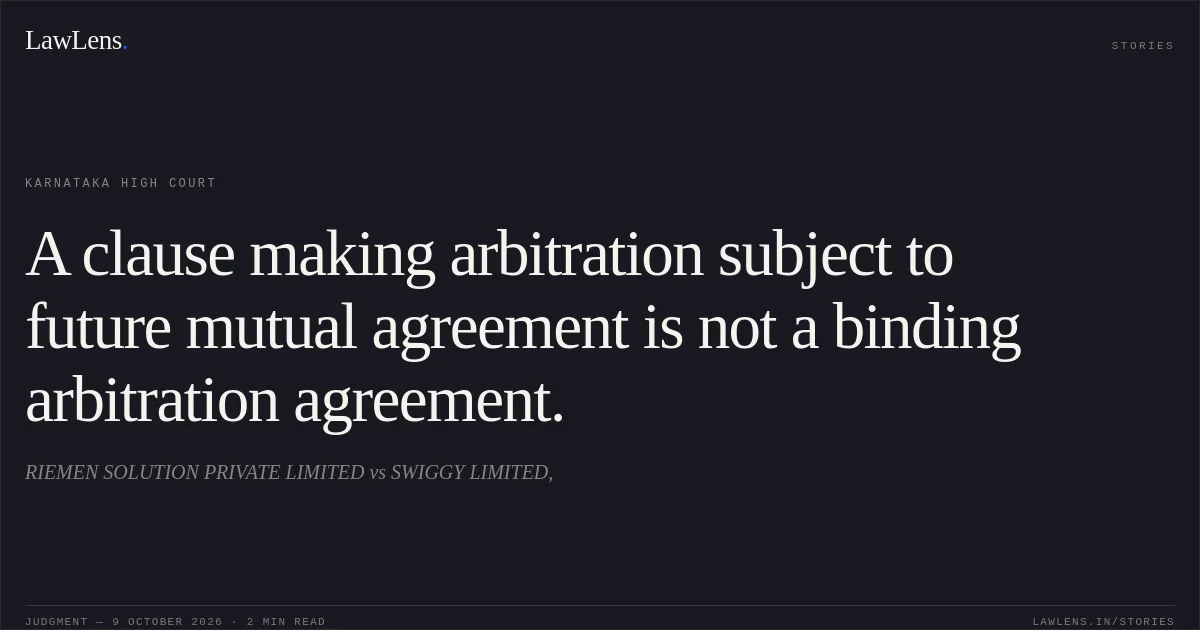
The Court answered the framed issue in the negative, holding that the clause was not a presently binding arbitration agreement because arbitration depended on further mutual agreement.
In the absence of an arbitration agreement, the Court declined to appoint an arbitrator and dismissed the Section 11(6) petition.
Source reference: paras. 65–66; OrderActs & Sections Cited
3 provisions across 1 statute referred to in this judgment. Each provision opens on LawLens.
Arbitration and Conciliation Act, 19963
Original Court PDF
RIEMEN SOLUTION PRIVATE LIMITEDvsSWIGGY LIMITED,
Click to open original judgment
Original judgment, available to read, download and summarize on LawLens.in