Facts
An advertisement dated 16.12.2022 invited applications for Primary School Teacher (General/Special Education), Level-1. Rajendra Singh cleared the written examination, was provisionally and finally selected, and was called for counselling; his name appeared at Serial No. 5339 in the final selection list and Serial No. 295 in the counselling list.
Source reference: p.2However, appointment was withheld because a criminal case was pending against him under Sections 199, 200, 466, 467, 468, 471 and 420 IPC. He had earlier faced criminal proceedings arising from allegations that he had submitted incorrect REET marks and uploaded a fabricated marks-sheet. The trial court acquitted him on 07.07.2023, and the State’s appeal was dismissed by the Sessions Court, though the acquittal was described as being on the benefit of doubt.
Source reference: p.2By order dated 07.06.2024, the State denied him appointment. The learned Single Judge quashed that order and directed issuance of an appointment letter within 30 days. The State challenged that decision in the present special appeal.
Source reference: pp.2–4Issues
1. Whether the State could deny appointment to a finally selected candidate merely because he had faced prosecution for offences involving moral turpitude, despite his acquittal in the criminal case.
Source reference: pp.4–62. Whether the acquittal was one based on the benefit of reasonable doubt, attracting the principle in Avatar Singh v. Union of India, or a clear acquittal arising from the prosecution’s complete failure to establish the petitioner’s involvement.
Source reference: pp.6–83. Whether the learned Single Judge was justified in directing the State to issue the appointment letter.
Source reference: p.8Law Applied
The Court applied the principle that offences under Sections 420 and 471 IPC may involve moral turpitude and adversely affect public welfare, as recognised in Central Bureau of Investigation v. Jagjit Singh, (2013) 10 SCC 686.
Source reference: p.5It considered Delhi Administration v. Sushil Kumar, (1997) SCC (L&S) 492, which holds that verification of character and antecedents is relevant to determining a candidate’s suitability and that acquittal does not invariably eliminate the employer’s power to assess antecedents.
Source reference: p.4The Court further applied paragraph 38.4.3 of Avatar Singh v. Union of India, (2016) 8 SCC 471, under which, where an acquittal in a case involving moral turpitude or a serious offence is based on technical grounds or benefit of reasonable doubt and is not a clean acquittal, the employer may consider the relevant antecedents and take an appropriate decision.
Source reference: pp.4–6Such administrative decision-making, however, must be based on a proper consideration of the relevant facts and the applicable Circular dated 04.12.2019.
Source reference: p.6Reasoning
Although the offences alleged against the respondent were capable of involving moral turpitude, the Court examined the substance of the criminal judgment rather than relying solely on its formal description as an acquittal on benefit of doubt.
Source reference: pp.5–6The prosecution had to prove both that incorrect details and a fabricated marks-sheet were uploaded and that the respondent himself had uploaded them using his mobile device or internet connection.
Source reference: p.7The seized mobile phone contained no incriminating material, and the prosecution failed to connect the relevant IP address with the respondent’s mobile internet.
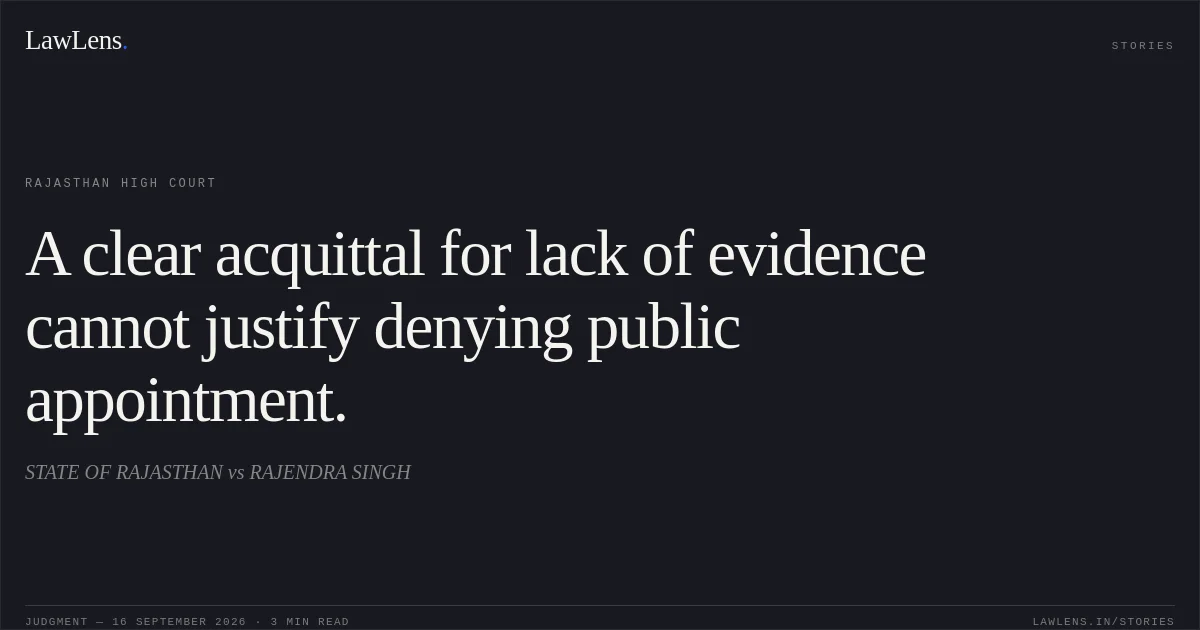
Source reference: p.7Thus, the evidence merely established that the incorrect material had been uploaded, not that the respondent was the person who uploaded it. The Court held that this was a case of complete absence of evidence linking the respondent to the alleged act, amounting to a clear acquittal rather than an acquittal founded on doubtful but incriminating evidence.
Source reference: pp.7–8Consequently, the State’s refusal to appoint him solely on the basis of the criminal case was unjustified, and the learned Single Judge correctly granted relief.
Source reference: p.8Holding
The Division Bench dismissed the State’s special appeal and affirmed the learned Single Judge’s judgment.
It held that the respondent’s acquittal was effectively a clear acquittal for want of evidence connecting him with the alleged uploading of the forged marks-sheet, and that the State had no sufficient basis to deny him appointment on that ground.
Source reference: pp.7–9The direction to issue the respondent’s appointment letter to the post of Primary School Teacher (Level-1) within 30 days of his approaching the authorities with a copy of the order was therefore upheld.
Source reference: pp.2–3, 8–9Acts & Sections Cited
7 provisions across 1 statute referred to in this judgment. Each provision opens on LawLens.
Indian Penal Code, 18607
Original Court PDF
STATE OF RAJASTHANvsRAJENDRA SINGH
Click to open original judgment
Original judgment, available to read, download and summarize on LawLens.in