Facts
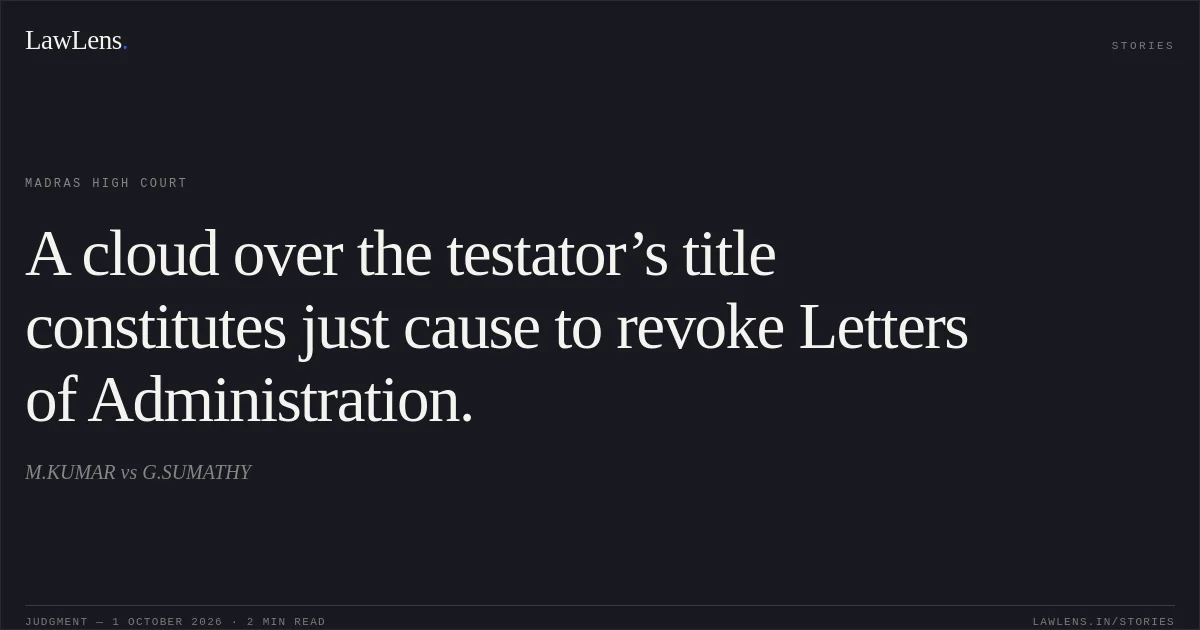
The dispute concerned Letters of Administration granted to G. Sumathy in respect of a Will dated 13 September 2006 allegedly executed by M. Marimuthu alias Mariappan.
Source reference: pp. 2–5, 8–10The appellant, the testator’s son, and the testator’s wife sought revocation of the grant.
Source reference: pp. 2–5, 8–10They contended, among other things, that the testator had no established title to the property bequeathed: the Tamil Nadu Slum Clearance Board had not executed a sale deed in his favour and had rejected his claim because he was not in possession.
Source reference: pp. 2–5, 8–10The grant had been made ex parte, and the appellant’s revocation application was dismissed by the Single Judge.
Source reference: pp. 2–5, 8–10Issues
1. Whether the appellant had a caveatable interest and had shown “just cause” under Section 263 of the Indian Succession Act, 1925, for revocation of the Letters of Administration
Source reference: p. 11, para. 112. Whether the ex parte grant should remain in force where the testator’s right or interest in the property was in question
Source reference: pp. 12–13, paras. 12–16Law Applied
Section 263 of the Indian Succession Act, 1925 permits revocation or annulment of a grant for “just cause.”
Source reference: pp. 11–13, paras. 11–16In deciding whether revocation is warranted, the court considers whether the applicant has a caveatable interest and whether the circumstances disclose just cause.
Source reference: pp. 11–13, paras. 11–16Here, the Court treated the unresolved question of the testator’s interest in the property, together with the appellant’s status as his son and the ex parte nature of the grant, as relevant to that inquiry.
Source reference: pp. 11–13, paras. 11–16Reasoning
The Court noted that the Board had not executed a sale deed in the testator’s favour and had rejected his claim on the basis that he was not occupying the property.
Source reference: pp. 12–13, paras. 12–16His interest in the property, and consequently his competence to bequeath it, were therefore in question.
Source reference: pp. 12–13, paras. 12–16In light of that unresolved issue, the appellant’s relationship to the testator, and the fact that the grant was made ex parte, the Court found that the appellant had a caveatable interest and had shown just cause for revocation.
Source reference: pp. 12–13, paras. 12–16It confined its observations to that threshold determination and left the Will’s genuineness and validity for adjudication in the testamentary suit.
Source reference: pp. 12–13, paras. 12–16Holding
The Court held that the appellant had shown just cause under Section 263 and allowed the appeal.
It set aside the order dismissing the revocation application and revoked the Letters of Administration.
Source reference: pp. 13–14, paras. 16–18The original petition was directed to be converted into a Testamentary Original Suit, with an opportunity for all parties to file pleadings; the Single Judge was directed to decide the suit independently and in accordance with law.
Source reference: pp. 13–14, paras. 16–18Acts & Sections Cited
1 provisions across 1 statute referred to in this judgment. Each provision opens on LawLens.
Indian Succession Act, 19251
Original Court PDF
M.KUMARvsG.SUMATHY
Click to open original judgment
Original judgment, available to read, download and summarize on LawLens.in