Facts
A dead body was found in a paddy field in District Kaushambi on 28 September 2011, leading to registration of Case Crime No. 376 of 2011 under Sections 302 and 201 IPC against unknown persons.
Source reference: p.1, para. 3During investigation, co-accused Chander Prakash and others were arrested with stolen property allegedly taken from Truck No. HR 38 L 4908 after killing its cleaner. A separate FIR under Section 394 IPC was registered concerning the truck robbery and was subsequently merged with the investigation in Case Crime No. 376 of 2011.
Source reference: p.2, paras. 3–5The investigating officer recorded statements of the arrested co-accused, including Dharmender and Amarnath, who allegedly stated that certain stolen property had been kept at the applicants’ house.
Source reference: p.2, para. 4No applicant was arrested and no stolen property was recovered from the applicants. Nevertheless, the applicants were charge-sheeted under Section 414 IPC, while the other accused were charge-sheeted for offences including Sections 394, 302, 201, 34, 411 and 414 IPC.
Source reference: p.2, para. 4The applicants’ discharge application under Section 227 Cr.P.C. was rejected by the Sessions Judge, Kaushambi, by order dated 28 August 2012, prompting the application under Section 482 Cr.P.C.
Source reference: p.1, para. 2Issues
Whether the applicants could be put to trial under Section 414 IPC solely on the basis of statements/confessional statements made by co-accused, in the absence of recovery or other independent evidence connecting them with the stolen property?
Source reference: pp. 3–5, paras. 6–13Whether the Sessions Judge erred in refusing discharge under Section 227 Cr.P.C. when the prosecution material consisted only of the alleged statements of co-accused?
Source reference: pp. 3–5, paras. 8, 11–14Law Applied
The Court applied Section 482 Cr.P.C., which preserves the High Court’s inherent jurisdiction to prevent abuse of process and secure the ends of justice, and Section 227 Cr.P.C., under which an accused must be discharged where the material does not disclose sufficient ground for proceeding.
Source reference: no citationSection 414 IPC requires material indicating that the accused voluntarily assisted in concealing, disposing of, or making away with property which the accused knew or had reason to believe was stolen.
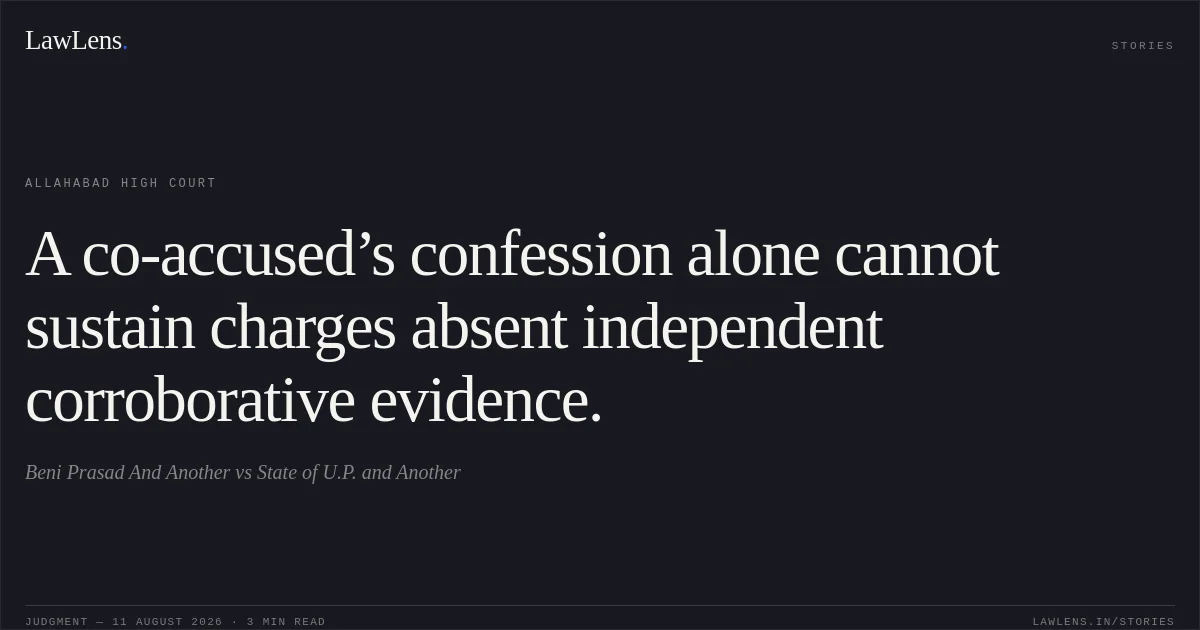
Source reference: no citationThe Court relied on Sections 3 and 30 of the Evidence Act and Hari Charan Kurmi v. State of Bihar, AIR 1964 SC 1184, holding that a confession of a co-accused is not substantive evidence against another accused; it may be taken into consideration only in support of other independent evidence and cannot, by itself, sustain a conviction or justify proceeding against the co-accused.
Source reference: p.3, para. 11; p.4, para. 12The Court also relied on Dipakbhai Jagdishchandra Patel v. State of Gujarat, AIR 2019 SC 3363, regarding the inadmissibility and limited evidentiary value of a confession made to a police officer.
Source reference: p.3, paras. 8, 13Reasoning
The prosecution case against the applicants rested exclusively on statements made by co-accused Dharmender and Amarnath during investigation, allegedly naming the applicants as persons at whose house stolen property had been kept.
Source reference: p.2, para. 4The Court noted that the applicants were neither arrested nor subjected to any recovery of stolen property, and that the trial court itself had found no material other than the evidence collected through the charge-sheet.
Source reference: p.3, para. 8; p.4, para. 12Applying Hari Charan Kurmi, the Court held that a co-accused’s confession may provide assurance only where there is other evidence independently connecting the accused with the offence; it cannot constitute the sole foundation for proceeding against them.
Source reference: p.4, paras. 11–12Since there was no independent evidence establishing that the applicants knowingly assisted in concealing or disposing of stolen property, the statutory ingredients of Section 414 IPC were not prima facie established.
Source reference: no citationThe Sessions Judge therefore failed to apply the governing principles while rejecting the discharge application.
Source reference: pp. 4–5, para. 13Holding
The High Court held that the applicants’ prosecution under Section 414 IPC was based solely on the alleged confessional statements of co-accused and was unsupported by recovery or other credible independent evidence.
It accordingly allowed the application under Section 482 Cr.P.C., set aside the Sessions Judge’s order dated 28 August 2012, and discharged the applicants from Session Trial No. 232 of 2012 arising out of Case Crime No. 376 of 2011.
Source reference: p.5, paras. 14–15Acts & Sections Cited
15 provisions across 2 statutes referred to in this judgment. Each provision opens on LawLens.
Indian Penal Code, 1860
Code of Criminal Procedure, 19734
Original Court PDF
Beni Prasad And AnothervsState of U.P. and Another
Click to open original judgment
Original judgment, available to read, download and summarize on LawLens.in