Facts
The petitioner, Accused No. 1 in Special C.C. No. 25/2016, challenged orders concerning Accused Nos. 6 to 8 and 10.
Source reference: p. 4The CBI had charged ten accused with offences including criminal conspiracy, cheating, forgery and offences under the Prevention of Corruption Act.
Source reference: p. 4Accused Nos. 6 to 8 and 10 applied for plea bargaining under Section 265E of the Code of Criminal Procedure (CrPC); the prosecution did not oppose, and the Special Judge allowed their application.
Source reference: p. 4The petitioner also challenged an earlier order deleting the charge under Section 409 IPC against those accused, contending that the orders prejudiced his defence and were passed without proper consideration.
Source reference: pp. 3, 5–8Issues
1. Whether the petitioner could challenge the order allowing Accused Nos. 6 to 8 and 10 to avail plea bargaining under Section 265E CrPC on the ground that it prejudiced his defence.
Source reference: pp. 5–8, 9–102. Whether the plea-bargaining order, and the related deletion of the Section 409 IPC charge against those accused, could be set aside on the grounds advanced by the petitioner.
Source reference: pp. 3, 5–8, 9Law Applied
Section 265E CrPC provides an accused with the opportunity to seek the benefit of plea bargaining, subject to the court’s consideration of the application.
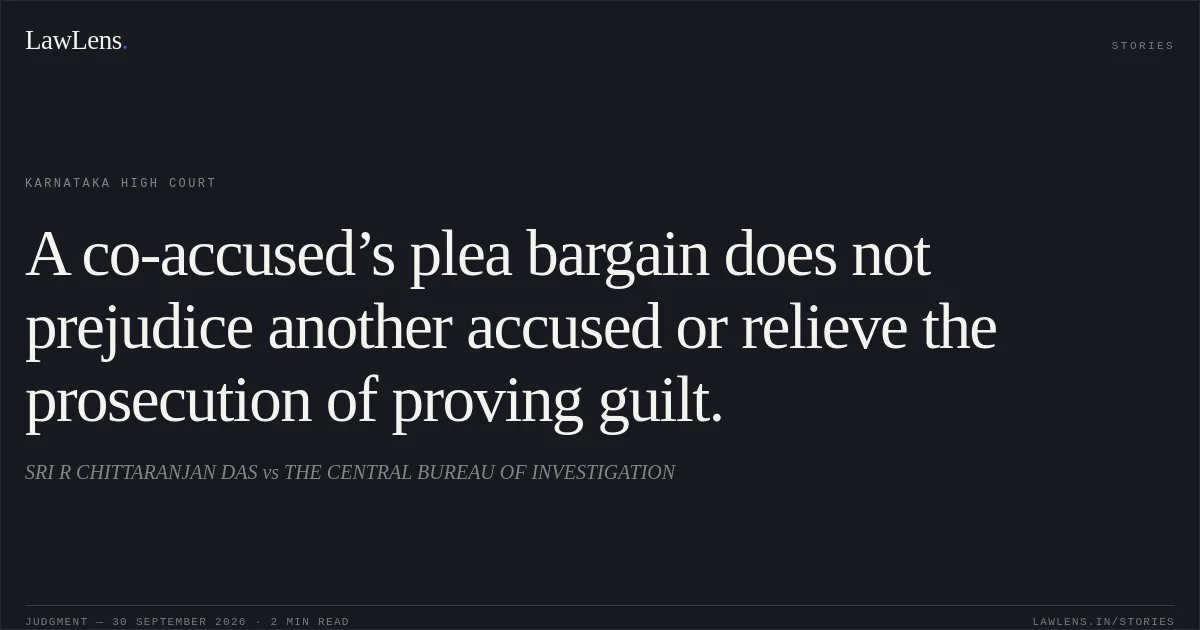
Source reference: pp. 9–11An accused’s plea-bargaining decision does not, by itself, relieve the prosecution of proving the charges against other accused; the prosecution must establish their guilt through evidence independently of the plea-bargaining outcome.
Source reference: pp. 10–11The Court distinguished an accused seeking plea bargaining under Section 265E CrPC from an accused seeking to become an approver under Section 306 CrPC, treating them as distinct procedures.
Source reference: p. 11Reasoning
The Court held that the Special Judge was required to consider the applications made under Section 265E CrPC and noted that the prosecution had not opposed them.
Source reference: p. 9It rejected the petitioner’s asserted prejudice as hypothetical: the prosecution remained obliged to prove the case against him, including any conspiracy allegation, by cogent evidence, and the admissions of co-accused would not automatically establish his guilt or diminish his right to defend himself.
Source reference: pp. 10–12The Court therefore found no legal basis in the petitioner’s grounds for interfering with the plea-bargaining order.
Source reference: p. 12Holding
The High Court dismissed the writ petition, declining to set aside the impugned orders.
It clarified that the plea-bargaining order concerning Accused Nos. 6 to 8 and 10 would not affect the petitioner’s right to defend himself in accordance with law.
Source reference: p. 12Acts & Sections Cited
7 provisions across 3 statutes referred to in this judgment. Each provision opens on LawLens.
Code of Criminal Procedure, 19732
Indian Penal Code, 18604
Prevention of Corruption Act, 19881
Original Court PDF
SRI R CHITTARANJAN DASvsTHE CENTRAL BUREAU OF INVESTIGATION
Click to open original judgment
Original judgment, available to read, download and summarize on LawLens.in
![Central age-relaxation rules do not apply to GNCTD recruitment absent adoption.. BHAWNA KHANNA vs Delhi Subordinate Services Selection Board. CAT - ['Delhi']. LawLens](/stories/thumbnails/central-age-relaxation-rules-do-not-apply-to-gnctd-recruitment-absent-adoption-8a54cd0dcc2941f4bfaf9fb4908d5805.webp)