01Facts
The petitions sought anticipatory bail for accused Nos. 4 and 3, respectively, in a Lokayukta case registered under Sections 7(a) and 7(A) of the Prevention of Corruption Act, 1988
pp. 3–4The complaint alleged that police personnel demanded payments from truck drivers transporting sand; the complainant alleged that accused No. 3 reiterated a demand and instructed payment by PhonePe.
pp. 3–6The prosecution relied on recordings and stated that money had been recovered from accused Nos. 1 and 2.
pp. 3–6The petitioners denied demanding money and argued, among other things, that the recordings required authentication and that accused Nos. 1 and 2 had been granted bail.
p. 5, 8The prosecution opposed bail, citing the alleged recordings, the recovery, and the risk of interference with the investigation.
pp. 5–602Issues
i.1. Whether accused Nos. 3 and 4 were entitled to anticipatory bail in the circumstances of the case
pp. 10–12ii.2. Whether the material relied on against accused No. 4—an alleged statement by accused No. 1—provided a sufficient basis to deny anticipatory bail
p. 1103Law Applied
The Court considered Sections 7(a) and 7(A) of the Prevention of Corruption Act, 1988, concerning public servants obtaining, accepting, or attempting to obtain an undue advantage
pp. 6–7and Section 482 of the Bharatiya Nagarik Suraksha Sanhita, 2023, under which anticipatory bail was sought.
pp. 2–3It relied on Satender Kumar Antil v. Central Bureau of Investigation & Anr., reported as (2026) 7 SCC 311, for the principle that, for offences punishable with imprisonment up to seven years, arrest is not automatic: the investigating officer must assess its necessity and comply with the statutory requirements under Section 35 of the BNSS.
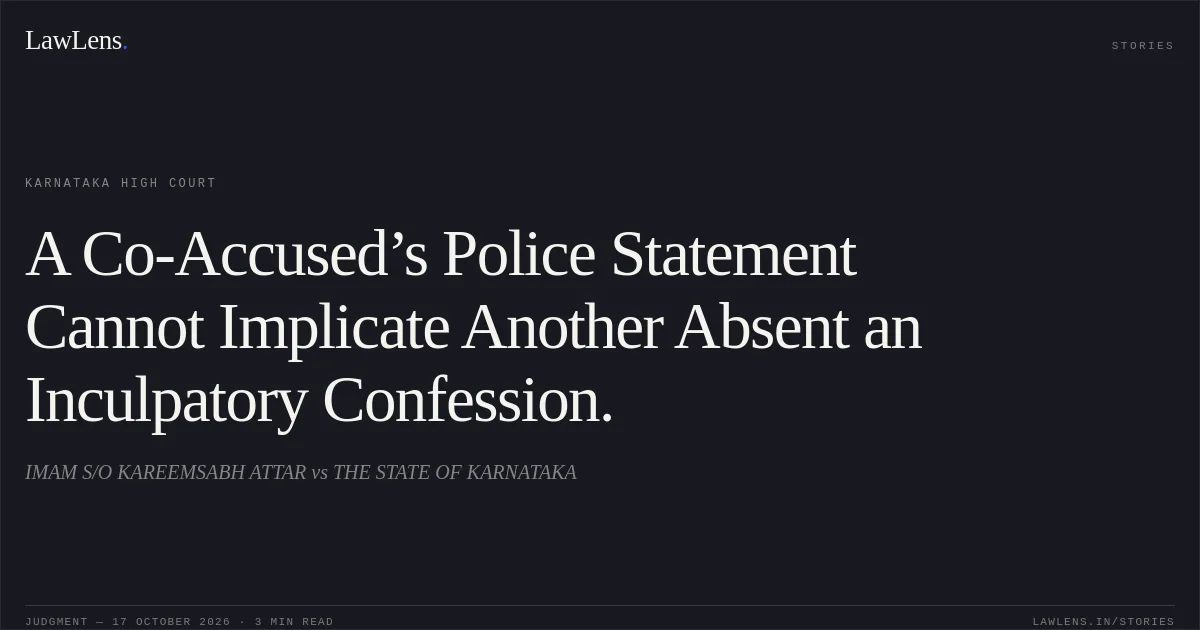
pp. 8–10The Court also relied on T. Krishna Mohan Reddy v. State of Andhra Pradesh, 2025 INSC 725, for the principle that a co-accused’s police statement cannot ordinarily be used as evidence against another accused, subject to the limited exception for an inculpatory confession.
p. 11In deciding bail, the Court considered the nature and circumstances of the offence, flight risk, likelihood of repeat offending or witness tampering, and the petitioners’ antecedents; it also noted that a bail hearing is not a mini-trial.
pp. 12–13Provisions in the judgment · 5 · Linked ones open on LawLens
Bharatiya Nagarik Suraksha Sanhita, 2023 Section 35Section 482
Prevention of Corruption Act, 1988 Section 7
Code of Criminal Procedure, 1973 Section 438Section 161
04Reasoning
The Court considered the alleged recordings and video material but held that their authenticity and whether the voices belonged to the accused required examination by the competent authorities; those questions could not be conclusively resolved at the bail stage.
pp. 7, 10–11As to accused No. 4, the material identified by the prosecution was a statement by accused No. 1, which the Court held could not, by itself, be used against a co-accused.
p. 11The Court further noted that the petitioners were government servants whose presence could be secured, that the alleged offences were not punishable with death or life imprisonment, and that they had no criminal antecedents.
pp. 11–12Applying the BNSS arrest principles, it concluded that the alleged circumstances did not justify denying anticipatory bail.
pp. 9–1205Holding
The Court allowed both petitions and ordered accused Nos. 3 and 4 to be released on anticipatory bail in the event of arrest in Crime No. 6/2026, on a personal bond of ₹2,00,000 each with two sureties for the like amount.
p. 13Conditions included attendance before the investigating officer on the first and third Sundays of each month for six months or until filing of the final report, whichever occurred earlier; non-tampering with prosecution witnesses; cooperation with the investigation; regular appearance before the competent court; and refraining from committing further offences.
pp. 13–14Breach could result in the prosecution seeking cancellation of bail.
pp. 13–14Original Court PDF
IMAM S/O KAREEMSABH ATTARvsTHE STATE OF KARNATAKA
Click to open original judgment
Original judgment, available to read, download and summarize on LawLens.in