Facts
The petitioner-tenant challenged, under the proviso to Section 25-B(8) of the Delhi Rent Control Act, 1958 (“DRC Act”), the order dated 19 March 2026 by which the learned Rent Controller dismissed his application for leave to defend and passed an eviction order concerning premises bearing No. D-3, Ground Floor, Rana Pratap Bagh, New Delhi
Source reference: p.1, paras. 1–2The petitioner contended that the respondent lacked locus because the premises had allegedly devolved jointly upon the respondent and her brother, Vikas Sharma, and that the respondent relied on a fabricated and unregistered family settlement
Source reference: pp.2–3, paras. 3–8He also alleged that the respondent deliberately caused summons to be served at the tenanted premises despite knowing that the premises were vacant, while being aware of his business address
Source reference: pp.3–4, paras. 9–12The Rent Controller found that the petitioner had admitted the tenancy and payment of rent to Vikas Sharma, had not disputed the title of the respondent’s predecessors-in-interest or the rent receipts, and that the respondent could maintain the eviction petition as a co-owner. It further found no concealment of address, particularly since the petitioner filed the leave-to-defend application within time
Source reference: pp.6–7, para. 21Issues
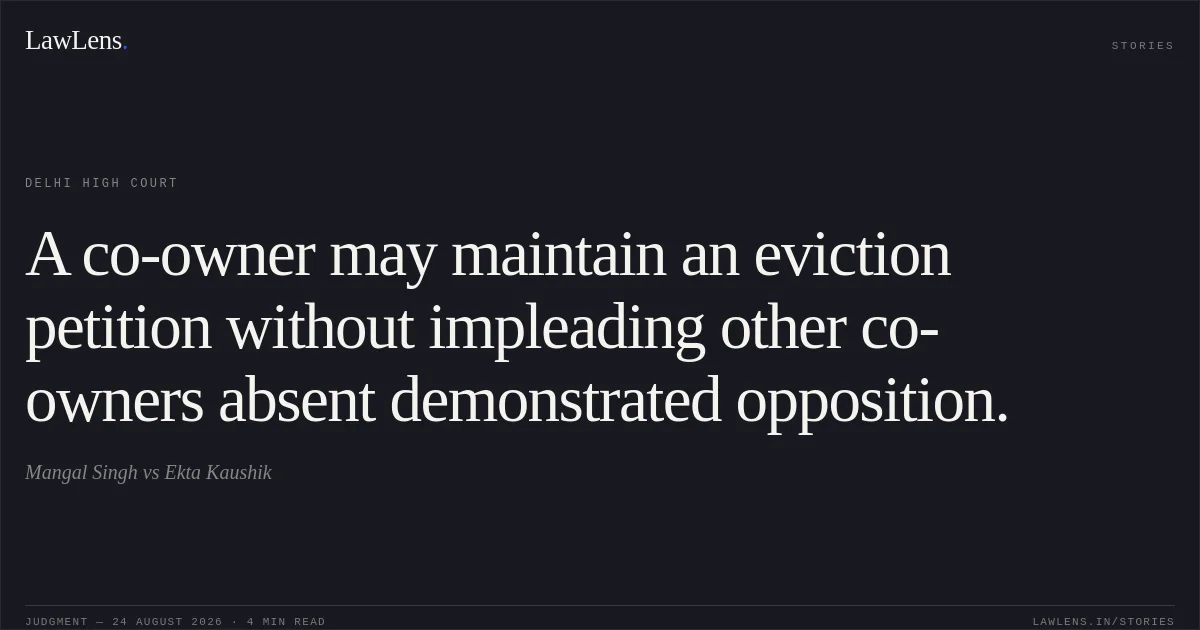
Whether the respondent, as one of the legal heirs/co-owners of the premises, could institute and maintain the eviction petition without impleading her brother, Vikas Sharma, as a co-owner
Source reference: pp.6–10, paras. 22–35Whether the alleged invalidity of the family settlement or the respondent’s alleged concealment of the petitioner’s correct address raised a triable issue or otherwise vitiated the eviction proceedings
Source reference: pp.8–12, paras. 28, 32, 36–41Whether the impugned order disclosed any jurisdictional error, manifest illegality, material irregularity, perversity, or error apparent on the face of the record warranting interference under the proviso to Section 25-B(8) of the DRC Act
Source reference: pp.4–6, paras. 14–20Law Applied
The Court applied the limited supervisory and revisional jurisdiction under the proviso to Section 25-B(8) of the DRC Act, holding that the High Court cannot exercise appellate jurisdiction, reappreciate evidence, or substitute its view for that of the Rent Controller, and may interfere only for an error apparent on the face of the record, jurisdictional error, material irregularity, perversity, or failure in the decision-making process, as explained in Sarla Ahuja v. United India Insurance Co. Ltd., (1998) 8 SCC 119; Hindustan Petroleum Corporation Ltd. v. Dilbahar Singh, (2014) 9 SCC 78; Abid-Ul-Islam v. Inder Sain Dua, (2022) 6 SCC 30; Pankaj Pahwa v. Prem Wati, 2024:DHC:9322; and Sanjeev Hiranandani v. Sunny Grover, 2025:DHC:11285
Source reference: pp.4–6, paras. 14–19It further applied the rule that an eviction petition may be instituted by one co-owner without impleading the other co-owners, unless objection or withholding of consent by the other co-owner is demonstrated, as recognised in Dinesh Kumar v. Krishan Lal Khurana & Ors., 2024:DHC:9032
Source reference: pp.6–8, paras. 21–27The Court also relied on the doctrine that “once a tenant, always a tenant,” and on Section 116 of the Indian Evidence Act, 1872, which estops a tenant from denying the landlord’s title during the tenancy, as discussed in M/s Jagdambey Builders Pvt. Ltd. v. J.S. Vohra, (2016) 228 DLT 49
Source reference: pp.10–11, paras. 33–34Finally, it held that a challenge to service requires proof of procedural irregularity and actual prejudice; mere service at the tenanted premises is insufficient where the tenant received notice and filed leave to defend within time
Source reference: pp.11–12, paras. 36–40Reasoning
The Court held that the petitioner had admitted the tenancy, had paid rent to the respondent’s brother, and had not disputed the ownership of the respondent’s predecessors or the authenticity of the rent receipts before the Rent Controller
Source reference: pp.6–10, paras. 22–31On those admitted facts, the respondent’s status as a legal heir and co-owner was sufficient to maintain the eviction petition; the petitioner produced no material showing that Vikas Sharma objected to the proceedings
Source reference: pp.7–9, paras. 24–27, 35The challenge based on the family settlement was also rejected because it had not been raised before the Rent Controller or in the leave-to-defend application and could not be introduced as a new factual ground in revision
Source reference: p.8, para. 28In any event, the petitioner, having entered and remained in possession as a tenant under the respondent’s predecessors-in-interest, could not ordinarily dispute the landlord’s title in view of the tenant-estoppel principle
Source reference: pp.9–11, paras. 29–34The service objection likewise failed because the petitioner became aware of the proceedings and filed the leave-to-defend application within the prescribed period; no actual prejudice or material procedural irregularity was shown
Source reference: pp.11–12, paras. 37–40Consequently, the Rent Controller’s order did not suffer from any infirmity warranting revisional interference
Source reference: pp.12–13, paras. 41–42Holding
The High Court dismissed the revision petition, holding that the respondent could maintain the eviction petition as a co-owner without impleading her brother and that neither the alleged family-settlement defect nor the alleged concealment and mode of service disclosed a triable issue or revisional error
The eviction order passed by the Rent Controller was left undisturbed. The pending applications were also disposed of, with no order as to costs
Source reference: p.13, paras. 44–45Acts & Sections Cited
3 provisions across 2 statutes referred to in this judgment. Linked provisions open on LawLens.
Delhi Rent Control Act, 19582
Evidence Act, 18811
Original Court PDF
Mangal SinghvsEkta Kaushik
Click to open original judgment
Original judgment, available to read, download and summarize on LawLens.in