Facts
Respondent No. 7 was a co-operative housing society formed for persons belonging to the backward class.
Source reference: no citationAfter the original member’s death, Respondent No. 10, Hirabai Shinde, became the member of Flat No. 10.
Source reference: no citationThe petitioner claimed to have purchased the flat from her in 2013 and, with her, applied to the Collector for transfer of membership.
Source reference: pp. 3–4The Collector approved the transfer on 25 February 2014, subject to conditions including that false or misleading information in the petitioner’s affidavit could result in revocation of membership.
Source reference: p. 4The petitioner paid the prescribed transfer fee.
Source reference: p. 4Following complaints alleging use of fraudulent documents, the Collector issued an order on 31 January 2024 revoking the approval.
Source reference: pp. 4–5The petitioner challenged that order by writ petition.
Source reference: pp. 4–5Issues
Whether the Collector had authority to review and revoke the 25 February 2014 order transferring membership to the petitioner.
Source reference: p. 6Whether the petitioner had breached a condition of the 25 February 2014 order so as to justify revocation of the membership.
Source reference: pp. 6–8Law Applied
The Court considered the State Government Resolution dated 25 May 2007, No. LCS0606/P.K.54/J-1, which provided for regularisation of flat membership upon payment of a prescribed transfer fee.
Source reference: pp. 6–7It also applied the principle that an administrative authority may revisit its earlier order only where a relevant condition authorises that action or a provision of law confers review power; the Collector’s order itself made revocation conditional on the petitioner having furnished false or misleading facts in his affidavit.
Source reference: pp. 6–8The Court identified no statutory provision authorising the Collector to review the earlier order.
Source reference: p. 8Reasoning
The petitioner had paid the transfer fee, and the 2014 approval was granted under the cited Government Resolution.
Source reference: pp. 6–7Although the State defended revocation on the basis of allegedly fraudulent documents, it could not identify which documents were false or show that the petitioner had breached the condition concerning his affidavit.
Source reference: pp. 7–8The impugned order instead relied on the asserted need for Social Welfare Department approval and the inapplicability of the Government Resolution—grounds that did not establish breach of the stated condition.
Source reference: pp. 7–8Nor did the State identify any legal provision empowering the Collector to review the 2014 order.
Source reference: pp. 7–8The Court therefore held that the revocation order was unreasoned and made without authority.
Source reference: pp. 7–8Holding
The Court set aside the Collector’s order dated 31 January 2024 and allowed the writ petition, making the Rule absolute.
It clarified that Respondent No. 7 society remained at liberty to take steps in accordance with due process of law.
Source reference: p. 9Original Court PDF
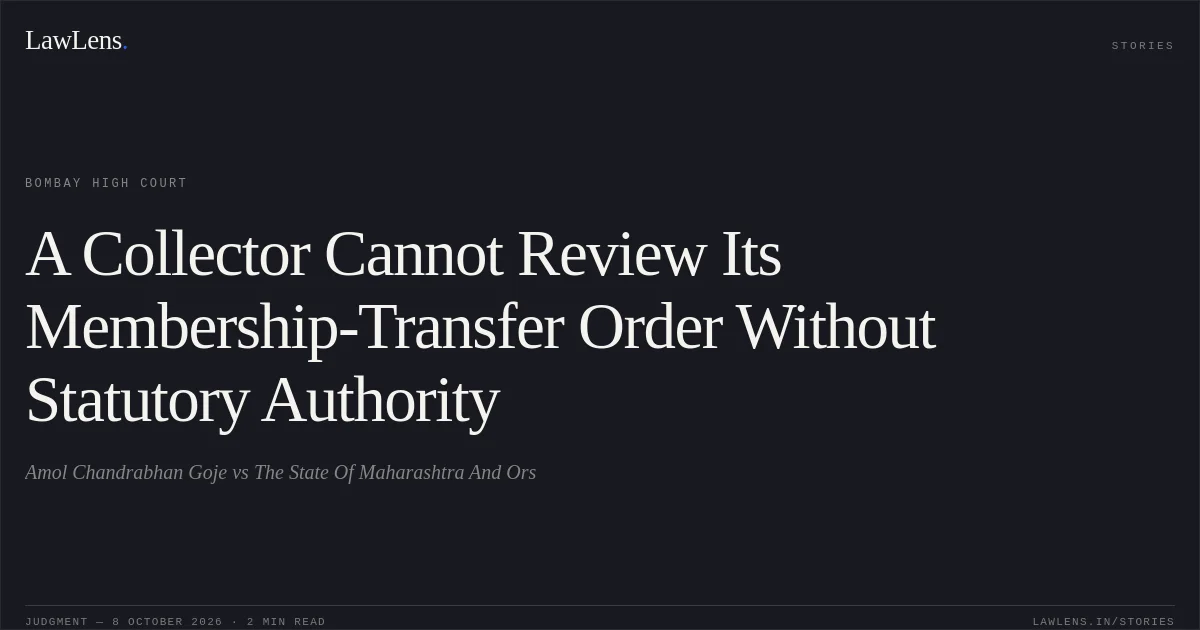
Amol Chandrabhan GojevsThe State Of Maharashtra And Ors
Click to open original judgment
Original judgment, available to read, download and summarize on LawLens.in