Facts
A cyber-fraud investigation found that ₹72,09,424 had been credited to and transferred through a bank account allegedly used to receive and move fraud proceeds.
Source reference: para. 3The prosecution alleged that Ravikant Sahu and others obtained the account holder’s passbook, cheque book and internet-banking credentials; Sahu was arrested on 7 October 2025
Source reference: para. 3His first bail application was rejected on merits on 11 March 2026, and his second was rejected on 20 April 2026.
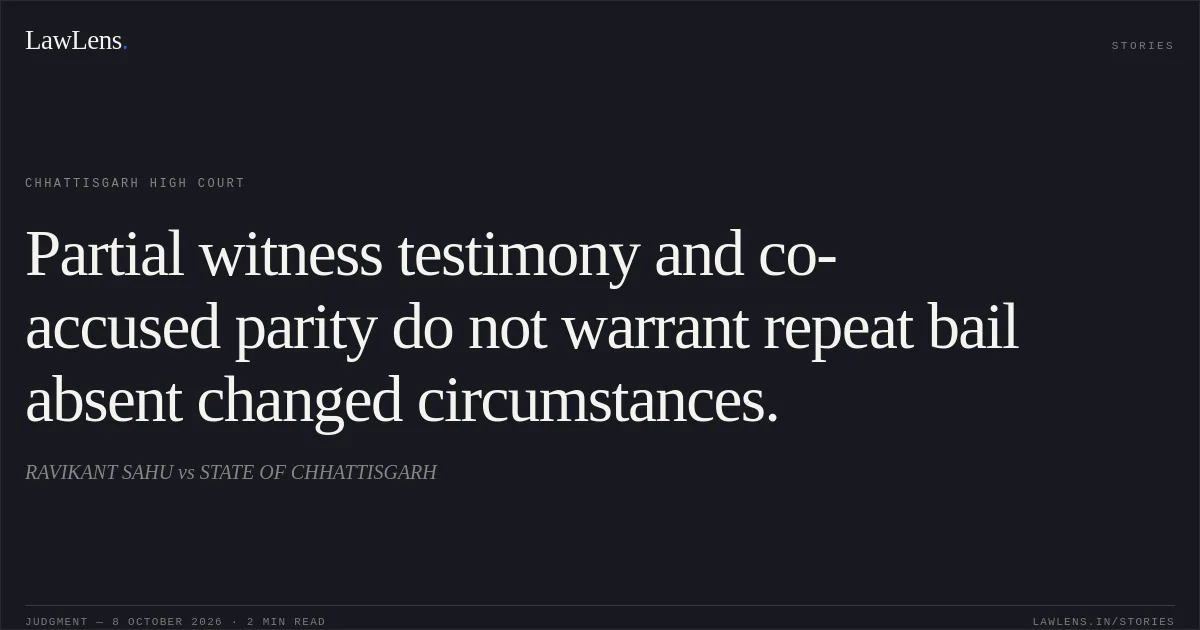
Source reference: para. 2In this third application under Section 483 of the Bharatiya Nagarik Suraksha Sanhita, 2023, Sahu relied on the examination of four of twelve prosecution witnesses, who allegedly had not supported the prosecution, his period in custody, the filing of the charge-sheet, absence of criminal antecedents, and bail granted to a co-accused.
Source reference: para. 4The State opposed the application, distinguishing the co-accused and relying on the specific allegation that Sahu induced the account holder to open a joint account for the alleged fraud.
Source reference: para. 5Issues
1. Whether the examination of four prosecution witnesses, together with the other circumstances advanced by Sahu, constituted a sufficient basis to grant bail after two earlier applications had been rejected on merits
Source reference: paras. 2, 4–5, 82. Whether Sahu was entitled to bail on parity with co-accused Aman Paswan
Source reference: paras. 4–5, 7–8Law Applied
Section 483 of the Bharatiya Nagarik Suraksha Sanhita, 2023, governs the application for regular bail.
Source reference: para. 1The Court applied the principle that a bail court must not conduct a mini-trial or undertake a detailed assessment of evidence; the credibility and reliability of witnesses are matters for the trial court.
Source reference: para. 7The Court also considered the prior merits-based rejections and the asserted change in circumstances, as well as whether the co-accused’s case was sufficiently comparable to support parity.
Source reference: paras. 2, 7–8Reasoning
The Court held that the testimony of four examined witnesses could not be evaluated for credibility at the bail stage, particularly while the trial remained ongoing.
Source reference: para. 7It found Sahu’s case distinguishable from Aman Paswan’s because of the specific allegation that Sahu induced the account holder to open a joint account and obtained it for the alleged fraud.
Source reference: paras. 5, 7–8The Court also noted that various bank passbooks, ATM cards, mobile phones and SIM cards had been seized from Sahu, which prima facie indicated involvement in large-scale cyber fraud.
Source reference: para. 7In view of these circumstances and the two previous rejections on merits, the Court declined to grant bail.
Source reference: para. 8Holding
The Court rejected the third bail application under Section 483 BNSS.
It held that the asserted circumstances did not warrant bail, and that parity with Aman Paswan was unavailable because the allegations against Sahu were distinct.
Source reference: paras. 8–9Acts & Sections Cited
5 provisions across 2 statutes referred to in this judgment. Each provision opens on LawLens.
Bharatiya Nagarik Suraksha Sanhita, 20231
Bharatiya Nyaya Sanhita, 20234
Original Court PDF
RAVIKANT SAHUvsSTATE OF CHHATTISGARH
Click to open original judgment
Original judgment, available to read, download and summarize on LawLens.in