Facts
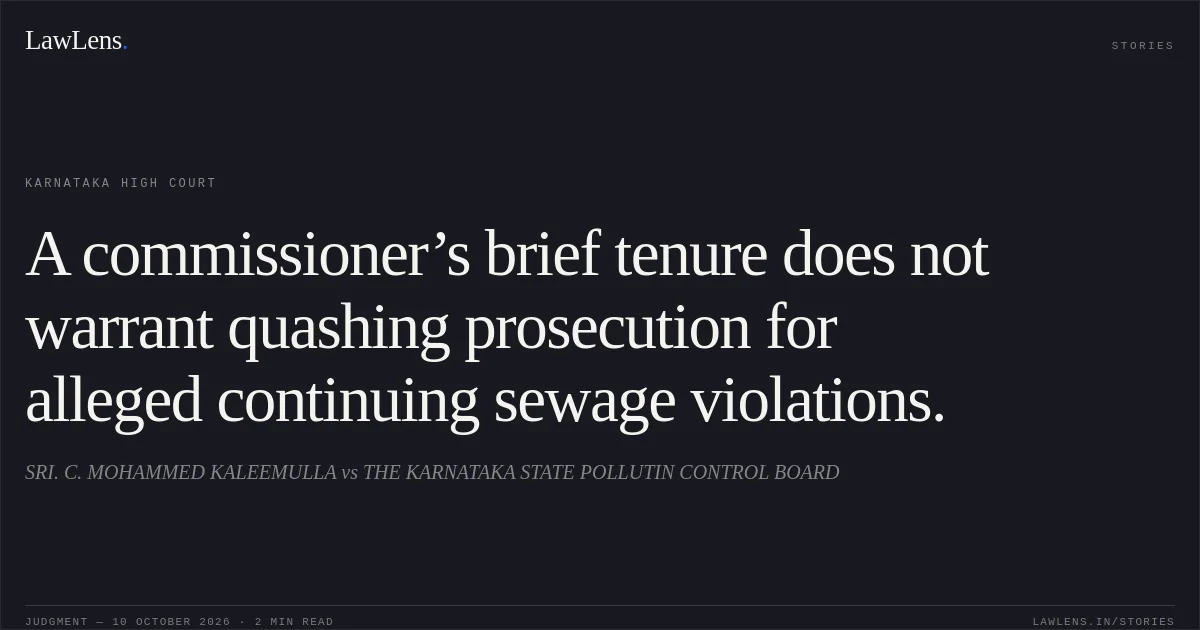
The Karnataka State Pollution Control Board filed a complaint against seven persons who had served as Commissioners of the City Municipal Council, Krishnarajapuram, alleging that the Council failed to provide sewage treatment and underground drainage facilities and discharged untreated sewage into nearby water bodies, contrary to Section 25 of the Water (Prevention and Control of Pollution) Act, 1974 (“Water Act”).
Source reference: para. 3, 5The complaint alleged that consent granted on 3 November 2005 expired on 30 June 2006 and was not renewed, and that a condition requiring a sewage treatment plant had not been met.
Source reference: para. 5, 8The petitioner, arrayed as accused No. 6, served as Commissioner from 18 to 31 May 2006.
Source reference: para. 3–4, 7He sought quashing under Section 482 CrPC, arguing, among other things, that the alleged failure to renew consent occurred after his tenure and that the complaint did not support prosecution against him.
Source reference: para. 3–4, 7He also relied on earlier orders quashing proceedings against co-accused, which the Supreme Court had set aside.
Source reference: para. 6, 9Issues
1. Whether the proceedings against the petitioner should be quashed under Section 482 CrPC because his tenure ended before the consent expired and the complaint did not disclose a basis for prosecuting him.
Source reference: para. 3–4, 8–102. Whether the Magistrate’s cognizance was invalid because the cognizance order did not expressly refer to Sections 25 and 44 of the Water Act.
Source reference: para. 4, 9Law Applied
Section 25 of the Water Act requires consent for relevant new or altered outlets and discharges, while Section 44 prescribes punishment for contraventions of specified provisions, including Section 25; Section 49 governs cognizance of offences under the Act.
Source reference: para. 2, 5, 9Section 482 CrPC permits the High Court to intervene to prevent abuse of process or secure the ends of justice.
Source reference: no citationThe Court relied on Karnataka State Pollution Control Board v. B. Heera Naik, (2020) 16 SCC 298, in which the Supreme Court set aside this Court’s earlier quashing orders concerning the same complaint and directed the Magistrate to proceed in accordance with law.
Source reference: para. 6, 9It also noted the cited principle that prior sanction under Section 197 CrPC is not required for proceedings under Section 49 of the Water Act.
Source reference: para. 9Reasoning
The Court treated the complaint as alleging an ongoing failure to comply with the consent conditions and to provide sewage-treatment and drainage facilities, not merely a failure to renew consent after the petitioner left office.
Source reference: para. 8, 10It noted that the consent and its treatment requirements pre-dated the petitioner’s brief tenure, and concluded that the alleged non-compliance during that earlier period could not be dismissed solely because the consent expired later.
Source reference: para. 10The Court also considered that the Supreme Court had set aside the earlier quashing orders in the same complaint and rejected the argument that the cognizance order was defective for not expressly naming the relevant provisions.
Source reference: para. 9It therefore found no sufficient basis to exercise its inherent jurisdiction to quash the proceedings.
Source reference: para. 10–11Holding
The Court answered the issues against the petitioner and dismissed the petition.
The prosecution in C.C. No. 1101/2006 was permitted to proceed against him; no relief was granted under Section 482 CrPC.
Source reference: para. 11Acts & Sections Cited
8 provisions across 2 statutes referred to in this judgment. Each provision opens on LawLens.
Code of Criminal Procedure, 19732
Water (Prevention and Control of Pollution) Act, 19746
Original Court PDF
SRI. C. MOHAMMED KALEEMULLAvsTHE KARNATAKA STATE POLLUTIN CONTROL BOARD
Click to open original judgment
Original judgment, available to read, download and summarize on LawLens.in