Facts
Kishan Singh instituted a suit for recovery of ₹5,80,910 against M/s Rita Plastic Industries, described as the proprietorship concern of Rita Batra, claiming arrears of rent, electricity dues, and ₹1,00,000 represented by a dishonoured cheque.
Source reference: pp. 2–5, paras 7–18The premises had been let by the plaintiff’s father to the proprietorship concern at a monthly rent of ₹6,500 under a rent agreement.
Source reference: pp. 2–5, paras 7–18The defendant contended that the proprietorship had been converted into M/s Rita Plastics Private Limited, that the premises had been vacated in June 2012, that the electricity dues had been paid, and that the cheque had been issued as a blank security cheque after which ₹1,00,000 was allegedly paid in cash to the plaintiff’s father.
Source reference: pp. 2–5, paras 7–18The Trial Court rejected the claims for rent and electricity dues but decreed ₹1,00,000 with simple interest at 6% per annum from the date of institution until realisation, holding that the cheque’s issuance was admitted and that the defence of cash payment was unproved.
Source reference: pp. 6–7, paras 24–26The defendant appealed under Section 96(1) CPC, challenging the maintainability of the suit, the attribution of liability for the cheque, the application of Section 139 of the Negotiable Instruments Act, and the plaintiff’s entitlement as a co-owner.
Source reference: pp. 7–9, paras 27–39Issues
Whether the suit was bad for misjoinder or non-joinder because the tenancy was with the proprietorship concern, whereas the cheque was drawn on the account of M/s Rita Plastics Private Limited.
Source reference: pp. 3–4, para. 14; p. 10, paras 41–44Whether the plaintiff was entitled to recover ₹1,00,000 on the dishonoured cheque when the defendant alleged that it was a blank security cheque and that the amount had subsequently been paid in cash.
Source reference: pp. 4–5, paras 16–17; pp. 11–12, paras 45–49Whether the plaintiff, being a co-owner under the Will, could maintain the suit and recover the decretal amount without impleading or obtaining the express consent of the other co-owner.
Source reference: pp. 12–13, paras 50–52Whether the Trial Court’s decree for the cheque amount was inconsistent with its dismissal of the claims for subsequent rent and electricity dues.
Source reference: p. 9, paras 35–38; pp. 11–12, paras 45–49Law Applied
The Court exercised appellate jurisdiction under Section 96(1) of the Code of Civil Procedure, 1908.
Source reference: p. 1, para. 5Order I Rule 9 CPC embodies the principle that a suit should not fail merely for misjoinder or non-joinder where the controversy can be effectively adjudicated; the Court also relied on Mumbai International Airport Pvt. Ltd. v. Regency Convention Centre & Hotels Pvt. Ltd., AIR 2010 SC 3109, concerning non-joinder and effective adjudication.
Source reference: p. 6, para. 22Under Section 139 of the Negotiable Instruments Act, 1881, once the execution and signature of a cheque are admitted, a presumption arises that it was issued in discharge of a legally enforceable debt or liability; the drawer may rebut it on a preponderance of probabilities, as explained in Basalingappa v. Mudibasappa, (2019) 5 SCC 418.
Source reference: pp. 6–7, paras 25–26; pp. 11–12, para. 47Bir Singh v. Mukesh Kumar, (2019) 4 SCC 197, establishes that a voluntarily delivered blank signed cheque does not, by itself, negate the statutory presumption or absolve the drawer.
Source reference: p. 12, para. 48A co-owner is entitled to sue for protection or recovery concerning the entire property unless the other co-owners actively object, as held in Mohinder Prasad Jain v. Manohar Lal Jain, (2006) 2 SCC 724.
Source reference: pp. 12–13, paras 50–52Reasoning
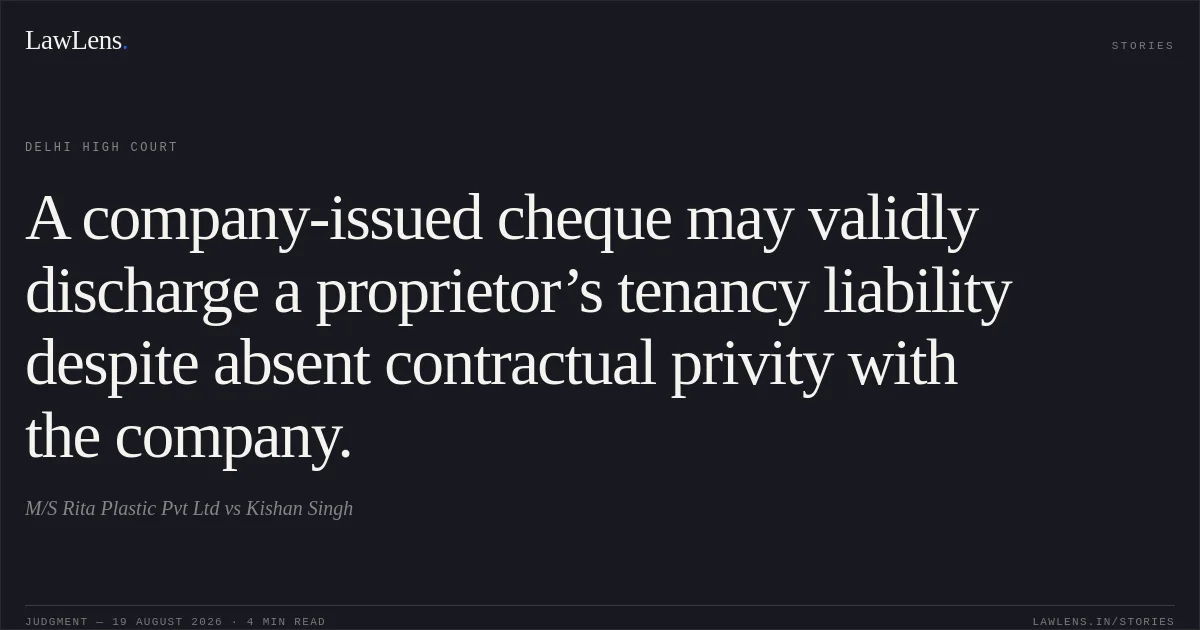
The Court held that although the cheque was drawn from the account of the incorporated company, it had been issued by Rita Batra in connection with the tenancy and in discharge of the liability arising from the underlying transaction.
Source reference: pp. 10–11, paras 42–44The continuity of management and the company’s own memorandum, which contemplated taking over the business, assets, and liabilities of the proprietorship, prevented the appellant from relying on a purely technical distinction between the two entities.
Source reference: pp. 10–11, paras 42–44Since issuance and signature of the cheque were admitted, Section 139’s presumption applied.
Source reference: pp. 11–12, paras 45–49The allegation that the cheque was merely a security cheque and that the amount had been paid in cash was unsupported by a receipt or by the testimony of the alleged witness, Ram Niwas; accordingly, the presumption was not rebutted.
Source reference: pp. 11–12, paras 45–49The Court found no inconsistency in awarding the cheque amount while rejecting the rent and electricity claims, because those claims were independently rejected for want of satisfactory proof, whereas the cheque liability was supported by the statutory presumption and the defendant’s failure to prove discharge.
Source reference: pp. 6–7, paras 24–26; pp. 11–12, paras 45–49The plaintiff could also maintain the action as a co-owner, particularly since he pleaded an oral partition and there was no objection from his brother.
Source reference: pp. 12–13, paras 50–52Holding
The High Court dismissed the appeal, holding that the suit was maintainable, that the cheque issued from the company’s account could be relied upon in relation to the tenancy liability, that the statutory presumption under Section 139 NI Act remained unrebutted, and that the plaintiff was competent to sue as a co-owner.
The decree for ₹1,00,000 with simple interest at 6% per annum from the date of institution until realisation, together with costs, was affirmed; the pending applications were disposed of.
Source reference: p. 13, paras 54–55Acts & Sections Cited
2 provisions across 2 statutes referred to in this judgment. Each provision opens on LawLens.
Code of Civil Procedure, 19081
Negotiable Instruments Act, 18811
Original Court PDF
M/S Rita Plastic Pvt LtdvsKishan Singh
Click to open original judgment
Original judgment, available to read, download and summarize on LawLens.in