01Facts
The petitioner-company filed O.S. No.116 of 2025 before the District Munsif Court, Ponneri, seeking a permanent injunction restraining the respondents from interfering with its peaceful possession and enjoyment of an immovable property at Vallur Village.
¶ 3, 10–15The suit property had been purchased in the company’s name from Pridhvi Asset Reconstruction and Securitisation Company Limited under a registered Sale Certificate dated 24 November 2023.
¶ 10–15The respondents, who were former directors/shareholders of the company, claimed rights under a Memorandum of Understanding dated 23 November 2023 (“MOU”), allegedly concerning the transfer of their shares and interests in the company to D. Lingasamy and his wife.
¶ 10–15The MOU contained an arbitration clause in Clause 13.
¶ 10–15Pending the suit and the petitioner’s application for interim injunction, the respondents filed an application under Section 8 of the Arbitration and Conciliation Act, 1996, seeking reference of the dispute to arbitration.
¶ 10–15The trial Court allowed the application.
¶ 10–15The petitioner, which was admittedly not a signatory to the MOU, challenged that order under Article 227 of the Constitution.
¶ 3, 10–1502Issues
i.Whether the petitioner-company, though a non-signatory to the MOU, was a “veritable party” to the arbitration agreement and could consequently be referred to arbitration under Section 8 of the Arbitration and Conciliation Act, 1996.
¶ 20, 25, 44–51ii.Whether the respondents, having denied the MOU as fabricated and void, could rely selectively on its arbitration clause to seek reference of the dispute to arbitration.
¶ 25, 30–42iii.Whether the trial Court’s order allowing the Section 8 application warranted interference under Article 227 of the Constitution.
¶ 52–5703Law Applied
Section 8 of the Arbitration and Conciliation Act, 1996 requires reference to arbitration where the subject matter of the action is covered by a valid arbitration agreement, but a non-signatory may be referred only where it is shown, prima facie, to be a “veritable party” to the agreement.
¶ 44–50Applying Cox & Kings Ltd. v. SAP India Pvt. Ltd., the Court recognised that a non-signatory may be bound through consent-based doctrines such as agency, assignment, novation, third-party beneficiary principles and, in exceptional cases, alter ego or piercing the corporate veil; the non-signatory’s participation in negotiation, performance or termination and the benefit derived from the agreement are relevant factors.
¶ 44–50The Court also applied the principle of separate corporate personality from Bacha F. Guzdar v. Commissioner of Income Tax, holding that a company is a juristic entity distinct from its shareholders.
¶ 28It further held that a party which repudiates the entire agreement as fabricated and void cannot selectively rely on the arbitration clause contained in that same agreement.
¶ 30–42Provisions in the judgment · 3 · Linked ones open on LawLens
Arbitration and Conciliation Act, 1996 Section 8Section 16Section 21
04Reasoning
The Court held that the MOU was entered into only between the respondents, as the first party, and Lingasamy and his wife, as the second party; its object was the transfer of the respondents’ shares and interests in the petitioner-company.
¶ 15–19The company itself was neither a signatory nor a participant in the MOU negotiations, and it was the subject matter of the alleged share-transfer arrangement rather than a party benefiting under it.
¶ 21, 26–29, 43, 51Its ownership of the suit property arose from the Sale Certificate issued by Pridhvi ARC in the company’s name, not from the MOU.
¶ 21, 26–29, 43, 51Consequently, the company was not a veritable party under the principles in Cox & Kings.
¶ 51The Court further found that the respondents’ Section 21 notice expressly described the MOU as fabricated and void, while relying only on its arbitration clause and referring to an allegedly separate loan agreement whose terms were not produced.
¶ 30–42Such selective reliance was impermissible, particularly where the respondents denied execution of the MOU itself.
¶ 30–42The trial Court also erroneously treated submissions made before the Supreme Court in Cox & Kings as the Supreme Court’s own findings, demonstrating non-application of judicial mind.
¶ 53–5505Holding
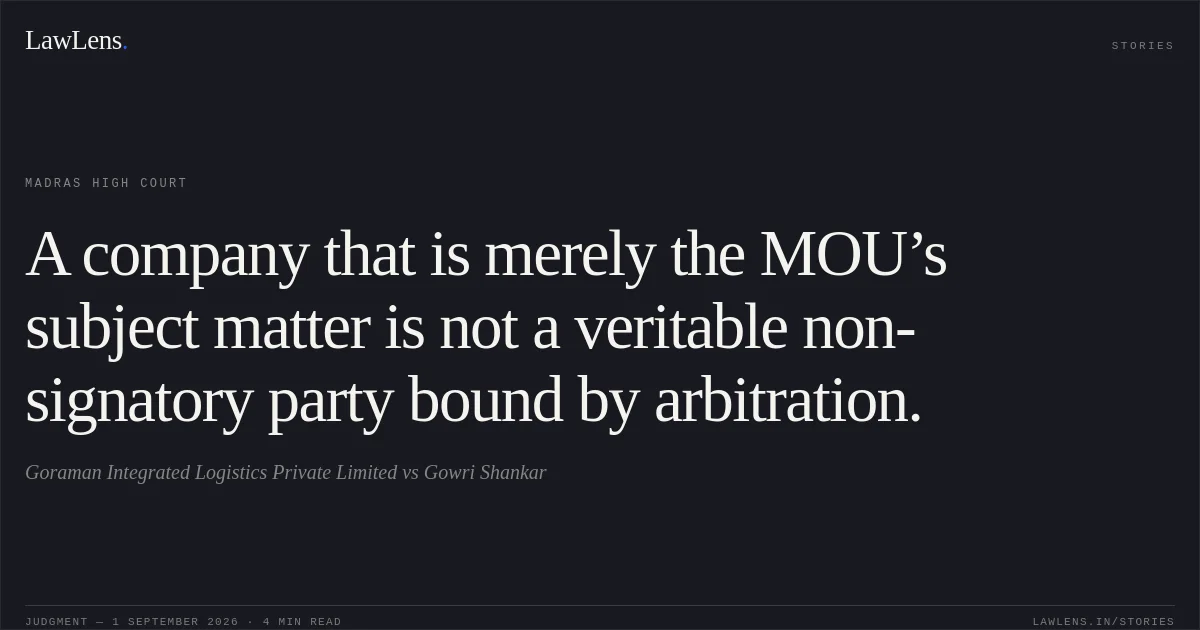
The petitioner-company was not a veritable party to the MOU or the arbitration agreement, and the respondents, having disowned the MOU as fabricated and void, could not invoke its arbitration clause alone.
¶ 57The order dated 9 June 2026 in I.A. No.4 of 2026 in O.S. No.116 of 2025 was set aside, and the parties were directed to have their disputes adjudicated by the civil Court.
¶ 57The trial Court was directed to decide the petitioner’s pending interim-injunction application, I.A. No.2 of 2025, within thirty days; the interim injunction protecting the petitioner’s possession was continued until that application was decided on merits.
¶ 58–60The civil revision petition was allowed without costs, and the connected miscellaneous petitions were closed.
¶ 61Original Court PDF
Goraman Integrated Logistics Private LimitedvsGowri Shankar
Click to open original judgment
Original judgment, available to read, download and summarize on LawLens.in