Facts
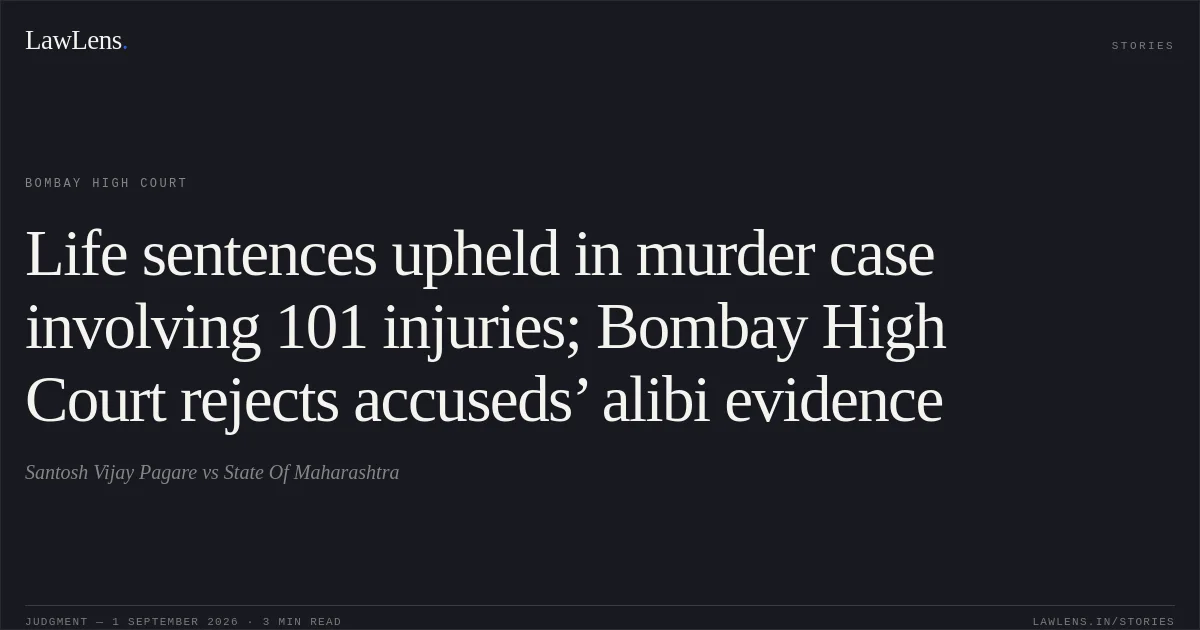
The appellants—Ganesh Ashok Ughade, Santosh Ashok Ughade, Jitesh @ Bandu Sampat Murtadak and Santosh Vijay Pagare—were tried in Sessions Case No. 261 of 2017 for the murder of Kiran Nikam.
Source reference: para. 4The prosecution alleged that on 18 May 2017 at approximately 10:00 p.m., the accused intercepted Kiran near Salve’s house in Nashik and assaulted him with sharp weapons, causing 101 injuries.
Source reference: para. 4The Additional Sessions Judge, Nashik, convicted all four appellants under Sections 302, 143, 147, 148 read with Section 149, and Section 120B of the Indian Penal Code, sentencing them to life imprisonment and fine.
Source reference: paras. 1, 3, 6Issues
Whether the prosecution had proved beyond reasonable doubt that the appellants participated in the fatal assault on Kiran Nikam, principally on the basis of the eyewitness evidence?
Source reference: paras. 44–49Whether the delay in lodging the FIR and recording the statements of material witnesses rendered their testimony unreliable?
Source reference: paras. 27–31, 44–47Whether the alleged recovery of sickles and clothes at the instance of Santosh Ughade could be relied upon?
Source reference: paras. 33–35, 50Whether the defence of alibi raised by Jitesh Murtadak and Santosh Pagare was established through the CCTV footage, photographs and defence witnesses?
Source reference: paras. 32, 52–53Whether the conviction and sentence imposed by the Trial Court required appellate interference?
Source reference: paras. 54–55Law Applied
The Court applied Sections 302, 143, 147, 148, 149 and 120B of the Indian Penal Code, concerning murder, unlawful assembly, rioting, rioting armed with a deadly weapon, vicarious liability of members of an unlawful assembly and criminal conspiracy.
Source reference: para. 3The Court applied the principle that a conviction may rest on credible testimony of a related or interested eyewitness if the evidence is consistent, natural and corroborated by surrounding circumstances.
Source reference: paras. 44–49It also applied the principle that delay in lodging an FIR or recording a witness’s statement is not, by itself, fatal where the circumstances provide a reasonable explanation.
Source reference: paras. 44–47The Court treated electronic records as requiring compliance with the certificate requirement under Section 65B of the Indian Evidence Act, 1872, and held that material not properly proved could not establish an alibi.
Source reference: paras. 24–25, 52Reasoning
The Court found Nitin Pagare to be a wholly reliable eyewitness. His presence near the scene was considered natural, his prior familiarity with the accused enabled identification, and his conduct in seeking shelter and informing the deceased’s wife was held consistent with the brutality of the assault.
Source reference: para. 44The delay in registration of the FIR was not considered unexplained because Nitin accompanied the deceased to hospital and thereafter went to the police station; the FIR was registered during the same night.
Source reference: para. 45Archana’s delayed statement and imperfect identification affected the weight of her evidence but did not make her wholly unreliable; her presence on the terrace and her account of the assault corroborated Nitin’s testimony.
Source reference: para. 47The Court expressly rejected the recovery evidence because it was effected approximately two months after the incident and the accused was handcuffed and tied during the alleged memorandum and recovery process.
Source reference: para. 50Nevertheless, the conviction was not affected because the eyewitness evidence independently established the appellants’ participation.
Source reference: para. 50The alibi pleas failed because the electronic material was not properly proved under Section 65B of the Evidence Act, the witnesses had not operated or maintained the devices from which the recordings originated, and the defence evidence did not establish the accused’s continuous presence at the wedding venues at the time of the murder.
Source reference: paras. 52–53Holding
The Bombay High Court held that the prosecution proved beyond reasonable doubt that the appellants participated in the murder of Kiran Nikam.
The recovery evidence was disregarded, but its exclusion did not undermine the prosecution case.
Source reference: para. 50The alibi pleas were rejected for want of properly proved electronic evidence and reliable supporting testimony.
Source reference: paras. 52–53Accordingly, the convictions under Sections 302, 143, 147, 148 read with Section 149, and Section 120B of the IPC, and the sentences of life imprisonment with fine, were affirmed.
Source reference: paras. 54–55Criminal Appeal Nos. 701 of 2023, 762 of 2023 and 1254 of 2023 were dismissed.
Source reference: paras. 54–55Acts & Sections Cited
6 provisions across 2 statutes referred to in this judgment. Each provision opens on LawLens.
Indian Penal Code, 18604
Code of Criminal Procedure, 19732
Original Court PDF
Santosh Vijay PagarevsState Of Maharashtra
Click to open original judgment
Original judgment, available to read, download and summarize on LawLens.in