01Facts
On 3 September 2006, a police party conducting a raid near Amjharia Dak Bungalow, Latehar, allegedly received information that six persons had assembled to commit a crime.
¶ 5 · pp. 3–5On seeing the police, the persons allegedly fled but were apprehended. A country-made pistol and cartridge were allegedly recovered from Santosh Lohra, a single-barrel muzzle-loading gun from Baleshwar Ganjhu, and other weapons from co-accused persons; no weapon was recovered from Akalu Ganjhu.
¶ 5 · pp. 3–5Chandwa P.S. Case No. 106 of 2006 was registered under Sections 399, 402 and 414 of the IPC and Sections 25(1-B)(a), 26 and 35 of the Arms Act.
¶ 5 · p. 5The trial court convicted Santosh under Sections 402 IPC and 25(1-B)(a) and 26(1) of the Arms Act, and convicted Baleshwar under Section 25(1-B)(a) of the Arms Act. Akalu was convicted under Section 25(1-B)(a)/35 of the Arms Act.
¶ 2–3 · pp. 1–302Issues
i.Whether the convictions and sentences suffered from any serious error of law warranting appellate interference?
¶ 14 · p. 7ii.Whether the prosecution proved beyond reasonable doubt that five or more persons had assembled for the purpose of committing dacoity, as required under Section 402 IPC?
¶ 16–20 · pp. 17–18iii.Whether recovery of the country-made pistol from Santosh established the offence under Section 25(1-B)(a) of the Arms Act?
¶ 22–23 · pp. 19–20iv.Whether the prosecution established the specific statutory ingredients of Section 26(1) of the Arms Act against Santosh?
¶ 21 · p. 19v.Whether recovery of the muzzle-loading gun proved the offence under Section 25(1-B)(a) of the Arms Act against Baleshwar?
¶ 24–25 · pp. 20–21vi.Whether Akalu could be convicted under Sections 25(1-B)(a)/35 of the Arms Act in the absence of recovery of any firearm from him?
¶ 26–28 · pp. 21–2203Law Applied
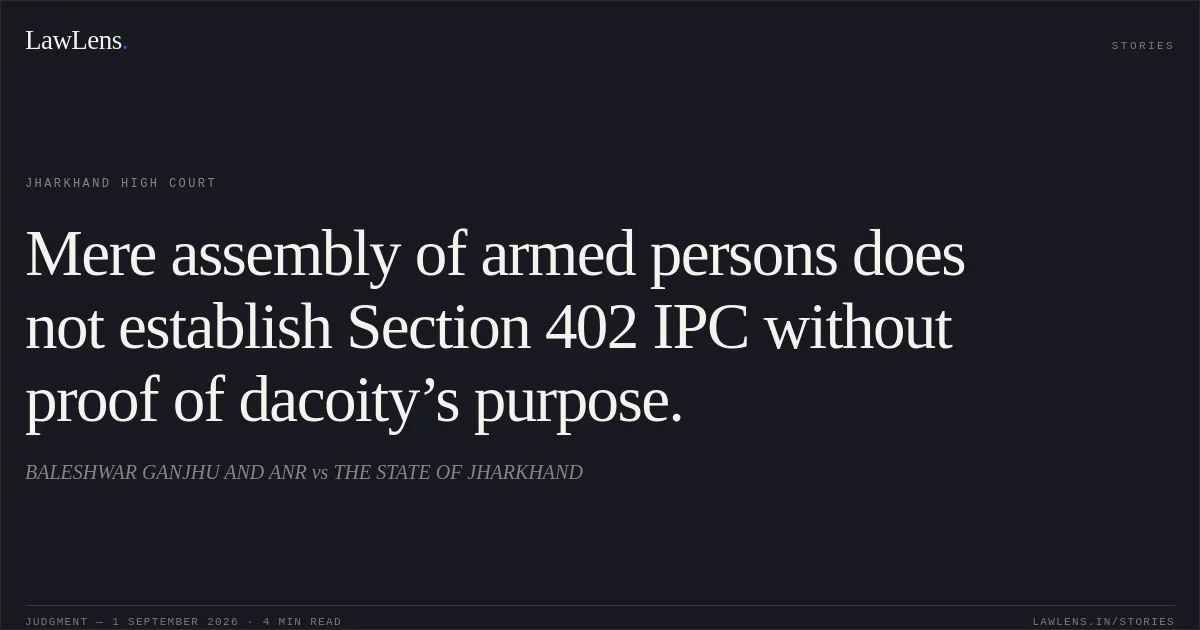
The Court applied Section 402 IPC, which criminalises being one of five or more persons assembled for the purpose of committing dacoity; mere presence in an assembly, even with alleged weapon recovery, is insufficient unless the purpose of committing dacoity is proved beyond reasonable doubt.
¶ 16 · p. 17Section 25(1-B)(a) of the Arms Act applies where an accused is proved to possess an illegally manufactured or prohibited firearm or ammunition; reliable recovery evidence, corroborated where appropriate by proof that the weapon is functional, may establish the offence.
¶ 22–25 · pp. 19–21Section 26(1) requires proof of the specific statutory circumstances, including the requisite secret contravention or other circumstances contemplated by that provision; mere recovery of a firearm does not automatically establish the offence.
¶ 21 · p. 19The aid of Section 35 of the Arms Act cannot be invoked merely because an accused was present with others from whom a weapon was recovered; conscious possession, knowledge, or control over the weapon must be established.
¶ 26–28 · pp. 21–22Provisions in the judgment · 6 · Linked ones open on LawLens
Indian Penal Code, 1860 Section 399Section 402Section 414
Arms Act, 1959 Section 25Section 26Section 35
04Reasoning
The Court held that the prosecution evidence did not establish the essential purpose of the alleged assembly under Section 402 IPC.
¶ 17–20 · pp. 17–18Although the police witnesses stated that the accused were present near the Dak Bungalow and attempted to flee, there was no cogent evidence of any specific preparation or overt act directed towards committing dacoity, no proved looted property, and no independent corroboration of the alleged intention to rob passengers.
¶ 17–20 · pp. 17–18The hostile or unsupportive seizure witnesses further failed to corroborate the prosecution on this essential ingredient.
¶ 19 · p. 18In contrast, the evidence of the informant and police members was found substantially consistent regarding recovery of the pistol from Santosh.
¶ 22–23 · pp. 19–20The Sergeant Major’s evidence and examination report established that the pistol was illegally manufactured and functional, and that the cartridge was capable of being fired and causing harm; accordingly, Santosh’s conviction under Section 25(1-B)(a) was sustained.
¶ 22–23 · pp. 19–20However, the prosecution failed to prove the distinct ingredients of Section 26(1), so that conviction was set aside.
¶ 21 · p. 19As to Baleshwar, the consistent testimony regarding recovery of the muzzle-loading gun, corroborated by the technical evidence that it was illegally manufactured and functional, proved the Section 25(1-B)(a) charge beyond reasonable doubt.
¶ 24–25 · pp. 20–21As to Akalu, no firearm or ammunition was recovered from him, and there was no evidence that he exercised control over, or had knowledge of, the firearm recovered from another accused.
¶ 26–28 · pp. 21–22His mere presence with the group was insufficient to establish conscious or joint possession under Section 35.
¶ 26–28 · pp. 21–2205Holding
The appeals were partly allowed.
¶ 30 · p. 22Santosh Lohra’s convictions under Sections 402 IPC and 26(1) of the Arms Act were set aside, but his conviction under Section 25(1-B)(a) of the Arms Act was affirmed.
¶ 30 · p. 22Baleshwar Ganjhu’s conviction under Section 25(1-B)(a) of the Arms Act was affirmed.
¶ 31 · p. 22Akalu Ganjhu’s conviction under Sections 25(1-B)(a)/35 of the Arms Act was set aside and he was acquitted by giving him the benefit of doubt.
¶ 32 · p. 22Considering that the occurrence was from 2006 and the appellants had already undergone substantial custody, the sentences of Santosh and Baleshwar were modified to the periods already undergone.
¶ 33 · p. 23As both were on bail, they were discharged from their bail bonds and the sureties were released.
¶ 35 · p. 23Original Court PDF
BALESHWAR GANJHU AND ANRvsTHE STATE OF JHARKHAND
Click to open original judgment
Original judgment, available to read, download and summarize on LawLens.in