Facts
The dispute concerned custody of the parties’ minor son, aged approximately fourteen years.
Source reference: paras. 8–13The parents’ marriage was dissolved by mutual consent under Section 28 of the Special Marriage Act, 1954, pursuant to consent terms incorporated into the decree.
Source reference: paras. 8–13Initially, physical custody was with the mother; under final consent terms dated 21 December 2019, physical custody and sole decision-making authority were given to the father.
Source reference: paras. 8–13The parties subsequently entered further consent terms on 11 November 2021, granting the mother access to the child once every two months for two nights and 50% of the summer and winter vacations.
Source reference: paras. 8–13The mother later sought modification of the custody arrangement, alleging that the father had restricted her access and that changed circumstances affected the child’s welfare.
Source reference: para. 14The Family Court partly allowed her application by order dated 20 September 2024, directing joint parenting, 50:50 vacation time, and ordinary residence with the mother from the next academic year, while requiring the father to bear 50% of the child’s educational expenses.
Source reference: para. 14The father challenged that order, contending that the application had been decided without a proper hearing or opportunity to lead evidence.
Source reference: paras. 15, 18, 43–48The mother also challenged portions of the Family Court’s order and separately challenged an execution order directing her to hand over custody to the father.
Source reference: paras. 15, 18, 43–48During the writ proceedings, the High Court interacted with the child, who expressed affection for both parents and, at one stage, a desire to return to the mother’s house.
Source reference: paras. 5, 33The Court also noted continuing distrust and conflicting allegations between the parents.
Source reference: paras. 2–7, 61–62The connected proceedings included the father’s contempt petition alleging breach of an interim stay order and the mother’s applications concerning access and reimbursement of the child’s expenses.
Source reference: paras. 2–7, 61–62Issues
Whether the Family Court validly modified the consent-based custody arrangement and imposed a joint-parenting arrangement without affording the parties a proper hearing and opportunity to lead evidence.
Source reference: paras. 50–58Whether the welfare of the child and the child’s expressed preference justified modification of the earlier custody orders.
Source reference: paras. 50, 54–58Whether the mother’s withdrawal of her earlier custody petition attracted the bar under Order II Rule 2 of the CPC.
Source reference: para. 53Whether the order directing the mother to hand over custody to the father in Regular Darkhast No. 142 of 2025 could survive after the High Court set aside the Family Court’s substantive custody order.
Source reference: para. 61Whether the mother had committed deliberate or wilful contempt by allegedly breaching the interim order dated 6 May 2025.
Source reference: para. 62Law Applied
The Court applied the principle that the welfare and best interests of the minor are the paramount consideration in custody disputes, rather than the competing legal rights of the parents.
Source reference: para. 50Under the parens patriae jurisdiction, the Court must consider the child’s comfort, health, education, emotional stability, intellectual development, surroundings, and, where the child is mature enough, the child’s intelligent preference; however, the preference is not conclusive.
Source reference: para. 50; Nil Ratan Kundu v. Abhijit Kundu, (2008) 9 SCC 413; Gaurav Nagpal v. Sumedha Nagpal, (2009) 1 SCC 42Custody orders, including consent orders, are not irrevocable and may be modified upon proof of changed circumstances demonstrating that modification is in the child’s paramount interest.
Source reference: para. 52; Jai Prakash Khadria v. Shyam Sunder Agarwalla, (2000) 6 SCC 598The Family Court, while exercising jurisdiction under Section 7 of the Family Courts Act, 1984 and Sections 151–153 of the CPC, must follow fair procedure, including adequate notice, pleadings, opportunity to present the case, and evidence where disputed facts require adjudication.
Source reference: para. 51; Aman Lohia v. Kiran Lohia, AIR 2021 SC 1748Sections 151 and 152 CPC cannot be used to alter the merits of an adjudication under the guise of correction or inherent powers.
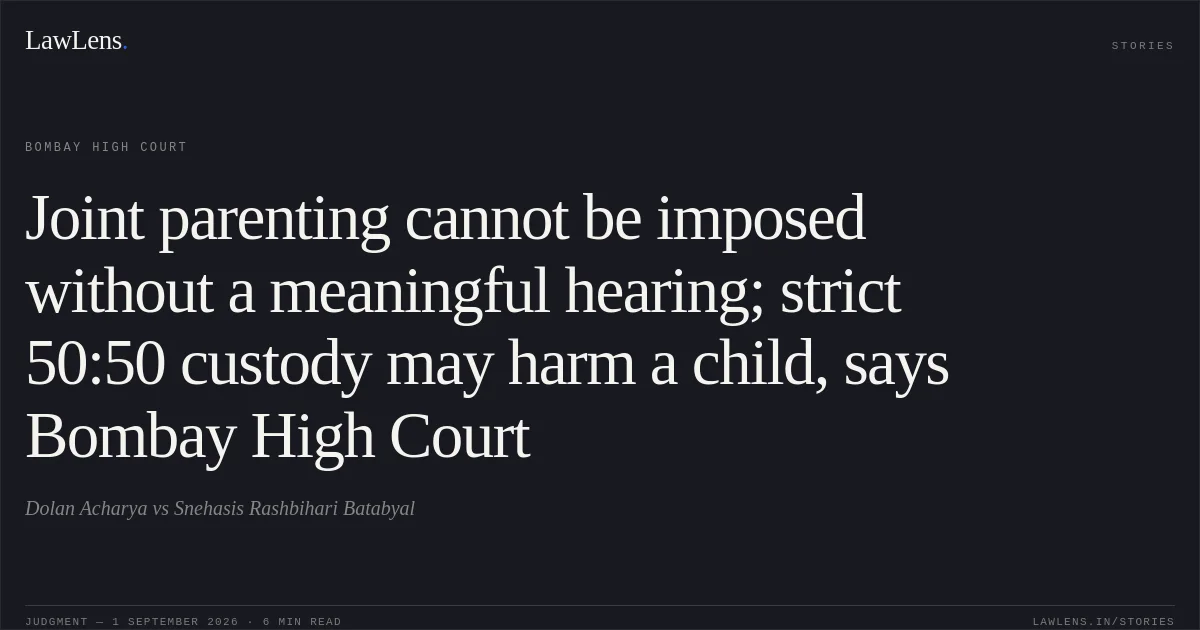
Source reference: para. 52; Dwaraka Das v. State of M.P., (1999) 3 SCC 500Indian law does not mandate equal or compulsory joint parenting; any shared-parenting plan must be structured around the child’s welfare, feasibility, stability, education, health, extracurricular activities, and emotional needs, with parental willingness being significant.
Source reference: paras. 56–58Order II Rule 2 CPC did not bar the mother’s application because her earlier withdrawal occurred pursuant to a joint pursis concerning implementation of access arrangements, while her modification application was based on alleged changed circumstances.
Source reference: para. 53Reasoning
The High Court found that the Family Court had substantially altered the existing custody arrangement by directing joint parenting and transferring ordinary residence to the mother, but the record did not establish that the application had been finally heard through a fair adjudicatory process.
Source reference: paras. 43–48The roznama indicated that the matter had been adjourned for judgment to 30 September 2024, yet it was preponed and decided on 20 September 2024 in the apparent absence of the father and his advocate, without clarity as to the reason for the preponement.
Source reference: paras. 43–48Since the parties had made serious and disputed allegations concerning the child’s education, medical care, emotional condition, access, and the conduct of each parent, the Family Court ought to have permitted proper submissions and evidence before modifying the consent orders.
Source reference: para. 54Although the child’s expressed desire to maintain a relationship with both parents was relevant, it could not by itself justify an inflexible 50:50 arrangement.
Source reference: paras. 55–58The Court emphasised that joint parenting must be workable and must not expose the child to further conflict or instability.
Source reference: paras. 55–58The existing consent arrangement had already been supplemented by an access order granting the mother overnight access and part of the school vacations; the immediate judicial task was therefore to assess whether there was a proved change in circumstances warranting further modification, while ensuring that the child maintained meaningful relationships with both parents.
Source reference: paras. 55–58Because the impugned order was procedurally defective and the merits of the alleged changed circumstances remained open, the matter required remand rather than a final determination of custody.
Source reference: paras. 55–58Pending reconsideration, the Court considered it appropriate for physical custody to remain with the mother, since the child was then residing with her, while ensuring substantial access and temporary custody to the father.
Source reference: paras. 59–62It also rejected the contempt allegation because the circumstances and prior orders did not demonstrate deliberate or wilful breach by the mother.
Source reference: paras. 59–62Holding
The High Court partly allowed Writ Petition No. 14746 of 2024 and the mother’s connected writ petition.
It quashed and set aside the Family Court’s order dated 20 September 2024 and restored Civil Miscellaneous Application No. 5 of 2024 for fresh adjudication after hearing both parties and permitting them to lead evidence, if desired; the parties’ merits were expressly kept open.
Source reference: para. 63(b)–(d)Pending the Family Court’s decision, physical custody was continued with the mother.
Source reference: para. 63(e)–(f)The father was granted overnight alternate-weekend access from Friday at 7:00 p.m. to Sunday at 7:00 p.m., temporary custody during the first half of the Diwali, Christmas, and summer vacations, and corresponding transportation responsibilities were imposed on both parents.
Source reference: para. 63(e)–(f)The parties were directed to share the child’s education and medical expenses equally.
Source reference: para. 63(g)–(h)The mother was entitled to reimbursement of one-half of proved expenses incurred during the period of her physical custody, subject to the procedure specified by the Court.
Source reference: para. 63(g)–(h)Writ Petition No. 7796 of 2025 was allowed; the execution order dated 29 May 2025 directing transfer of custody to the father was quashed and the underlying application was dismissed.
Source reference: para. 64Contempt Petition No. 474 of 2025 was dismissed for absence of deliberate or wilful breach.
Source reference: para. 65All pending interim applications were disposed of accordingly.
Source reference: para. 66Acts & Sections Cited
6 provisions across 3 statutes referred to in this judgment. Each provision opens on LawLens.
Special Marriage Act, 19542
Code of Civil Procedure, 19083
Family Courts Act, 19841
Original Court PDF
Dolan AcharyavsSnehasis Rashbihari Batabyal
Click to open original judgment
Original judgment, available to read, download and summarize on LawLens.in