Facts
The applicant/appellant was convicted by the Special Judge-I, Shimla, under Sections 18(a) and 20(ii), read with Sections 25 and 29 of the Narcotic Drugs and Psychotropic Substances Act, 1985 (“NDPS Act”), and was sentenced to 20 years’ rigorous imprisonment with a fine of ₹2,00,000 under each applicable count, with three years’ further imprisonment in default of payment of each fine.
Source reference: para. 1He filed Criminal Appeal No. 612 of 2019 against the conviction and sentence.
Source reference: para. 2During its pendency, he filed the present application in March 2026 seeking suspension of sentence.
Source reference: para. 2Although the appeal was listed for hearing, its final hearing could not be concluded on several dates due to adjournments, paucity of time, non-availability of counsel, and subsequent reconstitution of the Bench, requiring the arguments to be heard afresh.
Source reference: paras. 2–4, 12–13The applicant claimed that he had already undergone more than nine years of imprisonment, was a first-time offender, and that three co-accused had been granted suspension of sentence.
Source reference: paras. 5–10, 12The State opposed the application on the ground that the conviction related to a serious offence causing substantial harm to society and the Nation.
Source reference: para. 11Issues
Whether, having regard to the applicant’s period of incarceration, first-offender status, and the likelihood of prolonged hearing of the appeal, his substantive sentence should be suspended during the pendency of the appeal.
Source reference: paras. 5–6, 9, 12–14Whether the principle embodied in Section 479 of the Bharatiya Nagarik Suraksha Sanhita, 2023 (“BNSS”), concerning release of a first-time offender after detention for one-third of the maximum prescribed sentence, supported suspension of the applicant’s sentence.
Source reference: paras. 7–10Law Applied
The Court considered the conviction and sentence under Sections 18(a), 20(ii), 25 and 29 of the NDPS Act, which provide for punishment for offences involving narcotic drugs or psychotropic substances, liability for offences committed by companies or persons in charge, and criminal conspiracy or abetment, as applicable.
Source reference: para. 1It also relied upon the principle governing suspension of substantive sentence during the pendency of an appeal, particularly where the appeal is unlikely to be heard expeditiously and the convict has undergone a substantial period of incarceration.
Source reference: paras. 12–14Section 479 BNSS was relied upon as a statutory expression of the principle that a first-time offender may be released on bond after undergoing detention for one-third of the maximum period of imprisonment prescribed for the offence, subject to the statutory conditions and exceptions.
Source reference: paras. 7–10The Court further considered the applicant’s first-offender status, prolonged incarceration, the delay in hearing the appeal, and parity with co-accused who had already been granted similar relief.
Source reference: paras. 8–14Reasoning
The Court noted that the applicant had undergone more than nine years of imprisonment, exceeding one-third of the maximum 20-year sentence referred to by him, and that he asserted—without opposition on this aspect—that he was a first-time offender.
Source reference: para. 8Although the appeal had been placed on the hearing board, its hearing had repeatedly been deferred and, following reconstitution of the Bench, the arguments were required to be heard afresh, creating a further likelihood of delay.
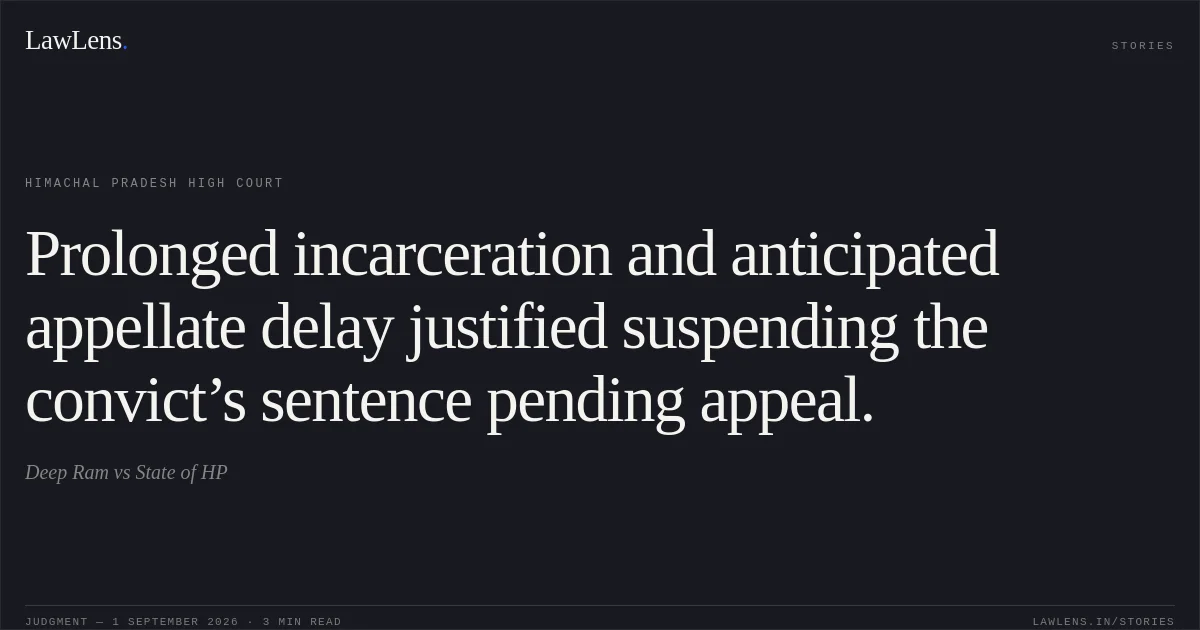
Source reference: paras. 2–4, 12–13Balancing the seriousness of the NDPS offences against the substantial period already served and the possibility of prolonged appellate proceedings, the Court held that the circumstances justified suspension of the substantive sentence.
Source reference: para. 14The Court also took into account that three co-accused had been granted similar relief.
Source reference: para. 12The order was expressly confined to the application for suspension and was not treated as an expression on the merits of the appeal.
Source reference: para. 18Holding
The application was allowed, and the applicant’s substantive sentence was suspended during the pendency of the appeal.
He was directed to furnish a personal bond of ₹2,00,000 with one surety in the like amount to the satisfaction of the Trial Court on or before 16 September 2026, with an undertaking to appear before the High Court as directed and to surrender to serve the remaining sentence if the appeal was dismissed.
Source reference: para. 15He was further directed not to commit any offence, particularly an offence under the NDPS Act; breach of this condition would render the suspension liable to cancellation.
Source reference: para. 16The Trial Court was directed to transmit the bail bonds to the High Court Registry, and was permitted to verify the order from the High Court website instead of insisting upon a certified copy.
Source reference: paras. 17, 19Acts & Sections Cited
5 provisions across 2 statutes referred to in this judgment. Each provision opens on LawLens.
Narcotic Drugs and Psychotropic Substances Act, 19854
Bharatiya Nagarik Suraksha Sanhita, 20231
Original Court PDF
Deep RamvsState of HP
Click to open original judgment
Original judgment, available to read, download and summarize on LawLens.in