01Facts
The appellants were prosecuted in connection with Hatgamharia P.S. Case No. 04 of 2016 arising from an alleged incident dated 11 February 2016.
¶ 3 · pp. 2–3The prosecution alleged that the informant, Brajmohan Chatomba, was unlawfully restrained, abused and assaulted by the appellants and two other persons, allegedly because he had informed the police about an earlier murder case.
¶ 3 · pp. 2–3The FIR was registered under Sections 341, 323, 504, 307 and 120B/34 IPC.
¶ 3 · pp. 2–3After investigation, the appellants were sent for trial.
¶ 4–12 · pp. 4–5The prosecution examined eight witnesses; P.Ws. 1 and 2 were the principal witnesses, while other witnesses were hearsay witnesses, hostile witnesses, or witnesses who did not support the prosecution case.
¶ 4–12 · pp. 4–5The trial court convicted the appellants under Sections 341, 325/34 and 504/34 IPC and imposed concurrent sentences, including three years’ rigorous imprisonment and fine for the offence under Section 325/34 IPC.
¶ 2, 13 · p. 1, 5The appellants challenged the conviction and sentence before the High Court.
02Issues
i.Whether the evidence of the informant and his wife was sufficient to establish the appellants’ guilt for wrongful restraint, voluntarily causing grievous hurt in furtherance of common intention, and intentional insult under Sections 341, 325/34 and 504/34 IPC.
¶ 15–16 · p. 5ii.Whether the prosecution evidence was reliable and sufficiently corroborated by independent witnesses and medical evidence to sustain the conviction.
¶ 5–12, 15–16 · pp. 4–503Law Applied
The Court applied Sections 341, 325/34 and 504/34 IPC: Section 341 criminalises wrongful restraint; Section 325 punishes voluntarily causing grievous hurt, read with Section 34 where the act is done in furtherance of common intention; and Section 504 concerns intentional insult likely to provoke a breach of the peace.
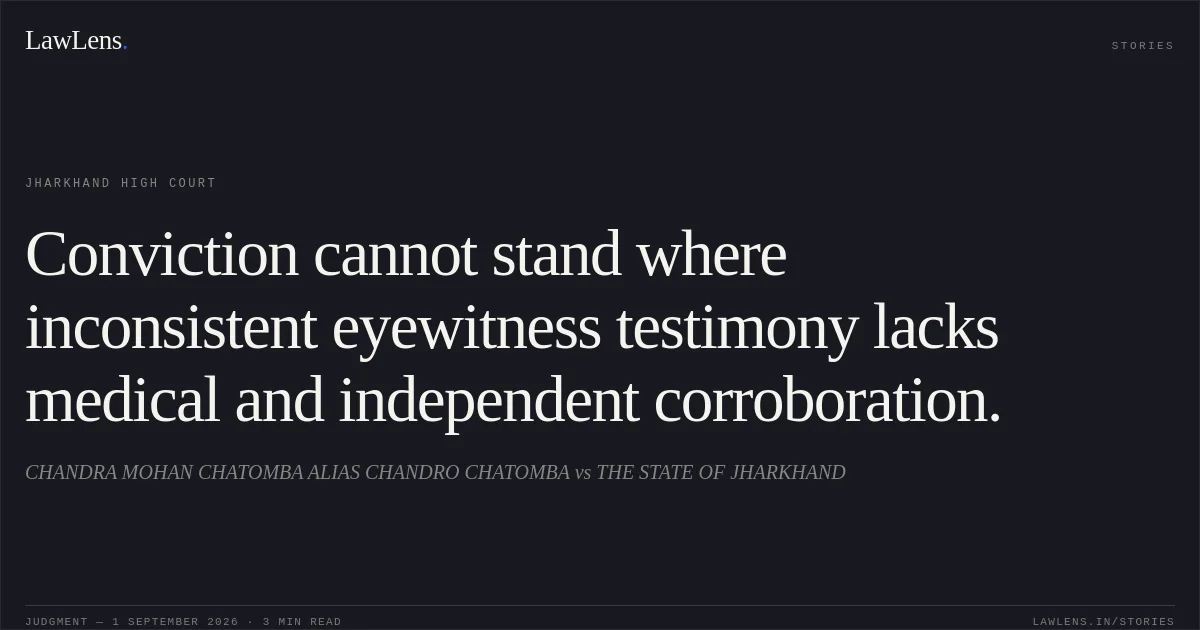
¶ 15–16 · p. 5The Court also applied the general evidentiary principle that a conviction must rest on reliable and legally sufficient evidence, and that material inconsistencies, absence of corroboration, and medical evidence inconsistent with the prosecution version may create reasonable doubt.
¶ 15–16 · p. 5No specific judicial precedent was cited or relied upon in the judgment.
¶ 15–16 · p. 5Provisions in the judgment · 6 · Linked ones open on LawLens
Indian Penal Code, 1860 Section 341Section 325Section 34Section 504Section 323Section 307
04Reasoning
The High Court found that the prosecution case substantially rested on the testimony of P.Ws. 1 and 2.
¶ 15(i) · p. 5Although P.W. 1 identified the appellants as assailants, he did not mention the presence of P.W. 2 at the place of occurrence, whereas P.W. 2 claimed to be an eyewitness and admitted that the accused were family members.
¶ 5–6 · p. 4The person in whose house the alleged occurrence took place was not examined, and the independent witnesses cited by the prosecution either turned hostile or did not support the occurrence.
¶ 5, 10–12 · pp. 4–5Further, the doctor found no external injury corresponding to the alleged indiscriminate assault, and the injury noted could have resulted from a fall on a hard and blunt surface.
¶ 9 · p. 4 · ¶ 15(iii) · p. 5In these circumstances, the Court held that the evidence was insufficient to prove the charged offences beyond reasonable doubt.
¶ 16 · p. 505Holding
The Court answered the issues in favour of the appellants, holding that the prosecution evidence was inadequate to sustain their conviction under Sections 341, 325/34 and 504/34 IPC.
¶ 16–17 · p. 5The judgment of conviction and order of sentence dated 13 December 2018 passed by the Additional Sessions Judge-I, West Singhbhum at Chaibasa, were quashed and set aside.
¶ 17–19 · p. 6The appeal was allowed, and since the appellants were on bail, they were discharged from the liability of their bail bonds.
¶ 17–19 · p. 6Original Court PDF
CHANDRA MOHAN CHATOMBA ALIAS CHANDRO CHATOMBAvsTHE STATE OF JHARKHAND
Click to open original judgment
Original judgment, available to read, download and summarize on LawLens.in