01Facts
The victim alleged that the appellant became acquainted with her at a marriage ceremony, obtained her telephone number, proposed marriage, and called her to Maynaguri on 14 June 2014.
p. 1She claimed that he forcibly took her to a Kali temple at Sevok Road, married her there, and thereafter took her to his relative’s house in Kaheli Para, Assam.
p. 1She stated that she subsequently discovered that the appellant was already married, informed her family by SMS, and was recovered by the police from Assam on 19 June 2014.
p. 6The appellant was convicted under Section 366 of the Indian Penal Code by the Additional Sessions Judge, 4th Court, Jalpaiguri, and sentenced to three years’ simple imprisonment with a fine of Rs. 10,000, with a default sentence of two months’ simple imprisonment.
p. 4In appeal, the appellant contended that the victim was an adult who voluntarily accompanied him pursuant to their romantic relationship and marriage, whereas the State supported the conviction.
pp. 4–502Issues
i.1. Whether the prosecution proved beyond reasonable doubt that the appellant abducted the victim by force, criminal intimidation, or deceitful means within the meaning of Sections 362 and 366 IPC.
¶ 10–18 · pp. 6–10ii.2. Whether the appellant abducted or induced the victim with the requisite intention to compel her to marry against her will or to force or seduce her to illicit intercourse, as required under Section 366 IPC.
¶ 14–17 · pp. 8–10iii.3. Whether the victim’s recovery from the appellant’s relative’s house in Assam, and the appellant’s failure to explain the circumstances under Section 106 of the Evidence Act, justified an adverse inference against him.
¶ 5–6, 14 · pp. 3–4, 803Law Applied
Section 362 defines abduction as compelling, by force or deceitful means, a person to go from one place to another; Section 366 requires proof that a woman was kidnapped or abducted with the intention that she be compelled to marry against her will, or be forced or seduced to illicit intercourse.
pp. 8–9The Court relied on Kavita Chandrakant Lakhani v. State of Maharashtra, (2018) 6 SCC 664, for the principle that mere abduction is insufficient under Section 366; the prosecution must also prove the specific statutory intent.
pp. 2–3 · pp. 9–10It further referred to the principles concerning inference of intention from conduct and surrounding circumstances in Haidar Shah v. Emperor, AIR 1930 Lah 52, and presumptions of fact under Syad Akbar v. State of Karnataka, (1980) 1 SCC 30.
pp. 3–4However, the burden under Section 106 of the Evidence Act arises only after the prosecution establishes the foundational facts of the alleged offence.
p. 8Provisions in the judgment · 3 · Linked ones open on LawLens
Indian Penal Code, 1860 Section 362Section 363Section 366
04Reasoning
The Court found that the victim was an adult and that the prosecution failed to establish the foundational fact of abduction.
¶ 9–12 · pp. 5–8Although she alleged that the appellant threatened and forcibly took her to the temple and then to Assam, she did not specify the nature of the force, the words of threat, or the particular deceitful conduct employed.
¶ 9–12 · pp. 5–8Her failure to seek assistance from fellow bus passengers, the temple priest, or passengers during the train journey created doubt regarding the alleged compulsion and supported the inference that she voluntarily accompanied the appellant.
¶ 11 · p. 7The concealment of the appellant’s existing marriage could show that her consent to the marriage was misinformed, but the Court held that a general allegation of “deceitful means,” without proof of the specific deception used to induce her movement, did not satisfy Sections 362 or 366 IPC.
¶ 12–14 · pp. 7–8Further, there was no evidence that she was forced or seduced into illicit intercourse.
¶ 14–17 · pp. 8–10Since abduction itself was not proved beyond reasonable doubt, the appellant could not be required to furnish an explanation under Section 106 of the Evidence Act, and his failure to do so could not sustain the conviction.
¶ 14 · p. 805Holding
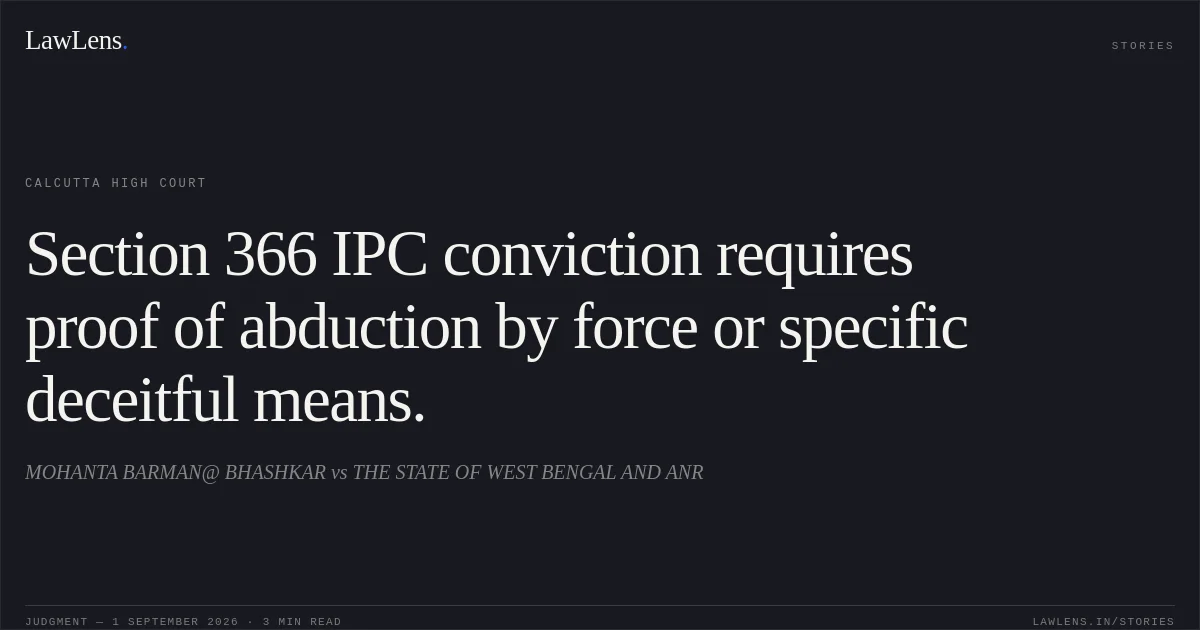
The Court held that the prosecution failed to prove force, criminal intimidation, deceitful means, or the requisite intent under Section 366 IPC beyond reasonable doubt.
¶ 18 · p. 10The victim’s recovery from Assam, by itself, did not establish abduction, and the evidence indicated her initial consent to accompany the appellant.
¶ 18 · p. 10The appeal was allowed; the judgment of conviction and order of sentence dated 17 December 2021 were set aside, the appellant was acquitted of the charge under Section 366 IPC, and he was discharged from his bail bond.
¶ 19 · pp. 10–11Original Court PDF
MOHANTA BARMAN@ BHASHKARvsTHE STATE OF WEST BENGAL AND ANR
Click to open original judgment
Original judgment, available to read, download and summarize on LawLens.in