01Facts
On 14 February 2004, the village chowkidar received information that the appellant had killed his wife with a lathi and fled. The informant and another villager went to the appellant’s house, where they found the deceased’s body. The appellant was subsequently apprehended while hiding in the house of Bigan Bhuiyan and allegedly confessed before the informant and other villagers that he had assaulted his wife because she had refused to withdraw a case against his brother
¶ 3On the basis of the informant’s fardbeyan, Nagar Untari P.S. Case No. 12 of 2004 was registered under Section 302 IPC. After investigation, a charge-sheet was filed and the case was committed to the Sessions Court
¶ 4The trial court examined nine prosecution witnesses; the defence adduced no evidence and pleaded total denial and false implication
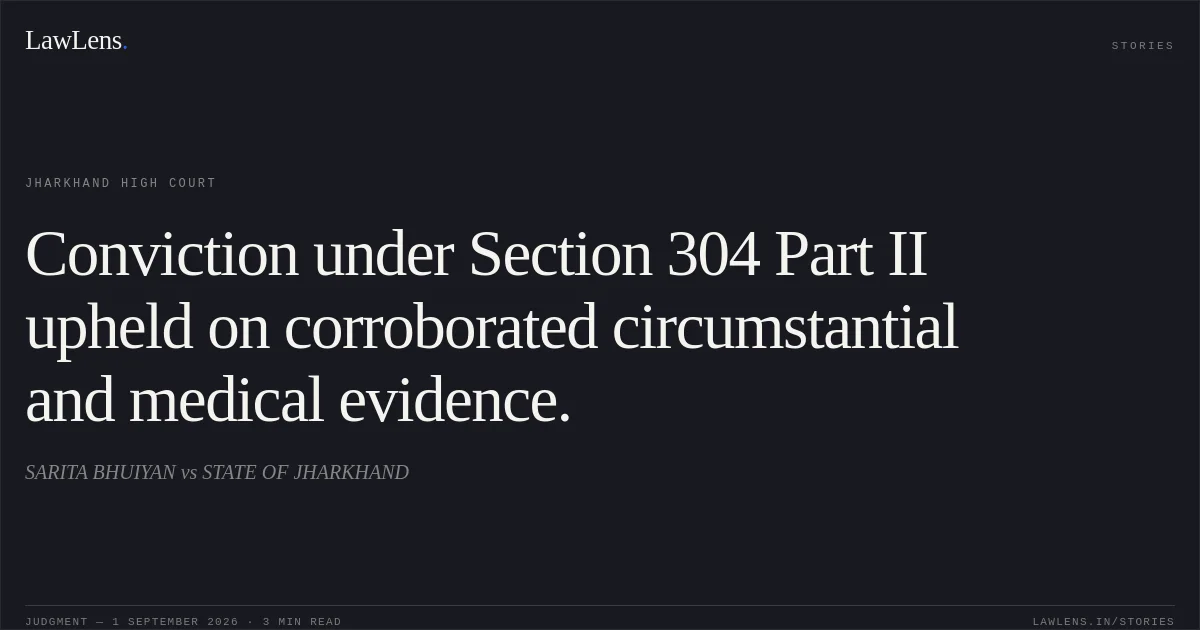
¶ 5–6By judgment dated 7 April 2006 and order dated 12 April 2006, the learned 2nd Additional Sessions Judge, Garhwa, convicted the appellant under Section 304 Part II IPC and sentenced him to five years’ rigorous imprisonment
¶ 202Issues
i.Whether the conviction of the appellant under Section 304 Part II IPC was supported by reliable and sufficient evidence, despite the absence of an eyewitness and the appellant’s challenge to the alleged extra-judicial confession?
¶ 7, 11–12ii.Whether the judgment of conviction and order of sentence suffered from any error of law warranting interference in appeal?
¶ 1003Law Applied
The court applied Section 304 Part II of the Indian Penal Code, which covers culpable homicide not amounting to murder where the offender has knowledge that the act is likely to cause death but lacks the intention contemplated under the graver forms of culpable homicide.
¶ 2, 4The court also applied the principle that a conviction may be sustained on a complete and reliable chain of circumstantial evidence, even in the absence of direct eyewitness testimony, when the circumstances consistently point towards the accused’s guilt
¶ 12Medical evidence corroborating the nature and cause of death is relevant to establish that the deceased died from injuries caused by a hard and blunt object
¶ 12Provisions in the judgment · 2 · Linked ones open on LawLens
Indian Penal Code, 1860 Section 304Section 302
04Reasoning
The court found that the evidence of P.Ws. 1, 2, 4 and 6 established the relevant chain of circumstances against the appellant, including his conduct in hiding immediately after the occurrence and his apprehension near the place of occurrence
¶ 12Although the appellant disputed his presence and challenged the form of the alleged extra-judicial confession, the court considered the prosecution evidence sufficient when assessed cumulatively.
¶ 12The testimony of P.W. 8, Dr. Jwala Prasad Singh, corroborated that the deceased had sustained injuries caused by a hard and blunt substance such as a lathi and that death resulted from shock and haemorrhage
¶ 12On that evidentiary basis, the court held that the trial court had correctly dealt with the material on record and that no legal or factual error had been shown warranting appellate interference
¶ 1205Holding
The High Court answered the issues against the appellant and upheld the conviction under Section 304 Part II IPC and the sentence of five years’ rigorous imprisonment.
¶ 12Since the appellant had already undergone the sentence imposed by the trial court, the appeal was dismissed on merits without further interference
¶ 12Any pending interlocutory applications were disposed of, and directions were issued for transmission of the judgment and trial court record and for payment of the prescribed fee to the learned amicus curiae
¶ 13–16Original Court PDF
SARITA BHUIYANvsSTATE OF JHARKHAND
Click to open original judgment
Original judgment, available to read, download and summarize on LawLens.in