01Facts
The petitioner, plaintiff in Regular Suit No. 455 of 2026, instituted a suit for declaration and permanent injunction concerning the management of Hind Charitable Trust and the hospitals and medical institutions administered by it.
¶ 2(a)–(i)He challenged the alleged minutes of meetings dated 16 January 2026 and 3 February 2026 as fictitious, fabricated and void ab initio, contending that they unlawfully revoked the resignation of two former trustees, inducted respondent Sarojini Verma as a founder trustee, removed him as Chairman, withdrew his executive and financial powers, and appointed respondent Richa Mishra to manage the institutions.
¶ 2(a)–(i)The trial court granted an interim injunction on 2 April 2026 restraining specified defendants from interfering with the petitioner’s functioning as Chairman and directed that the Trust’s bank accounts be operated in accordance with the trust deed.
¶ 2(k)Two appeals under Order XLIII Rule 1(r) CPC were filed, and the appellate court initially stayed the trial court’s order before ultimately allowing both appeals on 8 July 2026 and rejecting the injunction application.
¶ 2(l)–(o)The petitioner challenged the appellate judgment under Article 227 of the Constitution.
¶ 2(p)02Issues
i.1. Whether the First Appellate Court correctly interfered with the trial court’s discretionary order granting temporary injunction under Order XXXIX Rules 1 and 2 CPC?
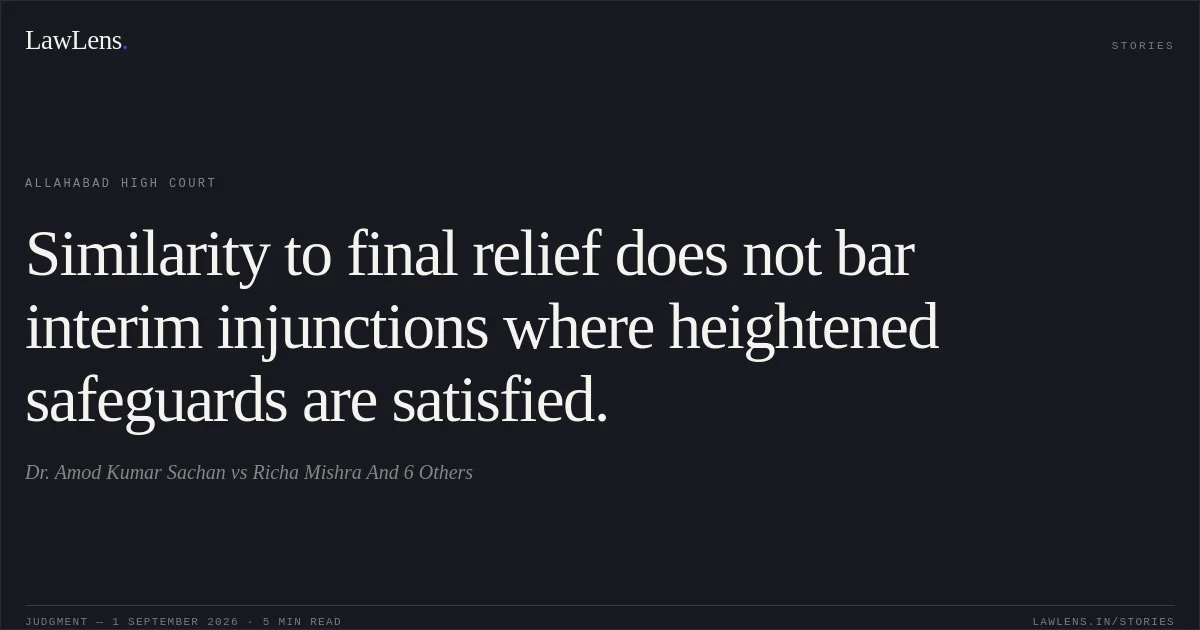
¶ 41–47ii.2. Whether the fact that the interim relief substantially resembled the final relief created an absolute bar against granting such relief at the interlocutory stage?
¶ 48–50iii.3. Whether the appellate court was justified in treating observations made in its earlier interim order as binding or operating as res judicata at the stage of final disposal of the appeals?
¶ 51–53iv.4. Whether the appellate court could rely, at the interim stage, on the alleged “accidental omission,” non-disclosure of facts, and non-compliance with an amendment direction without properly examining the trial court’s findings and the pleadings of the parties?
¶ 54–61v.5. Whether the impugned appellate judgment warranted interference under the limited supervisory jurisdiction of Article 227?
¶ 62–6303Law Applied
The Court applied Section 94 and Order XXXIX Rules 1 and 2 CPC, under which temporary injunction may be granted to prevent threatened injury to the plaintiff or the subject matter of the suit.
¶ 29–30The governing requirements are the existence of a prima facie case, balance of convenience and likelihood of irreparable injury; a prima facie case means a serious and triable question, not proof of title at the interlocutory stage.
¶ 30–34, 36Relying on Wander Ltd. v. Antox India (P) Ltd., 1990 Supp SCC 727, the Court held that an appellate court should not substitute its discretion for that of the trial court unless the discretion was arbitrary, capricious, perverse or exercised in disregard of settled principles.
¶ 35Dalpat Kumar v. Prahlad Singh, (1992) 1 SCC 719, Gujarat Bottling Co. Ltd. v. Coca Cola Co., (1995) 5 SCC 545, and Colgate Palmolive (India) Ltd. v. Hindustan Lever Ltd., (1999) 7 SCC 1, were relied upon for the trinity test, equitable nature of injunctions, clean-hands principle and consideration of public interest.
¶ 36–38Under Deoraj v. State of Maharashtra, (2004) 4 SCC 697, interim relief resembling final relief may be granted in rare and exceptional cases where withholding it would effectively defeat the suit, provided there is a particularly strong prima facie case, a decisively favourable balance of convenience and serious irreparable injury.
¶ 39Dorab Cawasji Warden v. Coomi Sorab Warden, (1990) 2 SCC 117, recognises the court’s power to grant interim mandatory relief in special circumstances, particularly to preserve or restore the last uncontested status quo.
¶ 49The Court also relied on Shruti Manav Sharma v. Sunaina Singh, 2026 SCC OnLine SC 1549, for the principle that interlocutory proceedings are not to become a mini-trial and that appellate interference is limited.
¶ 40Finally, under Article 227, supervisory jurisdiction may be exercised where there is an unwarranted assumption, gross abuse, or unjustifiable refusal to exercise jurisdiction, but it does not permit re-appreciation of evidence as an appellate court.
¶ 62Provisions in the judgment · 7 · Linked ones open on LawLens
Code of Civil Procedure, 1908 Section 94Section 39Section 151
Specific Relief Act, 1963 Section 36Section 37Section 41Section 42
04Reasoning
The Court found that the trial court had considered the relevant material and recorded prima facie doubts regarding the authenticity of the meetings dated 16 January and 3 February 2026, including the absence of agendas, discrepancies in the minutes and the petitioner’s removal without a show-cause notice or internal inquiry.
¶ 41–42It had also considered the three requirements of prima facie case, balance of convenience and irreparable injury.
¶ 43The appellate court was therefore required to identify why those findings were erroneous before substituting its own discretion.
¶ 44–47Its conclusion that interim relief could never be granted where it resembled the final relief was legally incorrect, because the similarity of relief is not an absolute jurisdictional bar; the court must examine the facts and apply the heightened standard applicable to exceptional cases.
¶ 48–50The appellate court further erred in treating its interim stay order dated 10 April 2026, including tentative observations made at the admission stage, as binding or res judicata during final adjudication of the appeals.
¶ 51–53It also improperly relied on “accidental omission,” although that plea had not been pleaded before the trial court, and prematurely determined issues concerning the validity of the meetings.
¶ 54The finding that the petitioner lacked clean hands was unsupported by an examination of the nexus between the allegedly suppressed facts and the relief sought.
¶ 55The appellate court additionally failed to examine whether the petitioner’s established status as Chairman could lawfully be terminated, whether the trust deed authorised such removal, and whether the prescribed procedure had been followed; it also risked converting allegations of misconduct into a trial at the interlocutory stage.
¶ 56–60These jurisdictional errors justified interference under Article 227 without the High Court itself deciding the merits of the injunction application.
¶ 61–6205Holding
The High Court held that the First Appellate Court had failed to exercise its appellate jurisdiction in accordance with the settled principles governing interlocutory injunctions.
¶ 63The judgment and order dated 8 July 2026 in Miscellaneous Civil Appeals Nos. 79 and 80 of 2026 were set aside, and both appeals were remanded for fresh decision after hearing the parties, preferably within three weeks from 9 September 2026.
¶ 63Since the appellate order was set aside, the trial court’s injunction order revived; however, to protect the functioning and accountability of the charitable Trust, hospitals and medical college, the Court directed that the Trust’s bank accounts would not be operated singly or jointly by the petitioner and respondent no. 1.
¶ 64The accounts were to be operated jointly by the petitioner and trustee Vikram Singh, with withdrawals restricted to salaries, recurring institutional dues, utilities, statutory liabilities, taxes and similar essential expenses, each payment being disclosed to the appellate court.
¶ 64The petitions under Article 227 were accordingly allowed, with no order as to costs.
¶ 65Original Court PDF
Dr. Amod Kumar SachanvsRicha Mishra And 6 Others
Click to open original judgment
Original judgment, available to read, download and summarize on LawLens.in