Facts
The petitioners claimed ownership and possession of land bearing Sy. No. 78 at Thanisandra Village, Bengaluru East Taluk, and denied executing any agreement of sale or receiving consideration in relation to it.
Source reference: para. 2Respondent No. 3, claiming to be a member of a Scheduled Caste, filed a complaint before the Karnataka State Commission for Scheduled Castes and Scheduled Tribes under Section 8 of the Karnataka State Commission for Scheduled Castes and Scheduled Tribes Act, 2002.
Source reference: para. 3He alleged that the petitioners and M/s Atheena Infra Build Pvt. Ltd. had agreed to sell him Flat No. 304 for Rs.40,00,000 and had received an advance of Rs.8,00,000/Rs.11,00,000.
Source reference: paras. 3, 20He sought delivery of the flat, compensation of Rs.20,00,000, and action alleging atrocity and untouchability.
Source reference: para. 20The petitioners denied the agreement, payment, and allegations of discrimination, contending that the document was fabricated and that the dispute was purely contractual and civil in nature.
Source reference: paras. 4, 21Despite their objections regarding maintainability, the Commission proceeded with the complaint and issued a warrant against petitioner No. 1, who was a senior citizen and was represented through counsel.
Source reference: paras. 5–6, 23, 26The petitioners consequently invoked Article 226 of the Constitution seeking quashing of the Commission’s proceedings and orders dated 3 March 2017.
Source reference: para. 1Issues
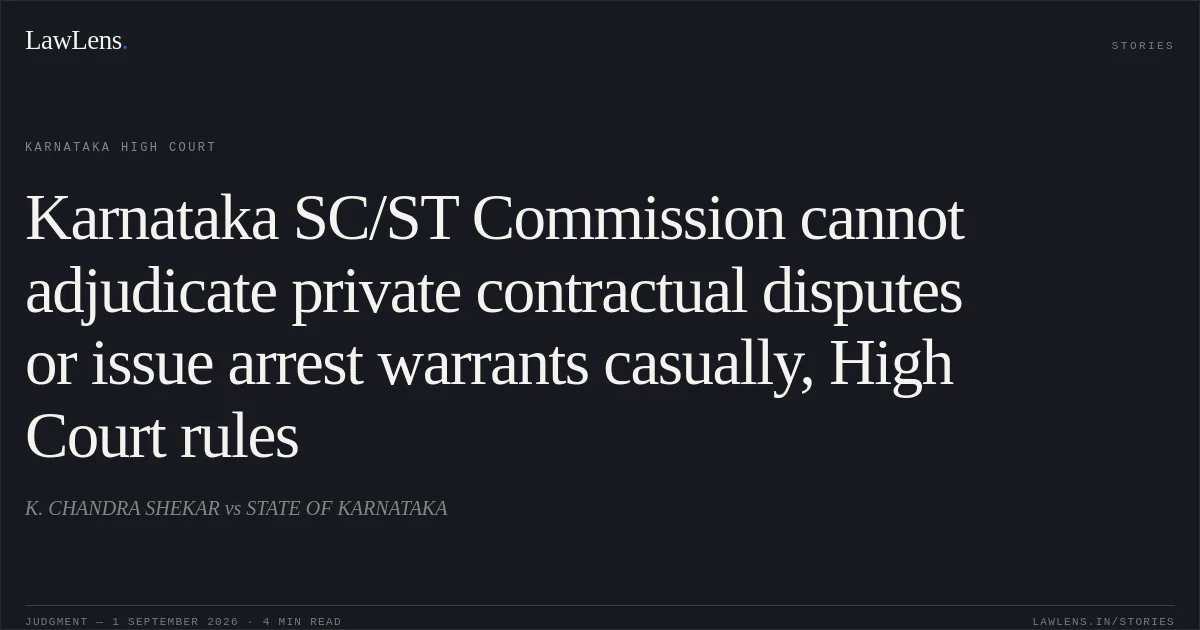
1. Whether the State Commission had jurisdiction under Sections 8 and 10 of the 2002 Act to adjudicate a disputed agreement of sale and grant contractual reliefs such as delivery of a flat or compensation?
Source reference: paras. 14–15, 22–242. Whether the Commission could issue a warrant against the petitioners in the circumstances of the case without establishing the statutory conditions and recording reasons for such coercive process?
Source reference: paras. 26–323. Whether the proceedings initiated by the Commission were liable to be quashed for want of jurisdiction?
Source reference: para. 36Law Applied
Section 8 of the Karnataka State Commission for Scheduled Castes and Scheduled Tribes Act, 2002 limits the Commission’s functions to investigating constitutional and statutory safeguards and inquiring into specific complaints concerning deprivation of the rights and safeguards of Scheduled Castes and Scheduled Tribes, with recommendations or follow-up before the appropriate authorities.
Source reference: para. 14Section 10 confers powers of a civil court on the Commission only while investigating or inquiring into matters falling within Section 8, and those powers are procedural—such as summoning persons, requiring documents, receiving affidavits, requisitioning records, and issuing commissions—and do not make the Commission a civil court or adjudicatory tribunal.
Source reference: para. 15Relying on All India Indian Overseas Bank, Scheduled Castes and Scheduled Tribes Employees’ Welfare Association v. Union of India, (1996) 6 SCC 606, the Court held that such powers do not include granting interim or permanent injunctions or determining private rights.
Source reference: para. 16Under Collector, Bilaspur v. Ajit P.K. Jogi, (2011) 10 SCC 357, the Commission may inquire into deprivation of SC/ST rights but cannot assume jurisdiction to finally determine matters outside its statutory remit.
Source reference: para. 17The Court also relied on M.B. Siddalingaswamy v. State of Karnataka, W.P. No. 63405/2016 (SC-ST), decided on 23 November 2020, holding that the Commission cannot adjudicate inter partes rights or function as a court or tribunal.
Source reference: para. 18Rules 12 and 13 of the 2012 Rules permit summonses and warrants only in exercise of the Commission’s civil-court powers; Form V requires that summons have been duly served and that the person failed to attend, while the CPC contemplates coercive attendance measures only within the circumstances prescribed under Sections 30 and 32.
Source reference: paras. 27–30Reasoning
The complaint was founded on the alleged agreement of sale, alleged payment of advance, and the petitioners’ alleged failure to deliver the flat or compensate the complainant.
Source reference: paras. 20, 22These allegations required determination of disputed questions of execution, authenticity, payment, contractual obligations, and entitlement to specific performance or damages.
Source reference: paras. 22–24They therefore constituted a private contractual dispute for adjudication by a competent civil court, not a complaint concerning deprivation of an SC/ST constitutional or statutory safeguard within Section 8.
Source reference: paras. 22–24The complainant’s status as a Scheduled Caste member, without a legally cognizable allegation of deprivation of a protected right, could not enlarge the Commission’s jurisdiction or enable it to grant contractual remedies.
Source reference: paras. 23–24The Commission’s civil-court powers under Section 10 were merely ancillary to an investigation or inquiry within Section 8 and did not authorise it to adjudicate the agreement of sale or issue substantive directions concerning the flat or compensation.
Source reference: paras. 15–18Further, the warrant against petitioner No. 1 was issued despite his representation through counsel and without reasons demonstrating that summons had been duly served and that he was avoiding attendance.
Source reference: para. 26Since a warrant affects personal liberty, it could not be issued casually or merely at the Commission’s discretion; the statutory and procedural conditions had to be satisfied and reasons recorded.
Source reference: paras. 29–32The Commission consequently acted beyond its jurisdiction both in entertaining the complaint as an adjudicatory dispute and in issuing the warrant.
Source reference: no citationHolding
The High Court held that the complaint did not fall within the scope of Sections 8 and 10 of the 2002 Act because it involved enforcement of alleged contractual rights arising from an agreement of sale.
The respondent No. 3 was left at liberty to pursue an appropriate remedy before the competent civil court.
Source reference: para. 36The writ petition was allowed, and the proceedings in Case No. 801/2016–17 before the State Commission were quashed.
Source reference: para. 36(i)–(ii)The Registry was directed to forward a copy of the judgment to the Chief Secretary of Karnataka to ensure that the concerned department and Commission members were sensitised regarding the Commission’s statutory powers and jurisdiction.
Source reference: para. 36(iii)Acts & Sections Cited
18 provisions across 5 statutes referred to in this judgment. Each provision opens on LawLens.
KARNATAKA STATE COMMISSION FOR THE SCHEDULED CASTES AND THE SCHEDULED TRIBES ACT, 20024
Code of Civil Procedure, 19084
Indian Penal Code, 18605
Code of Criminal Procedure, 19732
Original Court PDF
K. CHANDRA SHEKARvsSTATE OF KARNATAKA
Click to open original judgment
Original judgment, available to read, download and summarize on LawLens.in