01Facts
The respondent, a postal employee who had worked as Treasurer and Assistant Postmaster (Savings Bank) at Giridih Head Post Office, was implicated in an alleged fraud involving substantial public funds and was placed under suspension with effect from 27.09.2019 in contemplation of departmental proceedings.
¶ 2(i)–(ii), 43Although the suspension was periodically reviewed, the departmental charge memorandum was served only on 07.03.2022, more than two years after the suspension commenced.
¶ 2(vii), 43, 49The Central Administrative Tribunal, in O.A. No. 677/2022, by order dated 18.07.2025, quashed the orders extending suspension beyond the first three months, directed payment of salary for the period thereafter after adjustment of subsistence allowance, and left the first three months to be dealt with under the applicable Fundamental Rule.
¶ 1, 10–1102Issues
i.Whether continuation and extension of the respondent’s suspension beyond three months from 27.09.2019, without serving a charge memorandum within that period, was legally sustainable.
¶ 21(I) · ¶ 43–55ii.Whether the Tribunal was justified in directing payment of salary beyond the first three months of suspension, after deducting subsistence allowance already paid, subject to determination of the first three months under the applicable Fundamental Rule.
¶ 21(II) · ¶ 64, 67–6903Law Applied
The Court applied the limited scope of judicial review under Articles 226/227, as explained in L. Chandra Kumar v. Union of India, under which interference with a Tribunal’s decision is warranted for jurisdictional error, patent error, or perversity.
¶ 22Under Ajay Kumar Choudhary v. Union of India, the currency of a suspension order should not ordinarily extend beyond three months if the memorandum of charges/chargesheet is not served within that period; where it is served, continuation requires a reasoned order.
¶ 37Rule 10(6) of the Central Civil Services (Classification, Control and Appeal) Rules, 1965 requires review of suspension before expiry of 90 days and subsequent extended periods, with each extension not exceeding 180 days.
¶ 52The Court also applied the principles against unexplained delay in disciplinary proceedings laid down in State of M.P. v. Bani Singh, State of Punjab v. Chaman Lal Goyal, and State of A.P. v. N. Radhakishan.
¶ 58–62Provisions in the judgment · 1 · Linked ones open on LawLens
Code of Criminal Procedure, 1973 Section 167
04Reasoning
The Court held that the respondent’s suspension commenced on 27.09.2019, whereas the departmental proceeding was formally initiated only upon service of the charge memorandum on 07.03.2022.
¶ 42–43The Court found that the Department had not justified keeping the respondent under suspension for over two years merely because the CBI investigation was pending or because the alleged fraud was serious.
¶ 44, 55Periodic review by the Suspension Review Committee did not confer an unfettered power to continue suspension indefinitely; Rule 10(6) required lawful justification consistent with the principles in Ajay Kumar Choudhary.
¶ 52–54Since no chargesheet had been served within three months and the departmental proceeding was also prolonged thereafter without adequate explanation, the extensions beyond the initial three-month period were unsustainable.
¶ 55–63Applying the restricted standard of writ review, the Court found no perversity or error apparent in the Tribunal’s reasoning.
¶ 63–6905Holding
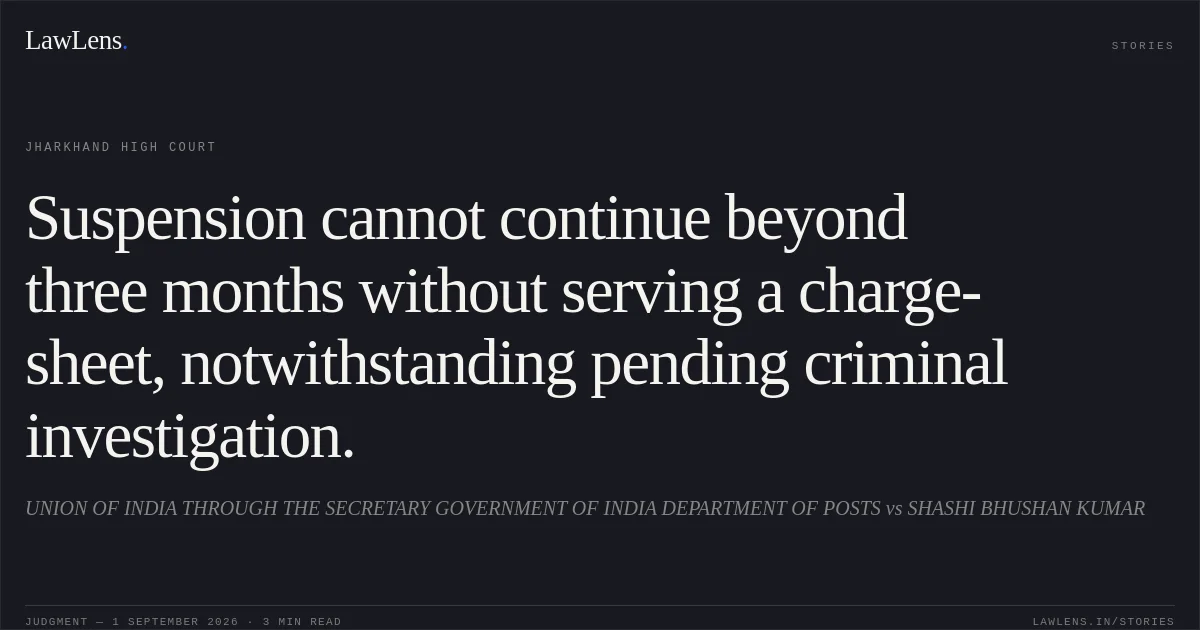
The High Court answered both issues against the Union of India. It held that continuation of suspension beyond three months from 27.09.2019, in the absence of timely service of a charge memorandum, was invalid, notwithstanding the pendency of the CBI investigation and the gravity of the allegations.
¶ 50, 55, 63The Tribunal’s direction granting salary after the first three months, less subsistence allowance already paid, was upheld, while the first three months were left to be determined under the applicable Fundamental Rule.
¶ 10, 64, 69The writ petition was dismissed, pending interlocutory applications were disposed of, and the Court clarified that any future challenge to the subsequent order of punishment would be decided independently on its own merits.
¶ 70–72Original Court PDF
UNION OF INDIA THROUGH THE SECRETARY GOVERNMENT OF INDIA DEPARTMENT OF POSTSvsSHASHI BHUSHAN KUMAR
Click to open original judgment
Original judgment, available to read, download and summarize on LawLens.in