01Facts
The petitioner challenged the Trial Court’s order dated 24 November 2025 refusing relief concerning 20% of the compensation awarded in proceedings arising from a complaint under Section 138 of the Negotiable Instruments Act, 1881, and the Revisional Court’s order dated 11 April 2026 dismissing Criminal Revision No. 143/2025 solely because Criminal Revision No. 165/2026 was pending before the High Court.
p. 1The Trial Court had convicted the respondent on 1 May 2025 under Section 138 of the Negotiable Instruments Act, sentenced him to eight months’ simple imprisonment, and directed payment of compensation of ₹10,66,000 under Section 357(3) of the Cr.P.C.
p. 1The respondent’s appeal was dismissed and the conviction was affirmed on 7 November 2025.
p. 2Pursuant to the appellate proceedings, ₹2,13,200—20% of the compensation—was deposited before the Trial Court.
p. 2The respondent’s subsequent Criminal Revision No. 165/2026 challenging the conviction was pending before the High Court, while an application seeking disbursement of the deposited amount had earlier been withdrawn with liberty to pursue an appropriate remedy.
p. 2The petitioner therefore invoked Section 482 of the Cr.P.C./Section 528 of the BNSS, 2023, seeking quashing of both orders and release of ₹2,13,200 in his favour.
p. 102Issues
i.1. Whether the Revisional Court could dismiss Criminal Revision No. 143/2025 merely because Criminal Revision No. 165/2026, arising from a different order and concerning the conviction, was pending before the High Court, without examining the legality and correctness of the Trial Court’s order on merits?
pp. 3–5ii.2. Whether the petitioner could be granted release/disbursement of ₹2,13,200 deposited towards 20% of the compensation, subject to the outcome of the pending criminal revision?
pp. 4–603Law Applied
The Court exercised its inherent jurisdiction under Section 482 of the Cr.P.C./Section 528 of the BNSS, 2023, to prevent improper exercise or failure to exercise jurisdiction and to secure the ends of justice.
p. 1Section 138 of the Negotiable Instruments Act, 1881 governed the underlying conviction, while Section 357(3) of the Cr.P.C. governed the award of compensation.
p. 1The Court applied the principle that a revisional court must independently examine the legality and correctness of the order challenged before it and cannot mechanically dismiss a revision merely because related proceedings are pending.
pp. 3–5It further held that pendency of a challenge to the conviction is not, by itself, an absolute bar to release of an amount already deposited towards compensation, particularly where the conviction has been affirmed on appeal; however, disbursement may be made subject to restitution, adjustment, and the final outcome of the pending proceedings.
pp. 4–6Provisions in the judgment · 4 · Linked ones open on LawLens
Code of Criminal Procedure, 1973 Section 482Section 357
Bharatiya Nagarik Suraksha Sanhita, 2023 Section 528
Negotiable Instruments Act, 1881 Section 138
04Reasoning
The Revisional Court’s proceedings concerned the Trial Court’s distinct order dated 24 November 2025, whereas Criminal Revision No. 165/2026 concerned the conviction and appellate judgment. Accordingly, the mere pendency of the latter did not make the former revision infructuous or relieve the Revisional Court of its duty to adjudicate the specific challenge on its merits.
p. 3By dismissing the revision solely on that ground and without recording reasons addressing the legality of the Trial Court’s order, the Revisional Court failed to exercise the jurisdiction vested in it by law.
pp. 3–5As to disbursement, the Court noted that the respondent had already been convicted and that the conviction had been affirmed in appeal, while ₹2,13,200 remained deposited pursuant to the appellate proceedings.
pp. 4–5The Court therefore found no justification for indefinite retention of the amount and considered release appropriate, while protecting the respondent’s interests by making disbursement subject to the final outcome of Criminal Revision No. 165/2026 and any subsequent restitution or adjustment order.
pp. 4–605Holding
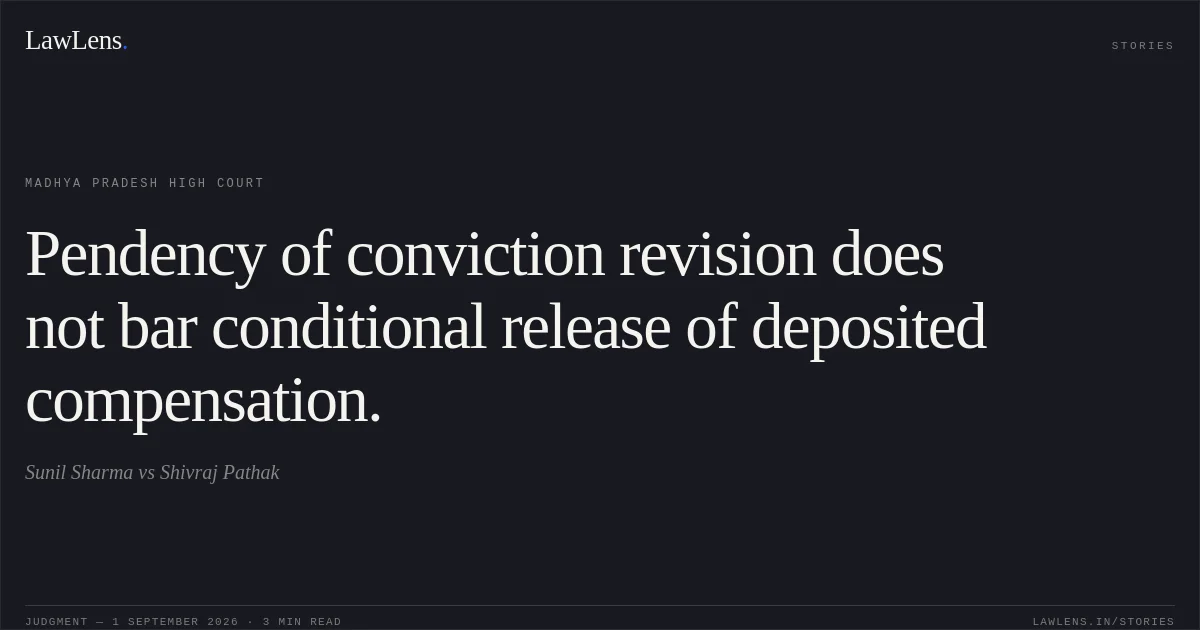
The High Court allowed the petition and set aside both the Trial Court’s order dated 24 November 2025 and the Revisional Court’s order dated 11 April 2026.
p. 5The Trial Court was directed to take consequential steps to release/disburse ₹2,13,200 to the petitioner after verifying the deposit and the identity of the person entitled to receive it.
p. 6The release was made subject to the final outcome of Criminal Revision No. 165/2026 and any further order of the competent court; the petitioner was required to comply with any future order for restitution or adjustment.
p. 6Original Court PDF
Sunil SharmavsShivraj Pathak
Click to open original judgment
Original judgment, available to read, download and summarize on LawLens.in