Facts
Ras Al Khaimah Investment Authority (“RAKIA”), an entity affiliated with the Government of Ras Al Khaimah, alleged that Nimmagadda Prasad (“NP”) misappropriated funds entrusted for the VANPIC Project in Andhra Pradesh.
Source reference: pp.3–4, paras.5–7The Ras Al Khaimah courts passed a decree directing NP to pay AED 267,941,374 with interest; the decree was affirmed in cassation and was sought to be enforced in India as a decree of a superior court of a reciprocating territory under Section 44A of the Code of Civil Procedure, 1908 (“CPC”).
Source reference: pp.3–4, paras.5–7RAKIA initiated execution proceedings before the Commercial Courts at Hyderabad and Ranga Reddy and obtained attachment of NP’s assets.
Source reference: p.4, para.9During execution, RAKIA sought impleadment of IQuest Enterprises Pvt. Ltd. (“IQuest”) and restraint over its assets.
Source reference: p.5, para.10The Hyderabad Commercial Court recorded IQuest’s statement that it had decided not to proceed with the proposed acquisition of Viatris, and closed the injunction application.
Source reference: pp.5–6, paras.10–11RAKIA later alleged that the transaction was routed through Matrix Pharmacorp Pvt. Ltd. (“Matrix”), which acquired Tianish Laboratories Pvt. Ltd. (“Tianish”), and that the subsequent amalgamation of Tianish with Matrix was designed to defeat execution.
Source reference: p.6, paras.12–13The Telangana High Court dismissed RAKIA’s contempt proceedings, holding that IQuest’s statement was clarificatory rather than an undertaking and that contempt proceedings were unsuitable for determining complex questions of corporate control and lifting the corporate veil.
Source reference: pp.7–8, para.18The NCLT sanctioned the amalgamation but imposed protective conditions concerning alienation and creation of charges over the assets; the NCLAT later expunged those protections.
Source reference: pp.8–10, paras.19–23Issues
Whether IQuest’s statement, recorded in the Hyderabad Commercial Court’s order dated 1 May 2024, constituted a clear and enforceable undertaking, breach of which could attract contempt jurisdiction.
Source reference: pp.22–25, paras.56–60Whether contempt proceedings could be maintained against Matrix, Tianish, Viatris, Moschip Technologies Ltd. (“Moschip”), NP and other connected persons on the basis of the alleged undertaking and the alter-ego or corporate-veil-piercing theory.
Source reference: pp.25–26, paras.60–61Whether, pending determination in the execution proceedings, the status quo and protective conditions over the assets of NP and the respondent entities ought to be continued or modified subject to furnishing additional security.
Source reference: pp.26–31, paras.62–73Whether the question of treating NP’s family-controlled entities as a unified structure, and reaching their assets in execution of the foreign decree, should be finally determined in the present appeals or left to the executing courts.
Source reference: pp.27–32, paras.64, 72–75Law Applied
The Court applied Section 44A CPC, under which a decree of a superior court of a reciprocating territory may be executed in India as if it had been passed by the relevant Indian district court, subject to the objections under Sections 13 and 47 CPC.
Source reference: pp.26–28, paras.62, 65The Court also considered Section 60 CPC concerning attachment of property liable to execution, while leaving the question of whether the respondent entities’ assets were legally reachable for determination by the executing courts.
Source reference: p.16, para.39; p.32, para.74Under Section 2(b) of the Contempt of Courts Act, 1971, civil contempt requires wilful disobedience of a judgment, decree, direction, order, writ or other process of a court, or wilful breach of an undertaking given to a court.
Source reference: p.19, para.48Relying on Babu Ram Gupta v. Sudhir Bhasin, (1980) 3 SCC 47, the Court held that an undertaking must be construed strictly and that no implied undertaking may be assumed.
Source reference: pp.23–24, para.57It further relied on Patanjali Ayurved Ltd., In re v. Union of India, (2024) 19 SCC 193, which recognises that a clear and express oral or written statement conveying a firm commitment to the court may have the force of an undertaking, even if the word “undertaking” is not used.
Source reference: p.24, para.58The principles of comity of nations and reciprocal enforcement require Indian courts to give due weight to an apparently executable foreign decree and to prevent interlocutory arrangements from frustrating its enforcement.
Source reference: pp.26–27, paras.62–63The doctrine of separate corporate personality and the question of lifting the corporate veil were not finally decided and were left for determination in the execution proceedings on the basis of pleadings and evidence.
Source reference: pp.27–32, paras.64, 74–75Reasoning
The Court held that IQuest’s statement that it had decided not to proceed with the Viatris acquisition was merely a statement of its position at that time and did not convey the firm, solemn and unconditional commitment required for an undertaking enforceable through contempt jurisdiction.
Source reference: pp.22–25, paras.56–59Since no qualifying undertaking existed, the alleged subsequent transaction could not constitute contempt, and contempt could not be extended to entities such as Matrix, Tianish, Viatris or Moschip, particularly when they had not been parties to the relevant order or had not themselves given any undertaking.
Source reference: p.25, para.60Nevertheless, the Court found that the sequence and timing of corporate restructurings, changes in control and transactions involving NP and his immediate family created a genuine apprehension that the decree might be rendered ineffective through asset dissipation or concealment.
Source reference: pp.25–29, paras.61, 66–67Given that the RAK decree was prima facie executable under Section 44A CPC and remained substantially unsatisfied, vacating all protection without adequate security could obstruct execution and undermine comity between courts.
Source reference: pp.26–30, paras.62–71The Court therefore restored the substance of the protective approach adopted by the NCLT, but avoided deciding conclusively whether the respondent companies were NP’s alter egos or whether their assets could be attached.
Source reference: pp.29–32, paras.68–74Those issues required adjudication by the Commercial Courts in the pending execution proceedings, where all parties could present evidence and contentions.
Source reference: pp.29–32, paras.68–74Holding
The Court upheld the Telangana High Court’s dismissal of the contempt proceedings, holding that IQuest’s recorded statement was not an unconditional or enforceable undertaking and that no contempt was made out against the respondent entities.
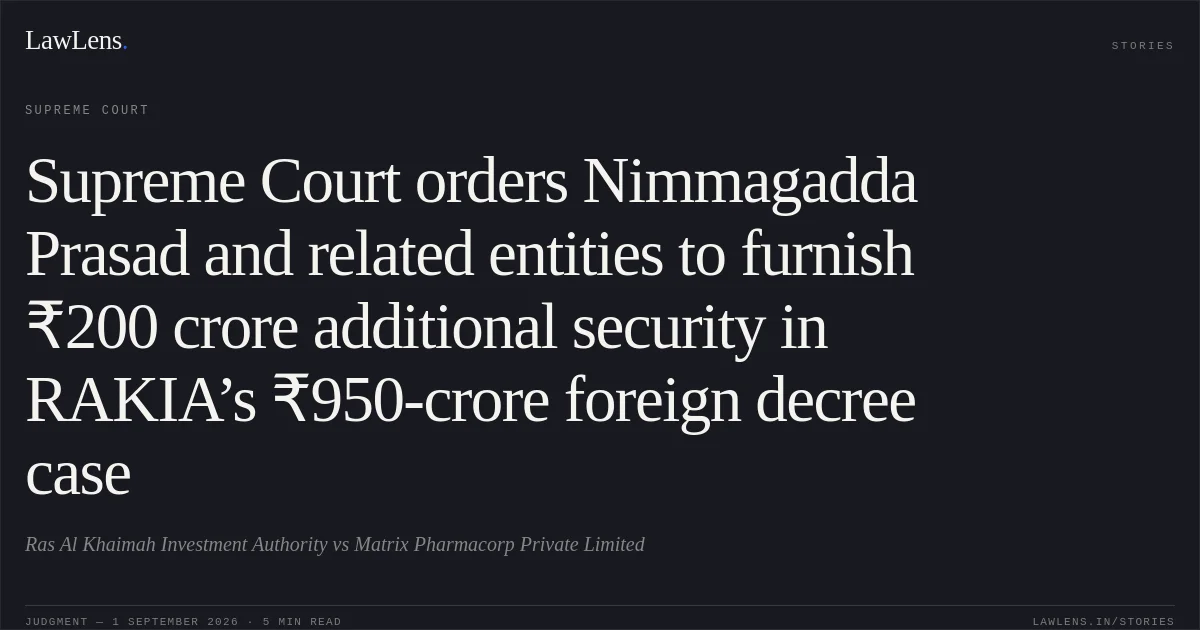
It directed NP and the respondent entities to furnish additional security of ₹200 crores with the Registry within two weeks, over and above the security and assets already deposited; the security would remain subject to the outcome of the execution proceedings.
Source reference: p.31, para.73; p.32, paras.75(ii)–(iii)The status quo and protective arrangements were accordingly continued or modified subject to such security.
Source reference: p.32, paras.75(ii)–(iii)The questions concerning the unified structure of NP’s family-controlled entities, lifting of the corporate veil and reachability of their assets were expressly left open for determination by the Commercial Courts at Hyderabad and Ranga Reddy.
Source reference: p.32, paras.74–75(iv)–(v)The NCLAT appeals were disposed of on these terms, and the Commercial Courts were directed to decide the execution petitions and connected applications expeditiously, preferably within four months.
Source reference: pp.31–33, paras.75(vi)–(vii)Acts & Sections Cited
6 provisions across 3 statutes referred to in this judgment. Each provision opens on LawLens.
Code of Civil Procedure, 19083
Companies Act, 20131
Contempt of Courts Act, 19712
Original Court PDF
Ras Al Khaimah Investment AuthorityvsMatrix Pharmacorp Private Limited
Click to open original judgment
Original judgment, available to read, download and summarize on LawLens.in