Facts
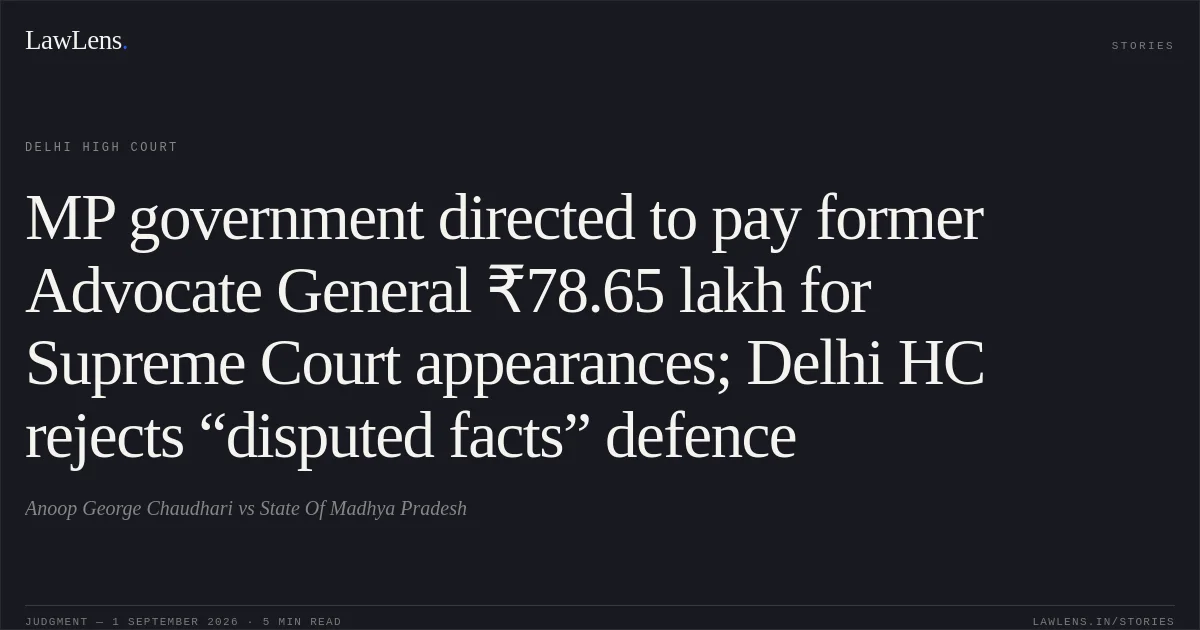
The petitioner, a Senior Advocate and former Advocate General of Madhya Pradesh, claimed unpaid professional fees from the State for appearing before a Constitution Bench of the Supreme Court in Indore Development Authority v. Manohar Lal and the tagged M.P. Housing Board matter.
Source reference: paras. 3–4, 7–8, 17–18, 69–77His appearances were recorded in the Supreme Court’s proceedings on fourteen dates between 16 October and 11 December 2019, and the Constitution Bench’s judgment also recorded that he had made submissions on behalf of the States and acquiring bodies.
Source reference: paras. 3–4, 7–8, 17–18, 69–77The petitioner raised 35 bills totalling Rs. 1,76,55,000/-, including appearance fees of Rs. 6,05,000 per appearance and conference fees of Rs. 1,65,000 each; the bills were addressed to the State’s Standing Counsel, Mr. Harsh Parashar.
Source reference: paras. 8–13Mr. Parashar subsequently forwarded the bills to the Principal Secretaries of Law and Revenue for remittance “as raised”.
Source reference: paras. 15–16, 90–92The State, the Indore Development Authority and the M.P. Housing Board denied liability or asserted that the petitioner had been engaged by another entity.
Source reference: paras. 20–25, 47–50During proceedings, however, the then Chief Secretary acknowledged that the petitioner had been engaged for the State in the IDA matter and that his bills could be processed at prevailing rates.
Source reference: paras. 86–89Issues
Whether a writ petition under Article 226 of the Constitution is maintainable for recovery of unpaid professional fees claimed by an advocate from the State, where the State disputes the engagement and liability.
Source reference: paras. 53–68Whether the petitioner’s engagement by, and appearance on behalf of, the State of Madhya Pradesh stood established from the Supreme Court’s record and the State’s own contemporaneous documents.
Source reference: paras. 69–97Whether the petitioner was entitled to remuneration for all recorded appearances, or only for the dates on which he personally made oral submissions.
Source reference: paras. 98–100Whether the petitioner was entitled to the fee rate claimed in his bills, including separate appearance fees for the IDA and Housing Board matters and conference fees.
Source reference: paras. 109–127What monetary relief and interest ought to be granted.
Source reference: para. 128Law Applied
The Court applied Article 226 of the Constitution and the principles in ABL International Ltd. v. Export Credit Guarantee Corporation of India Ltd., (2004) 3 SCC 553, holding that a contractual or monetary claim against the State is maintainable in an appropriate case and that disputed facts do not create an absolute bar to writ jurisdiction.
Source reference: paras. 54–55Relying on Popatrao Vyankatrao Patil v. State of Maharashtra, (2020) 19 SCC 241, and distinguishing T.R. Varma, Mahant Moti Das, Sukamani Das and Joshi Technologies, the Court held that writ jurisdiction may be declined only where the dispute genuinely requires a full trial and detailed evidence.
Source reference: paras. 56–58The Court considered Improvement Trust, Ropar v. S. Tejinder Singh Gujral, 1995 Supp (4) SCC 577, New India Assurance Co. Ltd. v. A.K. Saxena, (2004) 1 SCC 117, and Vijay Kumar Shukla v. State of U.P., while holding that they apply where an advocate’s entitlement is genuinely and seriously disputed, not as an absolute bar against advocates’ fee claims.
Source reference: paras. 59–65The Court also applied the doctrines of approbation and reprobation and estoppel, as explained in R.N. Gosain v. Yashpal Dhir, (1992) 4 SCC 683, and State of Punjab v. Dhanjit Singh Sandhu, (2014) 15 SCC 144.
Source reference: paras. 94–97Under Order IV Rule 1(b) of the Supreme Court Rules, 2013, a Senior Advocate may appear only upon instructions of, or with permission through, the Advocate-on-Record; consequently, recorded appearances in the State’s counsel block constituted strong evidence of authorized representation.
Source reference: paras. 78–80The Court further relied on Article 14’s requirement that State action, including contractual conduct, be fair, non-arbitrary and reasonable.
Source reference: paras. 55, 121, 142–144Reasoning
The Court held that the dispute did not genuinely require a trial because the petitioner’s appearances were established by fourteen Supreme Court order sheets, the Constitution Bench’s judgment, the forwarding of his bills by the State’s Standing Counsel, and the then Chief Secretary’s admission that he had been engaged for the IDA matter.
Source reference: paras. 70–77, 86–94Since the petitioner’s appearances were recorded alongside the State’s Standing Counsel and Advocate-on-Record, while the IDA and Housing Board had separate counsel blocks, the Court rejected the State’s contention that he had been engaged by those entities.
Source reference: paras. 72, 84–85The State’s shifting positions—first attributing liability to the IDA and Housing Board, then denying the petitioner’s appearance, and alternatively asserting that he appeared effectively on only two dates—were treated as contradictory and incapable of defeating writ jurisdiction.
Source reference: paras. 101–108The Court further held that remuneration was payable for each date on which the petitioner’s appearance was recorded, not merely for dates on which he made oral submissions.
Source reference: para. 100The fee rate of Rs. 6,05,000 per appearance was accepted because it had been conveyed before the hearings, was reflected in bills raised during the engagement, was forwarded for remittance “as raised”, and was never contemporaneously disputed; the State’s 2012 fee notification did not govern a specially engaged Senior Advocate.
Source reference: paras. 110–122However, double appearance fees for the two connected matters heard together were disallowed, as were the uncorroborated conference fees.
Source reference: paras. 123–125The Court therefore allowed one appearance fee for thirteen qualifying dates and excluded 15 October 2019, for which appearance was not established, and 11 December 2019, for which no bill had been filed.
Source reference: paras. 126–127Holding
The preliminary objection to maintainability was rejected.
The Court held that the petitioner had been engaged by and had rendered services to the State of Madhya Pradesh, and that the State’s denial of liability was arbitrary and contradicted by the record.
Source reference: paras. 94, 121–122The State was directed to pay Rs. 78,65,000/-—calculated at Rs. 6,05,000/- for thirteen appearances—along with interest at 9% per annum from the date of filing of the writ petition until payment.
Source reference: paras. 126, 128, 146Payment was ordered within six weeks, the petition was partly allowed, and all pending applications were disposed of.
Source reference: paras. 146–147Acts & Sections Cited
3 provisions across 2 statutes referred to in this judgment. Each provision opens on LawLens.
Right to Fair Compensation and Transparency in Land Acquisition, Rehabilitation and Resettlement Act, 20131
Advocates Act, 19612
Original Court PDF
Anoop George ChaudharivsState Of Madhya Pradesh
Click to open original judgment
Original judgment, available to read, download and summarize on LawLens.in